
Description
This block will take the student through a year of farming and gardening. They will learn about planting, harvesting, soil, the sun, compost, and much more. We will even plant a three sisters garden!

USD $45.00
This block will take the student through a year of farming and gardening. They will learn about planting, harvesting, soil, the sun, compost, and much more. We will even plant a three sisters garden!
This block will take the student through a year of farming and gardening. They will learn about planting, harvesting, soil, the sun, compost, and much more. We will even plant a three sisters garden!
A common misconception in education is that “blocks” contain only one subject of study. While blocks focus on a single subject, teaching without integrating other subjects is both unnatural for students and deprives them of a profound experience with that subject.
An authentic “block” is a unit of study that focuses on one subject while also incorporating supporting subjects and learning from other areas, such as history, art, science, language, and more. For example, when learning about Roman History, students create their own Main Lesson Books, thereby also practicing art and language skills. In addition, subjects such as math or science may be incorporated into various blocks so students can see how the math or science they are learning is used in real-life situations. For example, in the Eighth-Grade World War II Block, students also study physics. Why? Because World War II is often called “The Physicists’ War” because the conflict drove monumental advancements in science, forever intertwining physics with military technology.
Our teachers have spent numerous hours behind the scenes integrating as much learning as possible into your block. Everything you see in your block has been created with the purpose of developing well-rounded, creative students who can integrate subjects and make connections. Each block has been carefully crafted to include complementary subjects that provide the student with a deeper learning experience and enhance retention.
 The Earthschooling Curriculum is an award-winning, secular, and diverse curriculum (see award logos and links on this page) that offers core blocks, lesson plans, teacher support, and Living Lessons. These complete lessons take you through an entire year of any grade (preschool through high school), with a different theme each month. Lessons include recipes, a bread of the month, writing, science, math, appropriate lesson blocks for your child’s age, handwork lessons, nature crafts, nature walk ideas, and more. Your one-time payment allows you access to your chosen curriculum and all updates for life.
Tour Through Earthschooling Basic Curriculum Pages: CLICK HERE
Tour Through Earthschooling Extra Icons on Curriculum Pages: CLICK HERE
Tour Through Earthschooling Teacher Support Pages: CLICK HERE

Extras: All curriculum options include access to the Waldorf Basics member page. This page includes the e-book “My Waldorf Year Planner”, “Waldorf Basics”, mp3s of all the verses, basic video tutorials, lesson-planning calendars, tips and videos, an extensive FAQ section, celebration ideas & lessons for all holidays around the world, and more. All purchases come with free tech support.
 Loading...
The answers to some of the most frequently asked basic questions about Earthschooling are below. To see questions and answers to more specific questions (for example, “How can Earthschooling meet the needs of a child on the autism spectrum?”, please see our FAQs category)
What is the difference between the Curriculum packages and the Living Lessons? Earthschooling offers three levels for purchase, each progressively more comprehensive. The first level we offer is a Curriculum Package. This option includes written curriculum, audio files, and teacher tutorial videos. This curriculum is comprehensive. You will not need any additional books or educational materials when you purchase one of our Curriculum Packages. The video tutorials in these packages help you learn how to knit, do wet-on-wet watercolor, create chalk drawings, teach block crayon drawings, and more. These tutorials help you teach the curriculum. The second level we offer is our Living Lessons Main Lessons Only. In these lessons, a Waldorf-trained teacher will teach your student through a series of pre-recorded asynchronous lessons. These Living Lessons Main Lessons Only provide your student with a full set of main lesson videos for every subject in their grade. These lessons are directed towards the student but can also be used as a teacher education resource. Most students use these lessons directly. However, some teachers, parents, and schools use them as a guide for their own teaching. These lessons are also complete. You will not need any additional books or educational materials when you purchase one of our Living Lessons Main Lessons Only sets. The third option we offer combines the written lessons and the Living Lessons, and also includes specialty lessons in handwork, music, eurythmy, and art enrichment. This choice is called the Living Lessons Full Curriculum and includes everything in the Living Lessons Main Lessons Only curriculum as well as all the written curriculum, all the audio files, a full set of handwork lessons for the year, a full set of music lessons for the year, monthly eurythmy instruction, and additional art enrichment that goes above and beyond the main lessons.
Are the Curriculum Packages sent by mail or are they all PDFs online? Once you make your purchase, you can log in with a username and password you choose. Once you are logged in, you can view all the videos, audio files, PDFs, webinars, and tutorials included with your curriculum package. All these items can be viewed, watched, and listened to on any mobile device (tablet or phone) or computer. All items can also be downloaded to a USB, hard drive, or mobile device. Curriculum can also be printed. Most of our members print at least the verses and schedule. Beyond that, it depends on each member as to how they use the materials. Some like to print everything, and others use a tablet exclusively. One reason we rely on an online delivery system is that each curriculum package includes numerous videos, MP3s, and webinars in addition to the written curriculum.
Yes, you may receive credit for any of your previous purchases when you upgrade within a year. You will need to fill out a request form on this page here.
Which ages do each grade correspond to? Answer: See our list below…
Preschool: 3-5 Years
Kindergarten: 5-6 Years
First Grade: 7-Year-Old
Second Grade: 8-Year-Old
Third Grade: 9-Year-Old
Fourth Grade: 10-Year-Old
Fifth Grade: 11-Year-Old
Sixth Grade: 12-Year-Old
Seventh Grade: 13-Year-Old
Eighth Grade: 14-Year-Old
Ninth Grade: 15-Year-Old
Tenth Grade: 16-Year-Old
Eleventh Grade: 17-Year-Old
Twelfth Grade: 18-Year-Old
Planner Blocks: These lessons cover the same topics as the Subject Blocks; however, we have organized them into a detailed daily planner so you can open it each day and see your lessons laid out. All the instructions, recipes, verses, stories, and illustrations are contained in the planner, so you have everything you need on hand for an “open and go” experience. These lessons are ideal for classrooms that include multiple ages, families new to homeschooling or Waldorf-inspired education, or teachers/parents who function best with a firm structure. Subject Blocks: These are lessons arranged by subject, with each subject contained in a single set of files. To use these files, the teacher, parent, or (older) student will work through the provided lessons in order. A sample schedule is provided. However, the block system largely operates on the principle that the teacher, parent, or student can work through the materials at their own comfortable pace. Parents and teachers who work best with this system have previous experience with Waldorf education. Curriculum Packages: Curriculum Packages contain both Subject Blocks AND Planner Blocks, so the teacher/parent can try both or switch between them. Curriculum Packages also contain audio files for verses (Preschool through Fourth Grade), audio files for stories (Preschool through Second Grade at this time), video tutorials for teachers, hundreds of photos of main lesson book pages, access to the Earthschooling forum, access to the Cultural Enrichment pages, and access to the Parent/Teacher Essentials pages (with many basic tutorials).
What is the difference between buying the entire year and monthly? The curriculum content is the same whether you purchase it by Planner Block, Subject Block, or by grade. The benefit of purchasing the entire grade year at once is that you receive a large discount, access to the member forum, and numerous teacher tutorials and additional enrichment lessons for your student. The monthly curriculum offers the following benefits: 1. You pay only $45.00 per month. 2. You will receive access to one page containing all your lessons for the month, along with audio files of the verses and three basic resource files. The yearly curriculum package offers the following benefits: 1. Your cost for the year is greatly reduced. Instead of paying per month, you pay one low fee up front. 2. You receive a username and password to the website, which allows you to access all your curriculum for the year from any location using a computer, mobile tablet, or phone. You may also download these files to your computer from the website. 3. You receive access to the Subject Blocks as well as the Planner Blocks so you can choose which method of teaching you want to use or switch between methods during the year (the lessons have the same content). 4. You receive access to the member forum where you can share images and tips with other members, view their photos, and ask questions. 5. You receive a variety of teacher support videos based on the grade you have purchased. 6. You receive access to the “Cultural Enrichment Page,” which includes enrichment lessons in language and additional seasonal and holiday materials. 7. You receive access to the member’s blog where we put additional enrichment lessons and verses as they become available. We also archive all past Waldorf Teacher Q&A sessions here. 8. You receive access to the “Essential Parent/Teacher Guide” page, which contains many documents, webinars, and tutorials that help you learn more about the teaching techniques used in the curriculum. 9. You receive access to an enrichment page and a math problems page. These provide the student with optional enrichment lessons and math practice problems.
My 7-year-old child is coming from the public school system and already knows how to read and write. In this case, the language arts component of the first grade curriculum may not be a perfect fit. However, the child would probably find the other areas quite interesting. During the first grade year, students learn many core skills. They learn from drawing, knitting, handwork basics, tales that nurture the imagination, storytelling skills (which later become public speaking), wet-on-wet watercolor painting, block crayon drawing (used up to fifth grade), and more. During first grade, students also learn a unique way of looking at the four processes of math, which always seems to delight students even if they have ‘learned’ these skills quickly in school before. Even in the public school system, the four processes of math are something children practice over and over until the concepts finally seem to take hold around fifth grade. Read more on our blog post here.
Does your curriculum teach Common Core? We follow the Waldorf curriculum in our lesson plans, which teaches with a block structure. We also offer sets of daily planners (you have access to both as a curriculum package member) that offer the same methods in a scheduled format. In these daily planners, we have put the individual blocks into a schedule for you. That being said, many members use the curriculum in their own way. Some members even combine Montessori or another program or use “unschooling” style methods. If a state entity requires documentation demonstrating how the curriculum you use aligns with its Common Core standards, we can provide the requested correlations. These charts often just require us to show available material across different grades and to interpret where some lessons, like “form drawing,” would fit into their “boxes”.
Do I create exams myself or is there a PDF provided by Earthschooling? We do not give exams at Earthschooling. However, you may choose to grade your students’ work and use some of the provided material to administer exams if your state or region requires it. Our standard student evaluation method is for students to complete the assigned work in their Main Lesson Book until they demonstrate comprehension and mastery. This means that some students may do the assignment once while others will do it multiple times. Each time the assignment is done, the teacher will offer feedback. These evaluations can include tasks such as correcting math problems, editing grammar or spelling, or making other observations. If you would like to offer your student an exam, we suggest using the existing assignments and turning them into exams. For example, a math practice worksheet can be an exam or quiz instead of an assignment. Or, an essay assignment could be turned into an essay question on an exam.
How does testing work when we use the Earthschooling curriculum? The Earthschooling system operates on a “completion and comprehension” model, meaning the student will work through the lesson until they complete and comprehend it, rather than taking an exam after studying the subject briefly. Their completed work goes into a main lesson book, which provides a record and proof of their accomplishment. Parents can choose to grade this final work if needed. This can serve as an “open book exam” if you are required to administer exams by your region. However, because the system works on comprehension, students are prepared to take any outside exams that your region may require. For example, all of my children took the ITBS (Iowa Test of Basic Skills) exam, which the state administers to anyone upon request.
Could you describe the multicultural aspect of your curriculum? Yes, we embrace and leave room for many different cultures in our curriculum. This is how we do it: 1. Our curriculum follows themes each month or each block rather than seasons or holidays. This is so the curriculum can be used in both the Northern and Southern Hemispheres (we do include holiday and seasonal options for the blocks for those that want to include them). 2. We provide a “Cultural Enrichment Page” that has language lessons in Spanish, French, and Arabic. 3. Our “Cultural Enrichment Page” also includes extra verses and stories in other languages and from other cultures beyond Spanish, French, and Arabic. 4. We include stories from cultures around the world in all of our curriculum. The stories are not all from Grimm’s fairy tales or Western sources – the stories are from around the world. For first, second, and third grade, we even include extra stories that can be used as substitutes for the ones we chose. 5. The curriculum is planned so that stories or lessons can be easily “switched out” if you have something local or cultural you want to include instead. 6. Our members often share their cultural celebrations on the forum and contribute to the cultural enrichment page, so these resources are always growing.
People all around the world use our curriculum to teach in languages other than English. Although the curriculum itself is in English, we provide a variety of verses in French and Spanish. We also provide lessons that are easily adapted to any country in the world since we work with so many different students. For example, the local geography block in fourth grade provides a daily planner and detailed instructions on which lessons the child will do each day; however, the actual lesson will depend on the local surroundings the child is collecting data from. History blocks also include details on how to teach each lesson, making it easy to simply substitute a French history lesson for the one already in place for that block. The only extra task the teacher needs to do in that situation is to find a French history lesson. If you write to us and make a request, we can do that for you. We always fill these requests and then post them on the cultural enrichment page. Before fourth grade, this is usually not an issue, as children are working on basic language, math, handwork, and craft skills. These lessons, when taught by the parent/teacher, can be easily translated because they do not need to be translated word-for-word. Lessons are taught through stories, and there are tips on how each parent/teacher (even in English) needs to put those stories into their own words. For example, a story about “Sally” walking around the American countryside can easily be told in the teacher’s own words, with “Sally” replaced by any name, and her location set in a local area. I always do that when telling stories. I don’t think I have ever told the same story twice for any lesson, as I always adapt them to my audience. I find it easy to do as I am telling the story. It becomes “second nature” after a while. If you do want the children to hear a story in English, or you want to practice the English version, we do provide all the stories in preschool, kindergarten, and first grade as mp3s so you can listen to them. Many of our English-as-a-second-language parent/teachers use these MP3s.
Is the Earthschooling program accredited? Earthschooling is used in schools around the world and has been approved for use in both public and private schools. The curriculum had to go through an approval process at each school to demonstrate that it meets appropriate standards. In this way, Earthschooling has been accepted and accredited by individual schools. However, because of our international audience, we have not sought accreditation from a single entity, as it would not apply to all of our students, parents, teachers, and schools. You can read more details about our certifications here. ‘Are you accredited’ should not elicit a “yes” or “no” reply from any institution, so we advise caution with any institution that tries to push accreditation as a reason to join their program.
Earthschooling is a secular curriculum. We include the Old Testament stories for literary and historical reasons only and not for religious reasons. However, because some parents or teachers prefer to include these stories later in the student’s educational experience, alternative stories for the “Third Grade Old Testament Block” are available on the “Third Grade Enrichment” page. Also, on the main “Third Grade Curriculum Page” under “Main Lesson Stories,” there is an entire block you can substitute for the “Third Grade Old Testament Block.” It is called the “Third Grade Creation & Origin Myths” block. We included that block to act as a substitute for people who do not want to teach the “Old Testament Block”. However, we also recommend using this secondary block to expand the students’ experiences this year. You can also include or substitute stories from the Cultural Enrichment Pages (for example, the Aboriginal stories). The description of the third grade curriculum touches on why students study this block. It says, “By the third grade, children are beginning to comprehend the difference between self and other, and wonder where in the scheme of things they belong. To fortify their growing personal identity, they read origin and creation stories (you can choose one or more of the following: Aboriginal, Native American, European, African, Asian, Old Testament, or others). Creation and origin stories give the nine-year-old an inner picture of the vast offerings of the world and the sense of wonder and potential the world holds, provide a foundation for understanding different cultures, and provide a foundation for understanding world literature.” Because so many authors use references to the Old Testament in advanced literature (Moby Dick, etc.), it is important for the student to become familiar with these stories so they can understand the references later. In Western cultures, it is assumed that most people know these basic stories, so they are referenced in political speeches, magazine articles, and even daily conversation. Some terms have even made their way into modern colloquial speech. If preferred, however, this block can be saved until the student is older. We have provided plenty of other “origin & creation stories” from other cultures for you to share with your students at this point.
I see pentagrams explored as a movement in the Eurythmy lessons. Aren't these religious? Our program is secular in nature and does not follow any religion. Pentagrams are not religious. Although many religions have chosen them as a holy shape, that does not replace their value in math and movement. Circles are, in fact, used as a holy shape in more religions than the pentagram. Pentagrams are introduced briefly in the curriculum as complex form drawings and movement shapes that help the child coordinate brain and complex body movements. Pentagrams are actually the simplest of the “star polygons”, which is why they are used instead of the other stars. However, if you look up “star polygons” on the Internet, you could substitute a more complex star shape if you feel your student is up to the challenge. Official Definition: A star polygon {p/q}, with p,q positive integers, is a figure formed by connecting with straight lines every qth point out of p regularly spaced points lying on a circumference. The number q is called the polygon density of the star polygon. Without loss of generality, take q<p/2. The star polygons were first systematically studied by Thomas Bradwardine.
How seasonal are your lessons each month? Because we work with students, parents, teachers, and schools from around the globe, we keep the curriculum focused on monthly topics rather than seasons or holidays. We do include a light sprinkling of seasonal verses, stories, and lessons for the year, so each month does have a little seasonal “flavor” but is not dependent on it to use the lessons. Each of these verses, stories, and lessons is also flexible. The majority of the extra seasonal and holiday activities are found in the cultural enrichment lessons, which mesh with the curriculum itself but are set apart from it (these enrichment lessons are provided for free for all Curriculum Package members and are not part of the curriculum itself, but do add more options for holidays and seasonal activities for those that want more). When a month includes more seasonal activities, we try to make sure they are flexible and offer ideas people can use even when they are not in that season. For example, in January we have some lessons on ice (for winter); however, we also discuss how ice can be used in a fun summer lesson. The lessons themselves are also designed to be balanced, so you can start at any time of year. This means that the language lessons we have in April, for example, do not require that you have studied the ones in December first. All the lessons are self-contained. The only exception is the month of “August.” This month does not include any seasonal or holiday events, but it does include all the basics you need for the year. We always recommend starting with this month or purchasing it to use alongside the month you are starting with.
I am in Australia. What relevance will your science and geography blocks have for my homeschooling? For our Australian members, we provide the following resources/benefits: 1. A document called “My Waldorf Year in the Southern Hemisphere” that guides you through how to use the curriculum in Australia. 2. A “Cultural Enrichment Page” where we provide additional lessons for Australia, including Australian creation stories for the third grade block, Australian native history stories for the fourth grade geography block, and ideas for celebrating Australia Day. We add additional items to this page upon request. 3. Our science and geography programs are designed to be universal because we have students in all areas of the world. For example, the animals we have chosen to study in the “Man & Animal” block for fourth grade, such as deer, are commonly found in most areas of the world. We also provide a guide to creating lessons for additional animals. Our geography program focuses on geography skills rather than a specific location. However, we do provide ideas and suggestions for students around the world. 4. The curriculum can be started at any time of year. It does not need to be started during a certain month.
Do you offer your curriculum in Spanish or other languages? Currently, we offer the Earthschooling program in English. However, we do have many ways in which we assist parents and teachers who speak English as a second language: 1. We offer some basic verses in Spanish, French, German, and Arabic for grades preschool through fourth grade on the Cultural Enrichment Pages. 2. We offer some short stories in Spanish and French for early childhood on the Cultural Enrichment Pages. 3. We offer a teacher guide called Language in the Dell that instructs teachers on how to include other languages in the program. 4. We offer mp3s of all the verses and stories for preschool and kindergarten. Mp3s for first grade stories are coming soon, and we will be working our way through all the grades to continue this service. 5. Mp3s for verses are included for preschool through fourth grade. 6. Our video tutorials for teachers can also be used by students and provide an important visual, rather than audio, instruction. 7. Since you will be telling each story to the students as well as teaching each lesson, you are able to teach in any language. Even in English, I always change the names, locations, and many of the details in each story. 8. Our lessons are all “open and go,” and we keep the instructions basic and easy to follow.
Where can I find samples of the curriculum? All of our samples are listed under that grade.
There are many challenges in creating a secular curriculum for seasonal/holiday activities that provides sufficient quality content for main lesson topics and can be adapted for members around the globe. For this reason, we have created the Teacher/Parent Guide page that helps members plan their year. When sharing work online, you can share: If you have a question that is not answered on our website, please contact us hereWhat cannot be shared:MORE FAQS COMING SOON!
The Earthschooling curriculum includes all the books and lessons (digital editions) you need to teach each grade. All you need are some physical supplies like pencils, crayons, and paper! The supply lists below for each grade are recommended only. What you will actually need will depend on four things:
Loading...
Loading...
Loading...
Loading...
Loading...
Loading...Sixth AND Seventh Grade Supply List…
Loading...
Loading...
Some customers have been curious about why our prices have increased since we first opened in 1994, or how we make pricing decisions. When we first started Earthschooling in 1994, the requirements for an online business were very small. We only needed a one-page website, and all the files were sent by e-mail. The company was run by one person who handled the website, e-mail, and curriculum development. This meant that old prices were based on the simple labor costs of one person. Prices were very low, and the product was simple, with no multimedia or other options.
In today’s world, customers expect more than a simple syllabus for their curriculum. Businesses are also expected to host informative, comprehensive, multi-page, multimedia websites to maintain a friendly experience for customers/members. Websites used to be free. Now they cost money. It costs extra to send newsletters and host member files on the website. This did not used to be the case.
In addition, Earthschooling has added much more staff to the company. Our curriculum now goes beyond a simple document. Earthschooling is now able to provide a full curriculum experience with videos for teachers that show them how to do the lessons, mp3s for verses, support from Waldorf teachers on our forum, daily support from staff and other members on our Facebook forum, and files that can be accessed on any computer, tablet, or mobile phone. Our current prices are based on the following payments we make on a monthly basis to provide services and products to customers:
By pricing fairly and not offering sales, we are able to treat each customer equally and offer a product we are very proud of – the product we dreamed of so many years ago but were not able to create because of Internet limitations and the limitations of running a business as one person. Earthschooling is now the premier Waldorf homeschooling product online and offers more than any other similar curricula.
Over the past five years, we have calculated that a payment plan costs us about $50.00 per customer on our end due to plan management. Even though the plans are automated, we need to maintain those systems, make changes for customers when a payment is late or when a card changes, and perform many more tasks to keep the system functional. We do not charge you interest. We only charge what it costs for us to maintain the plan for you.
We ONLY increase prices when our cost goes up. We do not increase prices randomly “because we want to,” nor for any other reason. These are the only reasons we increase prices:
Our staff member conducted a comparison study of our prices with those of other curriculum providers and found that we are on the low to middle end of what is being charged for similar services. Other providers charge at least twice as much as we do for some of the same services. We will not double our prices to match them. At this time, we feel the prices are fair to our teachers, staff, parents, schools, and members. We will not increase prices to “match the market.”
If you have any additional questions about pricing, please contact us at: CustomerService@TheBEarthInstitute.com
Hi Earthschoolers! As you have probably discovered by now, every region of the world and every state in the United States has its own set of rules for regulating your homeschooling experience. Some areas simply require that you submit a short list of what you are doing for the year; other states require that you consult with a teacher each month, and other states require more detailed documentation. We have designed this page as a resource page for Earthschooling members so you all can find the resources you need to fulfill the requirements in your area. This is an ongoing project and one that is “in progress” at the moment, so if you have information to share, please share. The more contributions we receive, the more complete this page will be!
We can only provide resources specific to Earthschooling or help answer questions about how Earthschooling can fit into your state’s requirements (if you send them to us, we do not have the staff to conduct the research for you). To find resources specific to your state, forms, local groups that can help you, and more, visit the HSLDA website HERE.

1. Graduation Certificate in English for any curriculum purchased with us and a statement that your student has completed it.
2. Transcript in English
3. Sent to you by e-mail or regular mail at specific times of year (see below)
4. Letter of Attendance (This is only e-mailed. If you want it mailed, please make a payment for official documents)
5. Letter of Recommendation for Student (e-mail only, and you need to provide content)
6. Letter of Good Character for Student (e-mail only)
7. Core standard charts
We ONLY provide documents after you have made your payment and filled out the form below. We do not accept document requests by email.
You can order documents on this page HERE.
This is the only way we can accept information for your official documents. Please fill out this form to make your request. Do not send an email request or a follow-up email as it will delay fulfillment of your order.
What Earthschooling Cannot Provide
1. Translation Services. Any documents we send need to be translated by you. You can translate yourself or use an official translation service approved by your school board.
2. Rush services or special shipping services.
3. Personal pickup and delivery.
4. Any documents not listed on the list above.
5. Certificates or transcripts from curriculum not purchased from us.
6. Notary services
7. Printed and scanned documents are not part of the email service. If you need the documents printed (but not mailed), scanned, and emailed, you need to make a payment through the official documents link above.
8. Apostille verification of your documents: https://www.usa.gov/authenticate-us-document – The office for this service is in Washington, D.C and we are in Iowa
See below for details…
We serve as the administration, and you are the teacher. Just as in a regular public or private school, the teacher submits the grades and assessments to the administration, and the administration sends documents to the student. Just as in a school, there is no assessment done by the administration. Assessments are conducted solely by the teacher (we work with parent-teachers and teachers in public and private schools), and we assume that the information submitted to us is professional.
We serve as the administration, and you are the teacher. However, if you prefer that another teacher review your student’s work, you can register for a teacher evaluation package HERE.
Earthschooling can provide your family with these documents. They can be sent to you or directly to your state. Let us know. You can order these items HERE.
We can adapt the look or wording of the certificate or transcript to the language required in your area. Since members live in different parts of the world, we realize that the required language may vary. Please let us know if you need any modifications to the documents, or they will be sent as they appear in the photo. Once you have made your purchase, we will need the following information:
“I just heard from SNHU, and they are accepting Nils’ (Earthschooling) transcripts.” – Christa F.
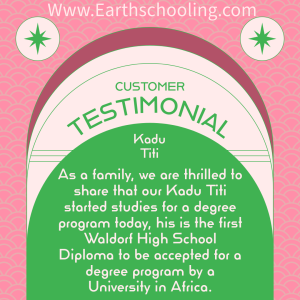
“As a family, we are thrilled to share that our Kadu Titi started studies for a degree program today; this is the first Waldorf High School Diploma to be accepted for a degree program by a University in Africa.” – Kadu
Yes, colleges will accept our transcripts. Over the past five years, an increasing number of colleges have accepted homeschooling transcripts. With the increase in home education brought on by the pandemic, this percentage has risen to nearly 100%. Our certificates and transcripts go beyond a “homeschool” transcript. So, although most colleges do not require them, they will help your student go “above and beyond,” and they are accepted.
Colleges in the UK, Canada, Europe, and Australia have also accepted our documents. However, as rules vary by country, you will need to check with your local school board or college to see what their document requirements are. You may want to refer them to our school page here to show how many accredited schools we work with.
Coming soon.
We can provide a letter addressed to you or your supervising organization that states your student(s) are attending Earthschooling. This letter is on letterhead and is signed by the dean of students. It can be mailed by USPS, scanned and e-mailed, or e-mailed to your address or the address of your supervising organization. You can see a sample letter below. If you need a similar letter, please let us know the following:
Loading...The letters below are samples without the student’s details filled in. These samples are to show you what you can request for your student to see if it suits your needs. Also note that the letters below can be modified to fit your needs
Letter of Recommendation for Student
Certificate of Good Moral Character for Student

Earthschooling works with many private and public schools around the world. As our curriculum is accepted at many schools, we have not found that students have ever had issues with our certificates and transcripts being accepted at their schools or colleges. The transition from Earthschooling back to public school or college is seamless.
However, in most cases, you do not even need to order a transcript or certificate from us. Some online education academies try to convince parents that they need a special kind of accreditation or certification to return to school. This is often used as a ‘selling point’ or as an excuse to charge extra for their program or require the purchase of certificates.
We do not make these claims or require them, as they are unnecessary. As a homeschooler, your rights are clear in each state, region, and country you are in. In the United States, this means that homeschooled children are treated the same as public school children when they transfer back to public school or when they enter college. All you need to do to enjoy these benefits is one of two things:
OPTION ONE: Do nothing. We take care of it all. Check with your state, region, or country’s laws. Some areas have laws that say that as long as you provide documentation and records (we provide those for you), your education for the year is accepted.
OPTION TWO: Register as a homeschooler in your state, region, or country. This is always an easy process, and we can help you with it.
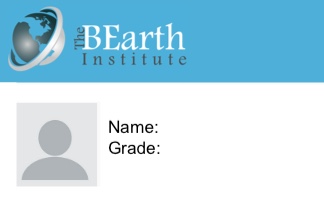
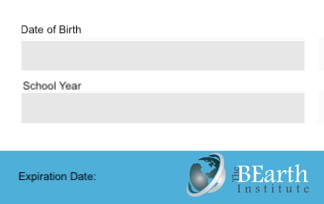
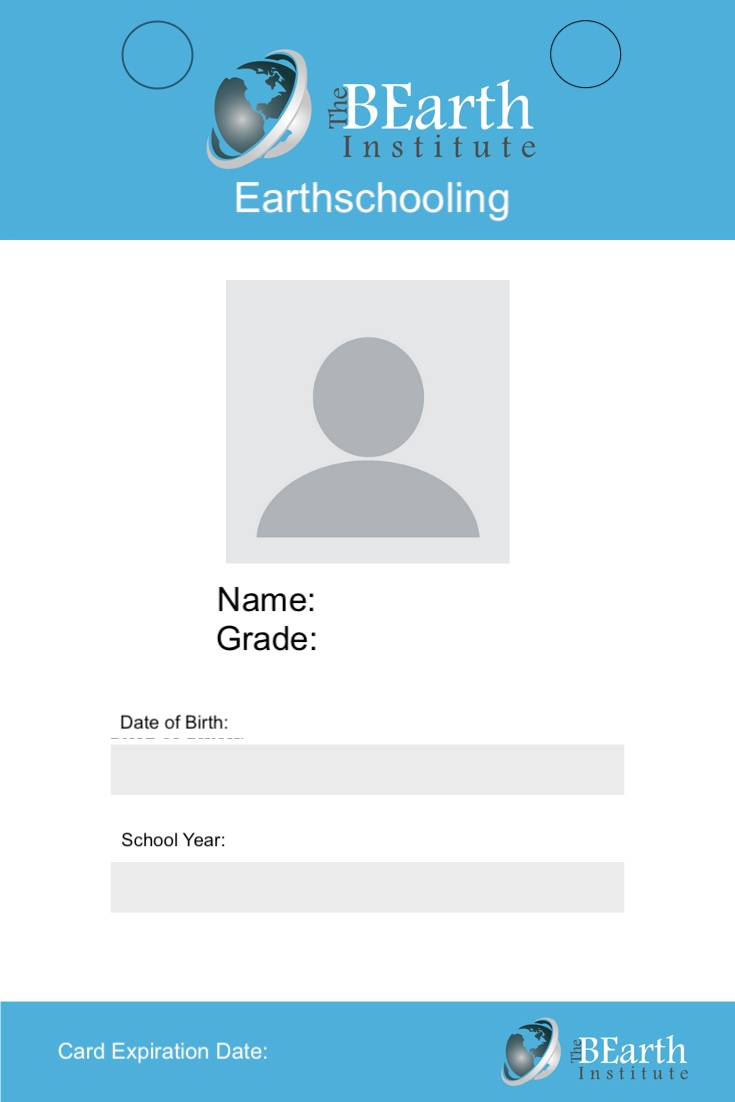
1. Download the template by clicking on the image to take you to the larger version and then download it.
2. Use any image program to “white out” or “erase” anything you do not need
3. Use the same image program to insert your own child’s information.
4. Laminate your card at home.
5. If you are unable to do steps 1-4 at home, you can order a personalized electronic version from us for $5.00. You can make a payment here, then e-mail CustomerService@TheBEarthInstitute.com with the Child’s Name, Birth Date, & Grade. We will assume your school year starts in August of the current year and ends in June of the next year unless you state otherwise. You can send us a picture of your child, or you can insert a photo on your end after you print the badge and before you laminate it.
Blank Templates…
(back and front: Large version and smaller wallet size)
Note: For some reason, the quality looks poor on the smaller online versions. However, when you download them, the quality is sharper
Earthschooling works with certified teachers, provides core standard charts to administrators, and provides weekly contact with a certified teacher. Earthschooling can also provide students with certificates and certified transcripts. This is sufficient to meet most regional accreditation requirements. If your region/state has specific requirements for your student, please check with them to ensure they are sufficient. Note that most states in the United States, Canada, and Australia do not have accreditation requirements for homeschooled students. These services are usually used by our International students.
Earthschooling is used in schools around the world and has been approved for use in both public and private schools. You can see a list of these schools here. The curriculum had to go through an approval process at each school to demonstrate that it meets suitable standards. In this way, Earthschooling has been accepted and accredited by individual schools. However, because of our international audience, we have not sought accreditation from a single entity, as it would not apply to all of our students, parents, teachers, and schools.
Question from a Student: Is your school accredited?
Reply from Earthschooling: When homeschooling, there are a few key considerations. Usually, schools in the United States do not require that you have attended an accredited school. You can enroll with them as a previous homeschooler. However, documents such as a graduation certificate and transcript help the school see that you have been keeping track of your work in an official capacity.
We offer you the opportunity to consult regularly with one of our teachers to fulfill your state requirements or receive ongoing help from a certified teacher. You can purchase these services HERE.
Iowa (my state) requires only that I provide them with a simple list of concepts we use each year. I submitted portions of the document below to my state teacher. She was very happy. Other years, I have given her the indexes. However, now that we are not using the indexes, you can also just print out the web pages to show them what you are doing for the year. We have provided a sample below…
Simple List of Curriculum Concepts
Some states require that you show how Earthschooling meets their Common Core curriculum standards. We can help you through this process. All you need to do is submit a list of your state’s Common Core curriculum standards in the format below. You can submit data for one grade, more than one grade, one subject, or whatever you need.
You can easily find a list of core standards for your state or region by using a search engine and entering the terms “(Region), Core Standards”. For example, to search for the Iowa Core Standards, I entered the term “Iowa Core Standards,” which took me to this website: https://iowacore.gov. Usually, the page you are looking for will end in .gov and appear at the top of the search engine results. Some states/regions have a more organized website than others. The Iowa website required me to visit multiple pages to download what I needed. Other states have everything on one page.
Be sure to check at the bottom of this page to see if we have already done your state. Once we do a state/region, we post it below so other members can use it.
This is the format you need to submit to us (You can download this example and cut and paste your own state/region’s information into it to make it easier):
Grade Two Core Standards in Ontario, Canada
OR another example (with the links to show you how I cut and pasted from the original):
Grade Two Core Standards in California, USA
We will then return it to you in the format below. Below are all those that have been submitted and finished. You are welcome to use any of the documents below for your state if you live in a place that already has an Earthshooling core standard.
Grade One Core Standards in California
Grade Two Core Standards in California
Grade Five Core Standards in California
Colorado Common Core Standard Chart for Kindergarten
Colorado Common Core Standard Chart for 4th Grade
Fifth & Sixth Grade Grade Core Science Standards for Iowa, USA
Educational Objectives Chart for 9th Grade in Pennsylvania
Fourth Grade Core Standards for Wisconsin, USA
Second Grade Core Standards for Ontario, Canada
Sixth Grade Grade Core Standards for Alberta, Canada
Second Grade Grade Core Standards for Alberta, Canada
Kindergarten Regional Requirements (Core Standards) for NSW, Australia
Stage 1:First & Second Grade Regional Requirements (Core Standards) for NSW, Australia
Stage 2: Third & Fourth Grade Regional Requirements (Core Standards) for NSW, Australia
Stage 4: Earthschooling Outcomes for Stage 4 (Grade 7-8) NSW Australia
If you have information on how you filed with your state as a homeschooler, or the main website for your state (or country/region), please let us know by sending an e-mail to CustomerService@TheBEarthInstitute.com. We can then share this information with other members to help them!
California
We work with many charter schools, schools, parents, and teachers in California. Most of our members register with the state as homeschoolers. However, we provide them with detailed schedules, core standard charts, and transcripts to make their record-keeping easy. The form to fill out in California is extremely easy to use. It is only one page HERE and is called a “Private School Affidavit”. Members who are using it have found it very easy to transition from public to homeschooling status.
To find up-to-date information for your state or country, please click here.




 Reload document
 Open in new tab