
Original Story by Kristie Burns
Copyright Earthschooling
(Image: Public Domain: Wampanoag boy and girl clothing at the exhibition of Cape Cod Museum of Natural History, Brewster, Massachusetts)
Writing Your Own Stories for Difficult Histories
There are many kinds of stories in Waldorf education. There are fables, fairy tales, personal stories, classroom stories, myths, and folk tales. Since Waldorf education emphasizes learning through stories, there are also many “historical stories” in the curriculum.
As with all historical stories, these are all historical fiction. Historical fiction is when someone takes a true account of history and turns it into a story. Some historical fiction stories are more accurate than others. For example, the traditional “Pilgrim Story” that has been told about “The First Thanksgiving” is largely a fictional and glorified account of a more complex story.
Similarly, the story I have written below is also historical fiction. It is an attempt to convey “historical fiction” in a more accurate manner than “The First Thanksgiving” stories I heard as a child. The actual historical account simply states that the Wampanoag people were worried about the noise from the pilgrim village, went to check it out, saw they didn’t have enough food for everyone, and wanted to help. I have made that historical account into a story. I originally wrote this for the First Grade Earthschooling Curriculum but then I realized that other Earthschooling students may want to use it or that some of our Earthschooling community may find the resources helpful so I am also posting this story here.
Upon seeing how gentle the story is your first question may be, “well that is not much better than the version I heard as a kid where the pilgrims are the saviors and invite everyone to eat pumpkin pie.” And you would be correct. It is not much better. But it is a start and that is how I have found is the best way to introduce difficult histories to children. There is a part two that will need to come after this story.
Without going into all the details I can share that within our own family there have been some very difficult things I’ve had to share with my children. One was a terrorist attack that happened just moments from our home. In this situation, as well as others, I have found that one of the best methods of introducing a difficult subject is to slowly ease the listener into the new story. The “pilgrim savior and pumkin pie” story has been around so long that it surrounds us all in cartoons, Thanksgiving decor, stories in public schools, stories in books, and so much more. Trying to avoid the story is like trying to shelter your child from Santa Claus – it would be very difficult.
Because of this, the “true” story might be disregarded as “too different” or “confusing” if suddenly presented to very young children. Even adults have difficulty switching gears on a story they have heard since childhood. In such cases I introduce the new story with a gentle retelling. So, in the following story we introduce the actual history of a meal that was shared. This story gently re-frames the entire meal in a different way and prepares the students to hear the second part of the story when they are ready.
You can choose to use my story, create your own, or substitute any indigenous story of sharing and thankfulness from the region you live in. I am not an expert in this subject or even this area of storytelling. This is simply an example of how you can take a fact from history or the news and make it into a story and how you can use that story to ease younger children into hearing more about difficult histories or even current events.
If you would like to read an official story from the culture of the Wampanoag people, you can visit this link here: https://www.native-languages.org/wampanoag-legends.htm
This is a link to a page that has detailed information about important Wampanoag mythological figures. After reading through these descriptions you can click on any mythological figure and it will take you to a list of stories to choose from that are specific to that mythological figure. Here are some more specific links to a couple of my favorites.
The Wampanoag people have lived in southeastern Massachusetts and Rhode Island for more than 10,000 years. Their ancestral homeland is known as Wôpanâak.
Our New Thanksgiving Story (part 1)
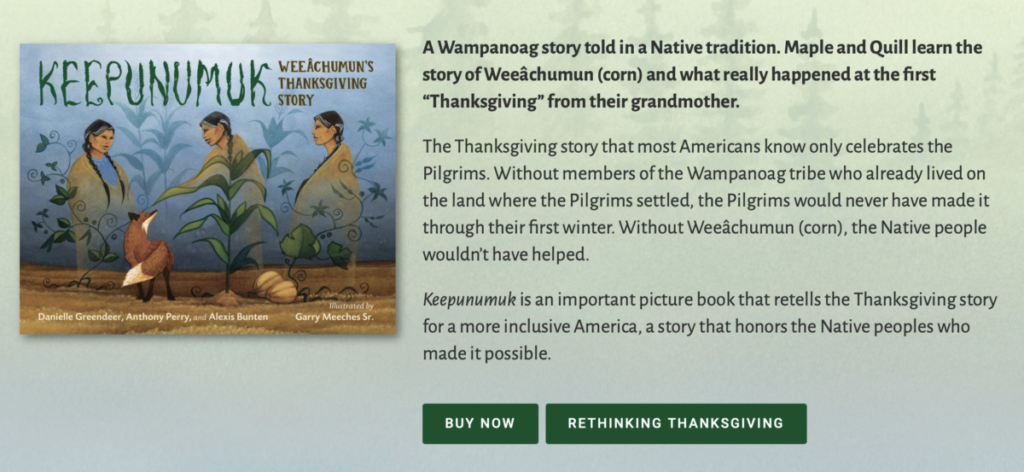
This is simply an example of how you can take a fact from history or the news and make it into a story and how you can use that story to ease younger children into hearing more about difficult histories or even difficult current events. Although there are a few books (linked above) about this specific historical event, not all historical events and current events have stories yet so it is a good to practice creating your own.
Grandma Weetamoo (meaning sweetheart or persuasive tongue) sat around the fireplace with the grandchildren and told them a story about their ancestors:
Many many moons ago (in 1620, if you want to be specific) The Wampanoag people lived a life close to nature. They built beautiful camps along the coast and had small inland villages to move to when the weather became colder in the winter months. Their houses were called wetus and were dome-shaped, made from bent saplings. Can you imagine getting to leave your house every summer and stay near an ocean, river, or pond instead? This is what the Wampanoag people would do. And while they were near the waters, they would go fishing, harvest shellfish, and plant crops. These things would keep them fed in the winter. In the winter, they would supplement this food with hunting. They hunted deer, bears, and moose.
One of their favorite farming techniques was the Three Sisters garden. You will learn more about that in third grade. The Three Sisters Garden is a way of planting corn, beans, and squash together in the same mound so they can help each other grow. Can you think of how corn could help beans grow? That’s right! The corn grew tall and made a natural trellis for the beans to grow up on.
Because they believed in hunting only what they needed to eat and only if they could use every bit of the animal they hunted, one of their art forms was to make beads out of whelk clam shells. These beads were called wampum and were used to make belts that would tell stories and even create government or personal contracts between people. They did not use written language for stories or contracts, so these belts were not only beautiful – they were also very important.
Once she had told the grandchildren a bit about their ancestors, she told them a story that her grandmother had passed down to her. And it goes like this:
One morning a boy named Wamsutta was working in the yard with his father. They were finishing up a canoe that would take them on the ocean to hunt fish. But Wamsutta was secretly hoping they would be one of the lucky ones who might catch a whale. He was deep in a daydream about seeing a whale in the ocean when he heard a loud crack. And then another loud crack!
Do you know the sound when you are trying to sleep, and fireworks are going off in the city around you? It was like that. Wamsutta was not sure what the sounds were, but his father looked very concerned. He followed his father to the center of the village where other men had gathered to discuss the sounds.
They talked about how some unusual people (Europeans) had recently landed near their villages and met with them. After these meetings, many of the Wampanoag people became sick and died. So these strange sounds brought concern. Was this another way these new people would bring harm to their tribe? The warriors of the village decided to go and investigate the frightening sounds. It was their job to protect the village so they needed to be brave.
They did not know it at the time, but the Europeans had brought many new diseases with them, and the Wampanoag people’s bodies were not used to those diseases, so they were much harsher on them and had a harder time recovering.
Wamsutta was supposed to stay behind and sand the canoe some more while the warriors went out. However, he was curious, and all that daydreaming about whales had put him in the mood for adventure! So he followed the men out of the village to an area where the unusual people had set up their homes.
In the middle of all the homes, in the middle of the square, was a long table with food and many people. Wamsutta saw a line of men standing and firing long objects that made loud sounds. He also saw men lighting fire to some strange, large contraptions that launched heavy metal spheres into the distance. It was fascinating and frightening at the same time. He covered his ears from the noise.
Wamsutta did not understand that these were muskets and cannons, but his father and the other men did. They came ready to defend themselves, thinking that perhaps these unusual people were planning to attack their village.
Wamsutta saw his father among the warriors. The two groups approached one another, and he feared what might happen next…
Instead, he saw something that surprised him! The leader of the unusual people ordered all the sounds to stop and he came out to meet the group. One of Wamsutta’s father’s friends shook hands with the leader and, after a bit of talking, the men started to sit down around the table and in other areas.
He did not know English, but Wamsutta heard the words “Harvest Festival” over and over. He didn’t know what that was, but it seemed to involve a lot of people together eating, and that looked fun! He breathed a sigh of relief. He wanted to sit at the table and join them, but he knew he would get in trouble if his father found out he had followed the group, so he went back home.
Wamsutta returned to find his mother quite worried.
“Where have all the men gone?” she asked.
“Oh, they are having a meal with the unusual people. They should be back soon,” replied Wamsutta.
However, they were not back soon!
A day passed, and the men were still gone.
Another half day passed, and the men were still gone.
Finally, halfway through the second day, a few of the men returned to the village to get their weapons.
Fearing the worst, Wamsutta asked his father, “Are we then going to war?”
His father laughed. “No, son, these people are not very skilled gardeners or hunters. They are celebrating a harvest, but they have so little food. We are going to help them.”
Wamsutta was so excited! He would probably get to go hunting with the men. They might hunt deer, or maybe even catch some fish!
The men also gathered some food from the Three Sisters Garden – corn and squash – to share at the harvest festival.
When the men were done gathering food, they returned to the unusual people and their celebration. The unusual people (known to us as the Pilgrims) were so grateful for the extra food. They spent a lot of time talking to the visiting men about how and where they found so much food. They also exchanged a few words.
They learned that the Wampanoag word for corn is weachamin and the Wampanoag word for squash is askꝏtasquash. The unusual people thought that was a great word, so they started to call their own gourds and pumpkins “Squash” after the new name they had learned.
The two people ate together for one more day. They did not know what the future would bring. All they knew was that on that day they were enjoying a meal together.
Part 2
Part two is your choice. This will depend on many factors. Is your child ready to hear this difficult history? Are they old enough? Or, if they are not old enough, do they have enough life experience that has already prepared them for this? Or, are they part of a culture or community that already experiences difficult histories on a daily basis? Ultimately, it will be you as the teacher/parent that decides if the students should hear part two. This will be a story you write yourself using the following resources. Part two introduces the historical facts of an illness brought by pilgrims that wiped out the majority of the indigenous peoples, the kidnapping of indigenous peoples, and the genocide of the local indigenous peoples. You can choose to create a story that introduces on historical event at a time, create a story that encompasses all historical events, or simply present the facts to (older) students as part of a lesson.









Leave a comment or question about this page below
You must be logged in to post a comment.