
Copyright Alan Whitehead & Earthschooling: No Part of this book, post, URL, or book excerpt may be shared with anyone who has not paid for these materials.
Alan speaks in a very symbolic and esoteric manner in some parts of his books. Although they can be read anthroposophically, passages speaking of Atlantis, archangels, gods, etc. do not need to be taken literarily to be meaningful. The more you read, the more you will realize he uses many different religions to express ideas in a symbolic manner and not in a religious manner. His writings are not religious. In some places his writings are meant to refer to religious events in a historical way. In some places he is using religious figures (from Christianity, Judaism, Islam, Buddhism, Hinduism, Paganism, Ancient Roman and Greek Religions, etc.) in a symbolic manner. However, at no point is he promoting a specific religion or speaking from a religious point of view.
I have kept the writing as close to one-hundred percent original so you will also find that he speaks of Australia often and some spelling or manners of speaking may be cultural. Any words I have changed are presented like this: <word>.
Also keep in mind that these books are written by a Waldorf teacher with decades of experience who also studied with a Steiner student himself, so he speaks to an audience that is dedicating their lives to the Waldorf method without exception.
Because of this, all of his views are not reflected in the Earthschooling curriculum and not all of them may be ones you want to embrace or are able to use. In all of Alan Whitehead’s writings the opinions are his own and may not align with Earthschooling or Waldorf Books. In some cases, we will be updating some of these chapters in the future with additional and/or updated information.
Ultimately, however, as I read through these passages I find I can distill wisdom from even those paragraphs that do not resonate with me.
We invite you to read with an open mind and heart and with eagerness to learn and discuss…
APRIL 25
Anzac Day
Alex Campbell from Tasmania, who died in 2002 at 103 years of age, was the last surviving Australian soldier who served at Gallipoli. He was only one of a distinguished parade of heroes and villains that have fought and or died at that perennial battlefield; not the least being his namesake, Alexander the Great. All have contributed, in one way or another, to the immortality of that small but so important region known in occult circles as The Womb of the World.
When our own Alex the Great joined his comrades in those trenches in the sky, what we experienced as living, breathing history entered the Halls of Legend – and in ages hence, of myth. Time will reveal that this heroic, but morally indefensible military campaign was so much more than an incompetent battle strategy in a relatively unimportant theatre of The Great War.
It was rather yet another of a long parade of pilgrimages of the Mars-inspired forces of masculinity to conquer the spirit of world femininity, which has its epicenter in this remarkable region of modem Turkey. Like most if not all of the assaults over the ages, the Anzac campaign failed – spectacularly.
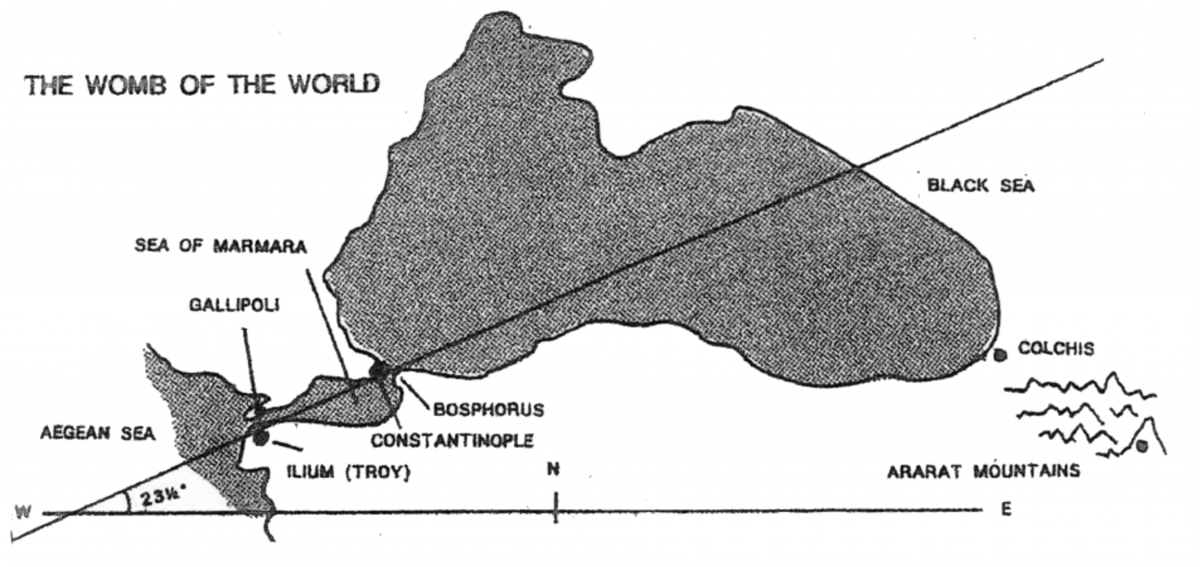
As the accompanying map shows, this Womb of the World is not mere metaphor, but a literal macrocosmic expression of the microcosmic female genitalia. The Gallipoli Peninsular itself, with the ancient site of Troy opposite are the labia, the Sea of Marmara is the vagina, the Strait of Bosporus the cervix. and the Black Sea the holy uterus. This Moon-inspired region is even set at the same axis as the female organs, about 23.5 ° – the angle most receptive to cosmic Sun forces. Our Anzacs failed even to broach the entrance to this sacred place, pulling out – as it were – long before presenting any real threat to the world hymen.
This calamitous event did, however, deflower Australia’s own national innocence as nothing else has done, before or since. Anzac Day is our country’s true national day, evoking each April 25th an incomparable physical, emotional, and spiritual response right across our wide, brown land. Perhaps it’s just coincidence that this date is also the Feast Day of St. Mark.
This ‘life’ gospel embodies the Mysteries of Muliebrity more than any other. It is the Spring or Resurrection Gospel. There are sixteen chapters in Mark; in Pythagorean numerology a significant number related to fecundity and rebirth.
Anzac Day also falls at the beginning of the (post-1413) zodiacal sign of Aries-Ares (Mars), the quintessential Martian constellation. Thus, April 25 is a fortuitous male-Aries, female-Mark complement. In Egypt, where Mark evangelized, sixteen is the Number of Hathor, mother deity supreme; one epithet being Ruler of the Sixteen in her regency over the annual fertile Nile flooding. Sixteen is also known as The Measure of Great Delight.
Curiously, the Anzacs first trained in – hence absorbed the subliminal influences of – the Land of Hathor prior to embarking for Gallipoli. Perhaps Australia’s elevating of a humiliating defeat has brought a subsequent ‘measure of great delight’, as in our burgeoning prosperity and quality of life, to our blessed shores? Like the Sun-Moon, male-female reality of sexuality, the Christian-Sun-Anzac, Moslem-Moon-Turk conflict has a parallel resonance. An unexpected outcome, and one which increases in intensity each year, is the comradely bonding of Anzac and Turk veterans. This ranges from the expression of noble sentiments to each other, to the downright maudlin.
Most opposing armies bear their hatred for each other for generations. Ask any old Aussie soldier what they think of their erstwhile Japanese or German opponents! But with the Turks, glowing goodwill only intensifies over the years, by the Grace of the Cosmic Virgin perhaps?
In spite of Anzac Day having always been a significant national day in Australia, in the anti-war 1960s it suffered what appeared to be an inevitable demise. This was hastened not only by the relentless flower-power pacifism of the time, but by films and plays, like that courageous theatrical apostasy The One Day of the Year (the title says it all, the “One Day” being Anzac Day). However recent years have seen a surge of new interest in Australia’s military past, especially Anzac. Each year, thousands of people make a solemn pilgrimage to the barren, windswept hills, and beaches of the Womb of the World. Here they shed tears for men who are long dead. Most of who were ignorant country boys who thought the whole thing ‘a bit of a lark’. Until they got there, of course.
This ennoblement of spirit is already transforming war into peace, and hatred into love. That indeed was the true, higher, mission of Anzac. In this they did not fail.
Our first official introduction to the Womb of the World is the story of Noah and the Flood. His ship’s company of eight hands – and lots of animals! – sailed out of the tumult of a sinking Atlantis to find dry land on ‘the mountains of Ararat’ (note the plural). These border the eastern shore of the Black (‘hidden’ or ‘occult’) Sea. The gestation of the seven post-Atlantean civilizations, of which we are the 5th, aptly occurred in the uterus of the world. Number, as always, is significant; Atlantis is the Age of Seven, numbering one from Ancient Saturn. The first post-Atlantean civilization, known generically as Ancient India (though of course it was a global phenomenon) was the Age of the Eight – hence eight people in the Ark. Locals in the Ararat area still enjoy ‘Noah’s pudding’ in their thanksgiving festivals.
This is based on the story that near the end of the forty days, the Noahs were so near to starving that they scoured the cracks in the floorboards for food scraps. Noah’s pudding is traditionally made from pantry odds-and-ends. The Ice Age sea-level-raising cataclysm broached the hymen of the world, the membranous bridge separating the Sea of Marmara from the Black Sea. Geologists call this the world’s greatest ‘portal collapse’.
Global ocean cascaded into the originally lower-lying fresh water Black Sea, inundating vast areas of settled land with salt water. This breaching of the world cervix is even recorded, if cryptically, in the story of the Odyssey, where the doughty Argo had to pass through the ‘clashing blue rocks’ which opened (and closed) the foaming strait with unimaginable violence.
As with Noah, a white bird led the Argonauts to safety. Even more coincidentally, Jason and his fifty oarsmen eventually beached the Argo (Argo – Ark?) at the very same place. Colchis is on the eastern shore of the Black Sea!
The timeless image associated with the Feminine Mysteries in general, and the Womb of the World in particular, is the Black Virgin. She was originally the divine Pallas, daughter of Tritonus (‘three tones’ the Titan – Greekspeak for one of the sea gods of Atlantis). Through a series of misadventures, Pallas, like many female figures in world legend, suffered a ‘fall’. Pallas tumbled to earth right into the Womb of the World, Troy. Or to be more precise, the planet’s genital labia.
Here she became the most sacred object in the ancient world, the Palladium; a small, black female figurine carved in remembrance of her friend by Athena herself – who, in remembrance, thereafter, became known as Pallas-Athena.
The assault of Troy by the Greeks was really motivated by the desire to wrest this icon of cultural advancement from the Trojans; though of course history focuses more on her flesh-and-blood counterpart, Helen of Troy. In fact, the whole Greek civilization took its name from Helle-Helen, as in Hellenistic.
Even Helen has a fascinating provenance. In Homer’s Odyssey and Iliad, we meet the two children, Phryxis and his sister Helle, bridging the two post-Atlantean civilizations, the Taurus Egypto-Chaldean and the Aries Greco-Roman. Hence the sky-borne ram and the quest for the Golden Fleece. Poor little Helle became yet another female sacrifice in her own ‘fall’ into the waters of the world cervix; forever after known as the Hellespont – ‘bridge of Helle’.
Later in the story, Jason’s success in returning the Golden Fleece to Greece, where it nurtured one of the most sublime civilizations the world has ever seen, was assured with the help of another remarkable woman. Medea was, a princess of Colchis (the placenta of the world!) – no, more than that, she was a sorceress, a high initiate of the Gaea or Feminine Mysteries. If a single, indispensable, individual can be thought of as conceiving “‘ in the literal sense – the great Greco-Roman civilization, it was the ever-wise Medea.
The magic ointment she gave Jason in the· Grove of Ares (Ares – Mars, lives in the House of Aries) provided by Prometheus himself to secure the Golden Fleece is a clear symbol of her initiating role. Prometheus means ‘god of the future’. A prelude to the combative, adversarial nature of this future Mars civilization is seen in the Dragon’s Teeth army fighting itself.
The Hellespont is also known as the Strait of Bosporus – ‘ox ford’. This is based on another tale focusing on this border of West and East. The beautiful Io had to turn into a heifer before she could cross. As such, she traveled on down to Egypt, and the Orient in general, to establish the Taurus civilization, and in particular, the mysteries of fertility on which it is based, those of the earlier mentioned Hathor. In fact, a frontal sectional view of the female genitalia is actually bovine in form.
The uterus is like a cow’s head, the ovaries the ears, the fallopian tubes the horns (see page 41). So even this woman-river, 4th post-Atlantean civilization was born in the Womb of the World. But back to Troy: this city was originally known as Ilium, hence the Iliad. We find this lovely word today in the main pelvic bone, the ilium – ‘protector of the womb ‘Achilles’ siege of Troy-Ilium lasted ten years; the Anzacs’ on Gallipoli, ten months.
A significant force in the Dardanelles (from Dardanus, founder of Troy) campaign was the Australian Light Horse – sans horses, alas! Could this be a 20th Century reflection of the ligneous stallion that penetrated fair Ilium by night? The word Palladium is also a common noun meaning ‘protector’. In the Trojan Horse fiasco, the Greeks wrested Helen, and the Palladium, from their enemies; however, deceit was repaid with deceit, as the statue they carried home in triumph was only a replica. The sacred original was secreted out by Aeneas westward to Italy. Here it gave birth – again literally – to the Roman civilization. This was born on the aptly named Palatine Hill, sacred site of the Temple of Vesta the Virgin. From its new home, the Palladium succored this great age until its (Rome’s) creative energy was exhausted.
With the Black Virgin’s invisible but spiritually potent help, the Emperor Constantine established a new empire at Constantinople. This was the site of ancient Byzantium, on the western lip of the cervix of the world.
Pallas was home again, to her earthly home, at least. Here she provided metaphysical impetus for a new, Christian, empire; one which waxes stronger as the centuries unfold.
The Palladium was said to be concealed under one of the massive columns of the church ~’f Sancta Sophia (‘holy wisdom’); as such, it yet again became a magnet for testosterone-driven hordes.
Moslems, Crusaders, Magyars, and other motley armies descended like black angels on Palestine (‘land of Pallas’); a region which extended north right through the Holy Land to old Ilium, today’s
southern Turkey. In fact, Palaic, ‘speech of Pallas’, is an ancient Turkish tongue. Among the legion questers to the Womb of the World for the Palladium were the Paladins; the legendary Twelve Peers of Charlemagne’s Court. These ‘Knights of Pallas’ initiated the refreshingly original concept of chivalry, a new respect for womanhood.
The civilizing precepts of chivalry are actually those upon which modern feminism is based; and its genesis was so long ago! The Mysteries of Pallas are the realm of esoteric rather than exoteric knowledge. Therefore, it is Esoteric Christianity, the major stream being Anthroposophy, which specifically supports feminist ideals. The exoteric church is rather patriarchal. Charlemagne thought so highly of this humanizing power that he instructed that his body be interred in the Palatine Chapel in Aachen. Even the essentially female word ‘palace’ (as opposed to the masculine ‘fort’) can be etymologically traced back to the Black Virgin.
Whoa! Rudolf Steiner a feminist? He was an ardent, both in practice and principle, advocate of women’s rights and equality. Even his founding Vorstand of the Anthroposophical Society comprised a balance of three men and three women: the latter being Marie Steiner, Elisabeth Vreede, and Ita Wegman.
The removal of the Palladium by whomever-Paladins? Templar Knights? Richard the Lionheart? – to Europe gave birth to yet another great civilization, the Anglo-Teutonic. Today many European sacred centers still embody a worship of the Black Virgin. Special among these are the Notre Dame (‘great lady’) cathedrals; sited as they are on a terrestrial mirror of the stars in the constellation – aptly – of Virgo. Chartres Cathedral, with its celebrated Crypt of the Black Virgin, is sited on one of the main stars in the constellation.
As we can see, The Womb of the World, a region of archetypal Earth genetics, is a perennial transition zone, not only physically dividing West from East, but historically, and by extension spiritually, as well. It was the boundary of Noah’s passage from Atlantis to Arya, the generic name Steiner provided for the current seven-civilization post-Atlantean epoch. It was also the theatre, a la Jason etc., for the change from the Egyptian to the Greek (747BC); and even, 2160 years later, from the Greco-Roman, via Sancta Sophia, to the Anglo-Teutonic (1413 AD).
What’s more, Rudolf Steiner predicted that when our own 5th post-Atlantean civilization has run its course, in about 3573 AD, the epicenter for the great shift eastward to the Slav cultural dominion will again be the contact-zone Balkans, Black Sea area. A prophetic aspect of this future conflict was witnessed, by those occultly informed, like Steiner, by the erupting of World War I in the very same region with the assassination of Franz Ferdinand, Archduke of Austria, in Sarajevo in 1914.
Even the turning point to the immanent defeat of Germany in World War 2 could be pin-pointed to the Battle of Stalingrad, just north of the spiritually potent Black Sea – which turned out to be the soft underbelly of the Nazis.
Australia’s war memorials, like Melbourne and Canberra, are inspired by the architecture of the Womb of the World. That in Melbourne is like a Babylonia ziggurat; the memorial in Canberra rather styled on the dome of Sancta Sophia in Constantinople! Why not a memorial based on, say, a Siamese palace to commemorate the horrors of the Burma Railway? Or Belgian baroque to sanctify the fallen on the Western Front?
No, our primary fascination has always been Gallipoli, a word meaning ‘city of the Gauls’; its origin being Celtic (gallic, Gaelic). According to Steiner, the archangel of the Celtic folk soul is responsible for the furtherance of Esoteric Christianity in the world – the female stream of the Christ impulse.
Even our war memorial in Hyde Park in Sydney is domed. The black-bronze statue of a naked, prostrate soldier in crucifixion gesture · within is unutterably moving. But where is the Black Virgin? Well, the designer of this image of nobility in tragedy, Rayner Hoff included a statue also of a naked woman in black bronze, The Crucifixion of Civilization; again, in the Golgotha pose, but upright, and to be outside, against the western wall.
The male was the death of the body, the woman the resurrection of the Spirit. However, the powers-that-be, those who eternally suppress the revelation of the world feminine, excised it, ostensibly on the basis of offense to modesty! So, the Mystery of Pallas in Australia remains just that. She exists rather in the hearts and minds of those who support the rights and dignity of women in our harshly male-dominant society.
She manifests in the deeds of those who invoke the Incarnation of the Goddess in our young but vibrant – largely Celtic – culture. So, even for people of peace and goodwill in the Esoteric Christian stream, next Anzac Day will once again be a ‘Lest We Forget’ event – no, not only in remembrance of Alex Campbell and his comrades, but a redemption, in the St Mark spirit, of the divinity of womanhood which continues to ennoble their long-gone but immortalized suffering and sacrifice.
But has the Black Virgin ever visited Australia? On an Anzac Day dawn in the early 1920s, a small group of revelers were wending their way home.
As they passed the Cenotaph (’empty grave’) in Martin Place Sydney, they saw an old woman tearfully lay a posy of flowers on the memorial for her lost son.
Both in respect, and in remembrance of the dawn landing on that same day in Gallipoli just a few years earlier, they joined her in a few moments silence. In later recounting the incident, and the powerful emotions it evoked, at their Returned Services Club, it was agreed to do likewise on the dawn of April 25 the next year. From this humble origin grew the most profound ritual in Australia. Today legions gather for the Anzac Day Dawn Service in every city and town in the land.
Paradoxically, the largest assembly in not in Oz at all, but, as earlier mentioned, on the heights of Gallipoli itself. Here, swelling numbers of mostly young Australians and others (including Turks!) watch the sun rise over ancient Troy across the strait, original home of the Black Virgin. Here they reflect on the – spiritual – birth of their own beloved home, half a world away from sunny Australia, on April 25, 1915. Is this venerative multitude blessed by the Being of Infinite Compassion, Pallas? She who has manifested to humankind over the eons in many guises – perhaps even that of a bereaved old woman?
***
In relation to my interest into one of Australia’s Sacred Places, Gallipoli, I have to make a disclaimer. My uncle, on my mother Esther Mary Smith’s side, was a soldier at this nation-forging event in 1915.
Private Warrick James McLeod was my mother’s half-brother, his, and my mother’s mother, being Esther Harriet Smith (nee Niblett): at the time of his birth my Grandmother was Esther McLeod.
Warrick’s World War I service records reveal quite a bit about my war-hero relative, who was sadly killed at Pozieres in France between 26th July and 1st of August 1916. I often reflect on my Grandmother’s grief at losing her son. His remains, like so many others, were never found.
Born in Australia in 1895, he was just 21 when he died. Warrick enlisted on 27th Feb. 1915 at Liverpool Barracks Sydney NSW, just a few months after the Great War hostilities erupted.
He was assigned to D Company, D Corps, 17th Infantry Battalion (about 1000 men), 5th Infantry Brigade (about 4000 men), 2nd Division (about 18,000 men) of the newly-formed AIF (Australian Infantry Forces). The 5th Brigade was from NSW. During The Great War Warrick’s blighted 2nd Division lost about 12,000 men (70%!) killed in action or died of wounds. My uncle was one of the slain.
At 21, Warrick was unmarried, and a signwriter by trade. Like many soldiers in those days he was small of stature, being only five feet, five and a half inches tall, and slim, weighing a tiny nine and a half stone. He had fair skin, grey eyes, and brown hair. My mother was only nine years old when her brother died.
He embarked from Sydney for the Womb of the World on May 12, 1915, less than a month after the first and most famous Gallipoli landing on April 25, 1915. His ship was HMAT Themistocles. Trivia, perhaps, but Themistocles was the Greek hero of the Battle of Salamis, where the Greek navy, against all odds, defeated the mighty Persian fleet of Xerxes I in 480BC.
Like Gallipoli, this too was an Orient (Turk, Persian) verses Occident (Greek, British) struggle. Ironically, the Aegean Sea where the battle took place was the very same region of the world where my uncle Warrick was headed.
Warrick proceeded to the MEF (Mediterranean Expeditionary Force – Gallipoli) in Egypt on the 16th of June 1915, where he trained. until mid-August. On the 20th of July the 17th Battalion became part of the Australian 2nd Division. The 17th landed on Anzac Cove on August 20.
“At Gallipoli the 17th Battalion participated in the last action of the August offensive, the attack on Hill 60 – before settling into defensive routine in the trenches. For a short period, part of the 17th garrisoned the notorious Pope’s Hill, but for most of its time on the Peninsular the Battalion was responsible for the defense of Quinn’s Post, one of the most contested positions along the entire Anzac Front. ”
My uncle served in Gallipoli mainly at the hell of Cape Relles, from then to 8th January 1916 – some seven terrible months of disease, privation and death on a horrific scale. For all he went through in both Gallipoli and French campaigns, my uncle received only one small commendation medal.
“The weekly wastage through sickness, mainly fly-borne, at Helles and Anzac was alarming, and though anti-typhoid inoculations averted the worst danger, paratyphoid and dysentery raged. ”
Warrick’s service record has no entry of sickness removing him from the line, so he must have been a tough little bloke – in every sense of the word.
As earlier mentioned, Cape Relles was named after Jason’s (of Argonauts fame) beautiful nubile partner, Helle, who fell from the back of the flying Golden Ram (Aries) to her death in the sea in that area, known as The Hellespont – Bridge of Helle.
The 17th Battalion also saw action in the nearby disastrous Suvla Bay Campaign (6-21 August 1915). For this, the doddering British General Frederick Stopford was dismissed.
“His performance in command was one of the most incompetent feats of generalship of the First World War.”
Lucky in leadership, my uncle was not!
Warrick’s record also has him serving a pre-war national service stretch with the Militia and 2nd Infantry Citizens Forces in Sydney. His 5th Brigade was really up to its neck in it at the Battle of Suvla. Following Stopford’s calamity:
“Hamilton demanded a farther effort before he gave up hope … Meanwhile a mixed Anzac force moved on Hill 60, the foot of one of the spurs on the boundary between the Anzac and Suvla spheres. This hill had actually been passed by the 4th Brigade in the advance on August 8, but since the withdrawal on that day it had been strongly fortified, and not until 28th August did a final attack establish the Anzac line near its low summit.
In this week’s fighting, troops of the 2nd Australian Division took part. That Division comprised the 5th Brigade, as well as the 6th and 7th under Major-General J. G. Legge.”
The Cape Helles troops were the last to leave the Dardanelles. Paradoxically, the Gallipoli retreat represents the. Greatest achievement of this blighted campaign, or of any campaign!
“An evacuation was carried out with exemplary skill … the enemy was completely deceived. A few guns were left and blown up at the last moment, and considerable quantities of stores remained, partly destroyed, on the beaches. But 80,000 men, 5000 horses, and 200 guns were withdrawn from this portion of the peninsula.
This was for the loss of only half a dozen casualties, and without any suspicion on the part of the Turks.
Three weeks later, on 8th January 1916, the troops at Helles were withdrawn with similar success and impunity.”
My uncle Warrick was one of the cunning heroes of this final historic retreat. He subsequently disembarked at Mudros on the nearby Adriatic island of Lemnos on the 9th of January 1916. From there he embarked for Alexandria in Egypt. It is not clear what role was played by Warrick’s unit in Egypt, but in general terms the returnees from Gallipoli were in it again:
“By the close of 1915, the Australians and New Zealanders were back in Egypt. There was fighting west of Alexandria from December to February, but by March the Arab rising was crushed. The Infantry from Gallipoli was hurried to fortify and hold a line east of the Suez Canal.”
***
“We must look forward one hundred, two hundred, three hundred years, to · (he time when the vast continent of Australia will contain an enormous population; and when that great population will look back through the preceding periods of time to the world-shaking episode of the Great War, and when they will seek out with the most intense care every detail of that struggle; when the movements of every battalion, of every company, will be elaborately unfolded to the gaze of all; ‘when every family will seek to trace some connection with the heroes who landed on the Gallipoli Peninsula, or fought on the Somme, or in the other great battles in France … ”
Winston Churchill, London, December 16, 1918
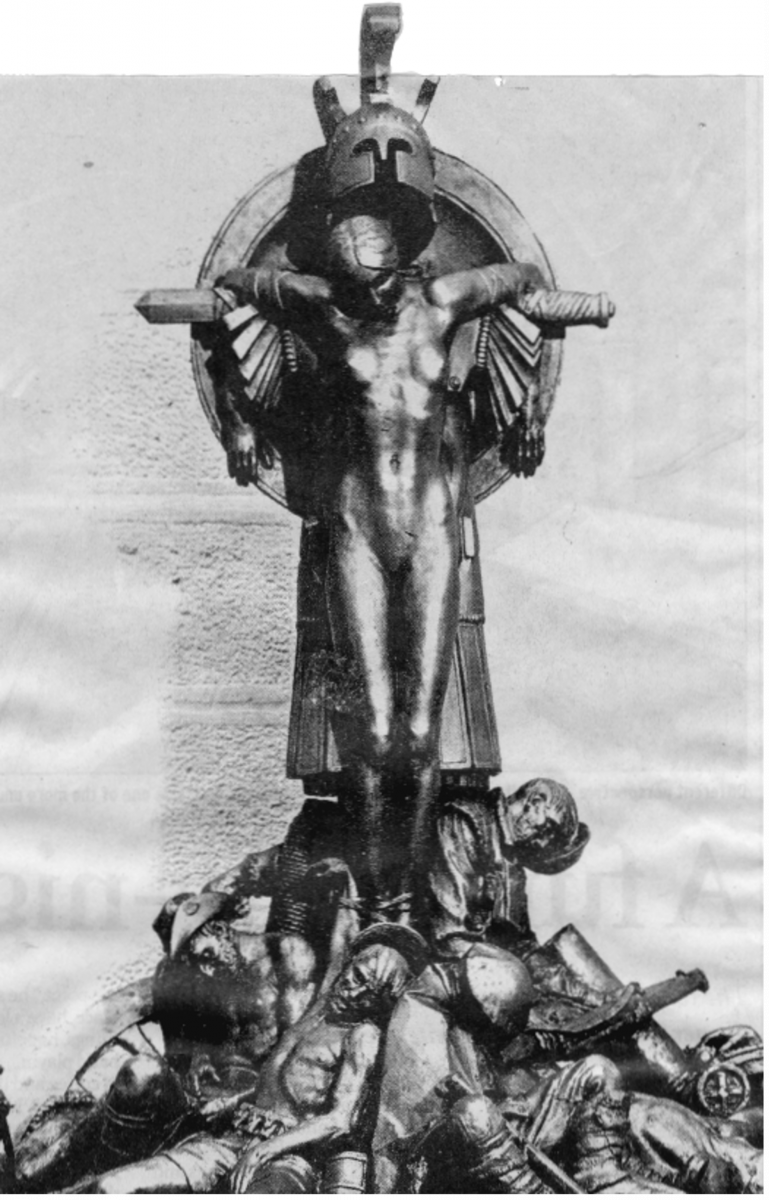
by Raynor Hoff. Statue for the Sydney War Memorial; now sadly lost. Note Trojan theme connecting Anzac to another great war that was fought just across the bay at ancient Troy.










Leave a Reply