
Copyright Alan Whitehead & Earthschooling: No Part of this book, post, URL, or book excerpt may be shared with anyone who has not paid for these materials.
Alan speaks in a very symbolic and esoteric manner in some parts of his books. Although they can be read anthroposophically, passages speaking of Atlantis, archangels, gods, etc. do not need to be taken literarily to be meaningful. The more you read, the more you will realize he uses many different religions to express ideas in a symbolic manner and not in a religious manner. His writings are not religious. In some places his writings are meant to refer to religious events in a historical way. In some places he is using religious figures (from Christianity, Judaism, Islam, Buddhism, Hinduism, Paganism, Ancient Roman and Greek Religions, etc.) in a symbolic manner. However, at no point is he promoting a specific religion or speaking from a religious point of view.
I have kept the writing as close to one-hundred percent original so you will also find that he speaks of Australia often and some spelling or manners of speaking may be cultural. Any words I have changed are presented like this: <word>.
Also keep in mind that these books are written by a Waldorf teacher with decades of experience who also studied with a Steiner student himself, so he speaks to an audience that is dedicating their lives to the Waldorf method without exception.
Because of this, all of his views are not reflected in the Earthschooling curriculum and not all of them may be ones you want to embrace or are able to use. In all of Alan Whitehead’s writings the opinions are his own and may not align with Earthschooling or Waldorf Books. In some cases, we will be updating some of these chapters in the future with additional and/or updated information.
Ultimately, however, as I read through these passages I find I can distill wisdom from even those paragraphs that do not resonate with me.
We invite you to read with an open mind and heart and with eagerness to learn and discuss…
MARCH 8
International Women’s Day
Having a specific celebration of women is even more unlikely than for seniors or rubbish collection. However, as the fair sex has been an oppressed majority for millennia, it seems only “fair” to recognize the value of women in society in general and their increasing individual contributions to all fields of life.
This is so whether in business, politics, public service, the arts, and sciences, or even sport. Though, it does seem to be the case that being born a boy is a more hazardous – if not fortune-blessed – destiny than if one arrives in the world as a girl.
The stark reality of boys and men being at more risk in many areas than girls and women is gradually seeping even into mainstream media consciousness. Studies and statistics in legion disciplines reveal the male of the species having less longevity, being more likely to suicide and have accidents, to be jailed, and to be poor sleepers even.
Poor sleepers? When asked why boy babies were more difficult to get to sleep, and in many ways were more distressed than girls, Rudolf Steiner said that the male body is denser – more material – than that of the female. This can be seen in harder musculature, more compacted skeleton, and so on.
As such, the gently incarnating soul-spirit of the individual finds greater resistance to entry into the carnal – it is like trying to put on a glove two sizes too small.
Of course, when the boy man does overcome this resistance, he has a stronger physical body with which to master the material world. “Subdue the earth” was God’s invocation to the first man, Adam (a name meaning red earth).
He said rather to world woman – “Go forth and multiply”. Another quote from Steiner in this Mystery of Muliebrity: “The woman sees in humanity a gift of the metaphysical worlds … if these remarks are not generally accepted today (1922), it is due to the fact that our present civilization shows all the signs of a male-dominated society.”
He goes on to describe how women are different from, but equal to, men; and that by sacrificing their femininity – or more correctly, their femaleness – in attempts to emulate men, they deny the world the necessary social and cultural gifts only women can bestow. Overalls doth not gender equality make, as it were!
Steiner was not only a zealous theoretical feminist – in an age when there were few of the female variety even – he brought these principles of equity into practical life as well. In all Steiner initiated organizations – whether medical, educational, or other – women had equal statis and equal pay with men.
In his educational reforms, Steiner insisted on a universal curriculum, where alt girls and all boys studied all subjects. The end result of a boy learning cooking and a girl motor mechanics is a more rounded individual:
“Boys and girls working side by side learn how to cooperate as men and women in social life later on. “he presciently explained. These attitudes may have resulted in a preponderance of women in Steiner activities in particular, and spiritual life in general.
In most gatherings on matters supersensible, ninety percent will usually be women. Steiner’s explanation is that women, with their finer corporeality; are simply more open to higher ideas, whether religious, moral, or philosophical.
The ‘difference’ between men and women he described as being one of a predominance of certain faculties. The human being is constituted from four principal elements: a physical, life and sentient body, and an ego -the shrine of Individuality. In women, the life and sentient bodies are generally more dominant than in men – both being ‘female’ organs as he describes them.
A simple anatomical expression may help to illustrate. The human head is protected by the skull – physical body – within this there are two protective membranes, the dura mater and pia mater – aptly meaning ‘strong mother’ and ‘good mother’ respectively. These are embodiments of the life and sentient bodies.
Both protect the brain, and specifically the pineal gland, the Holy Grail of ego-based Individuality itself. The strong and the good express the essence of woman – ‘strong’ of course relating to endurance above; as in ladies living longer, being able to endure more pain, and so on. And the ‘good’?
Mary Magdalene was the ultimate oxymoron, a so-called prostitute credited with being the partner of the Son of God!
Mary casts the light of truth on the aphorism that: “A soiled woman is more exalted than a virtuous man. ” The New Testament seems to affirm this in the fact that only the women associates of Jesus were present at the Crucifixion – not a craven disciple in sight for the entire event! The women were also the first to see him in his post-Golgotha ethereality.
But women are not all giving, nurturing, and protecting, they have needs as well; three being especially important – Singing, Touching (as in a caress), and Dancing.
Steiner takes us on a journey, via his spiritual research into the Akashic Chronicle, back to a pre-mineralized earth, a water world the spiritually aware Greeks called Panthalassa – ‘all ocean’. In the Oriental Yin Yang, water is female. Other legends refer to the epoch as Lemuria; a period when the sentient body incarnated on earth. Even though lost in the mists of time a few relics of this sentient era have remained buried in our collective folk memory. One of these is the enigmatic myth of the ‘honey-voiced woman’.
These siren-like women (our progenitors) sang, in tones of unendurable sweetness, the incipient soul into humanity’s gelatinous corporeality. Women generally have finer singing voices than men; hence they love – and need – to sing. Henry Kendall, 19th century Scottish-Australian poet, was sensitive to this mystery in his hauntingly beautiful poem “The Last of His Tribe”.
Will he go in his sleep from these desolate lands,
Like a chief to the rest of his race,
With the honey-voiced woman who beckons and stands,
And gleams like a dream in his face –
Like a marvelous dream in his face.
The plaintive sound of the black cockatoos ringing round the mountains is said to be the distant echoes from the Spirit of the honey-voiced woman.
Move forward an aeon or so to Ancient India where, not the sentient body this time, but the life body was invested into human culture. Among other things, the feminine mysteries expressed through the Kama Sutra, the ‘love book’ (Kama was the God of Love). This was not · created as a canon of erotica, rather as a profound guide to meditation practice via the power of sensuality. It was based on the Sense of Touch.
In esoteric teachings of the 12 Senses (so much more enlightening than a mere five), that of touch is relegated to the sign of Cancer. This was incidentally the vernal sign in Ancient India (about 8000 to 6000BC). It is the life body of woman, today, as well as in the past, that is stimulated and nourished by touching – both in a giving and receiving sense. Touch is not just sensual – or sexual even – but a path to higher experience. This need is being increasingly met by the relatively recent advances in massage, originating in India as much of it did. My observations are that women enjoy being massaged more than men.
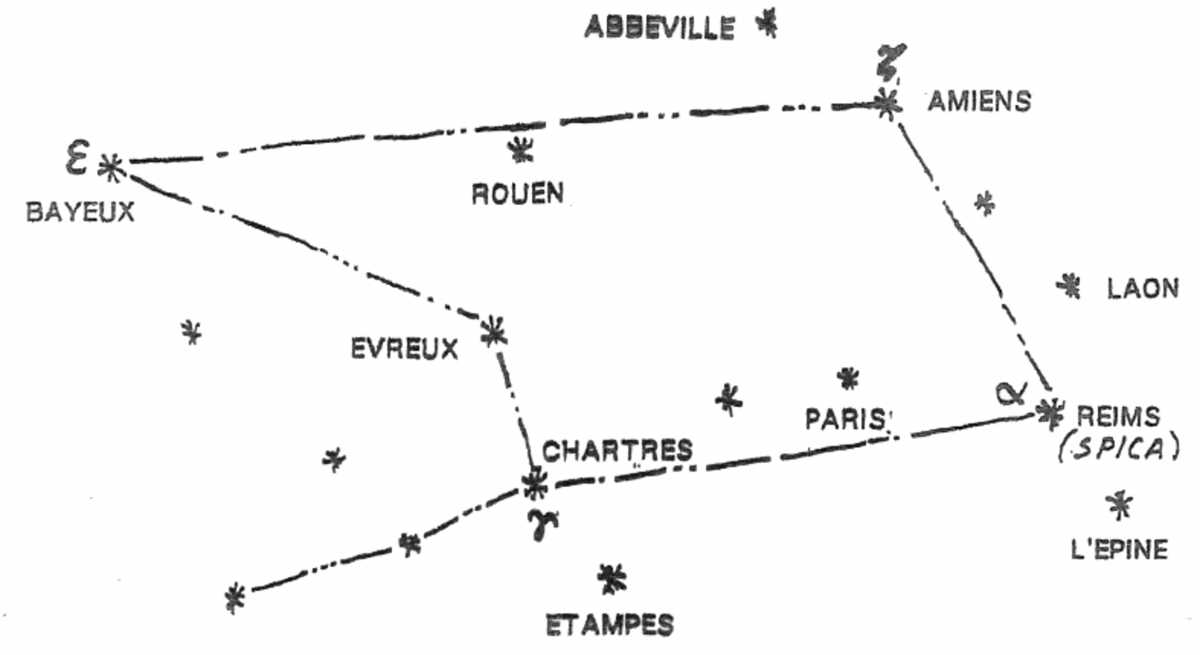
Even the male-dominant Christian era has an underground river of female worship. Taking their cue from the old Babylonian zodiac sign of Virgo, this is reinvented in the ubiquitous Cult of the Virgin – of Mary, Mother of God. Queen of Heaven devotion was especially strong in the Gothic age, when a series of Notre Damecathedrals of immense size and salubriousness, were built all over France. Not quite all over – the main Notre Dame (“great woman”) cathedrals were actually sited on the same geometric form as the main stars in the constellation of Virgo! (See illustration at end of chapter.) The odds of this being co-incidental are impossible. What we see is an ancient wisdom being resurrected in a new vestment.
In fact, no male was ever interred in Chartres Cathedral, one of the most sacred of all Notre Dame shrines. This was built over a pagan holy well; a vagina of the earth. ‘
These ‘great women’ Notre Dame centers were at first dedicated to, as well as singing, joyous ceremonies, and celebrations. In short, they were places of Dance. In Chartres, there are even geometric patterns on the tiled floor to direct the choreography so that the terpsichorean frolics would mirror divine principles – just as the siting of the cathedrals do.
The Virgoan sense is that of movement – the Art of Virgo is Dance. Again, we see Dance as a deep inner need of womanhood through the ages. Rudolf Steiner even went further than traditional dance forms in meeting the imperative of women (or anyone else for that matter) for artistic movement expression in initiating a new kinetic stage art, Eurythmy.
The Goddess of Women in Ancient Egypt was Hathor the Moon Cow; this bovine image is not arbitrary, being based, among other things, on the actual anatomy of the female genitalia – an artistic expression of course. (See picture at end of chapter.)
We meet this same woman-cow mystery in another light if we travel north to the Hebrides in Scotland: These wild isles were sacred to women; the name deriving from ‘bride’ – the Bride Isles. This is from the Celtic goddess of sacred wells and healing, Brigid (‘Brighde’). Like Hathor, Brigid is also Goddess of the Moon!
St. Columba sought refuge in these feminine havens in the 6th Century, establishing a monastery on Iona. To counter the power of pagan Brigid, Columba banned both women and cows from this sacred site, his immortal aphorism:
“Where there is a cow, there is a woman, and where there is a woman and there is mischief” condemns him to this day.
Spiritual research confirms what many people instinctively know, that within every woman there dwells a man – and within man, the woman within. It is these metaphysical faculties, not the mere physical body, which is the basis of the love of a man and a woman. The eternal struggle of eve1y individual is to ultimately reconcile these opposite but equal entities; or as Steiner says: ‘It is just because of this complementary character that the two kinds of love can become harmonized in life”.
For the woman, and the ‘woman within’ even, a life of well-being and fulfillment is more assured if she dwells in the three-story mansion of Song, Touch and Dance.
The establishment Christian religion is deeply discredited for its anti-woman policies and practices; but its founder is not, as this quote confirms.
The main Notre Dame – ‘grand lady’ – cathedrals in France; sited on an earthly mirror of the stars of the constellation of Virgo.
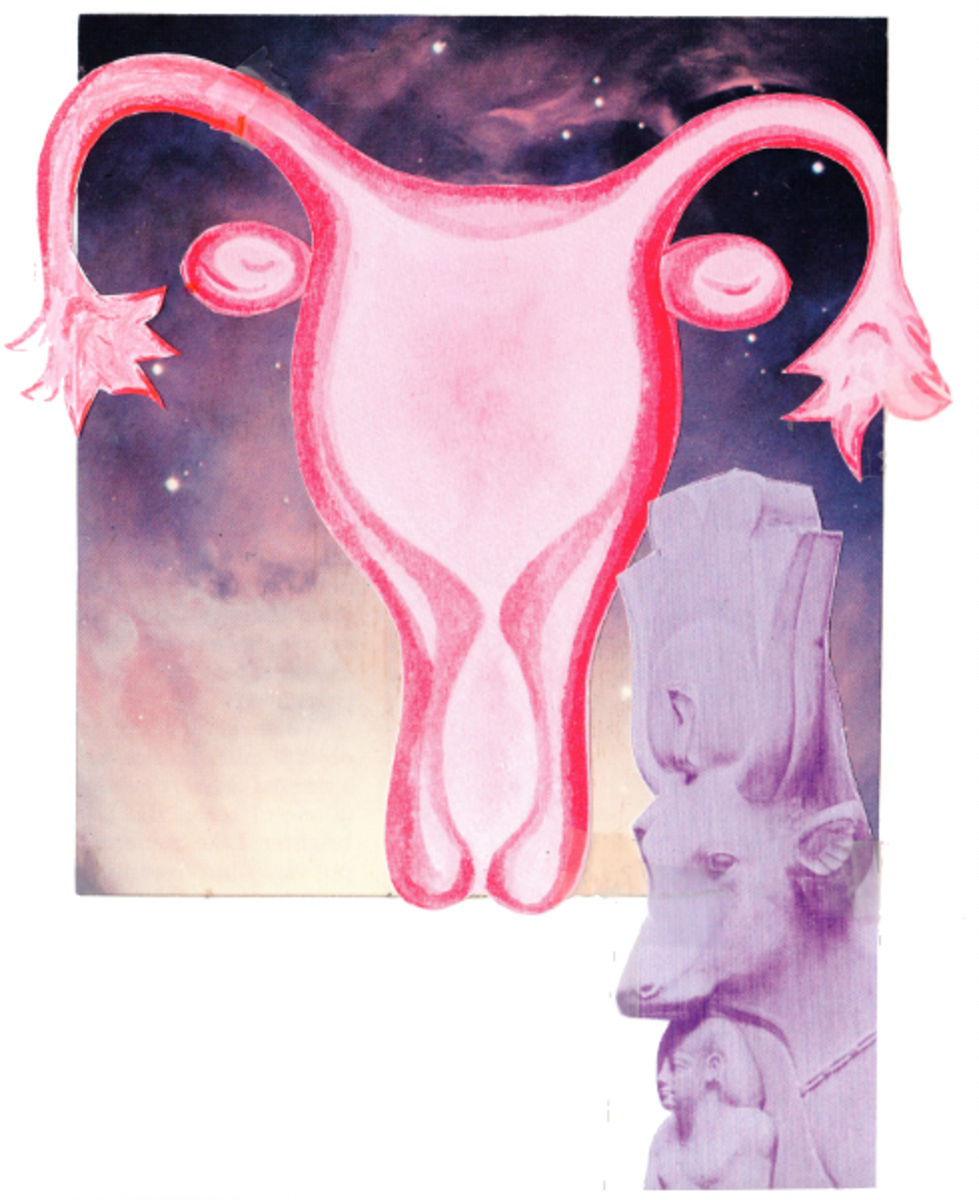
A stylized, Taurus-inspired illustration of the female genitalia,
with the similarly-shaped sculpture of the Egyptian Goddess of Women, Hathor.










Leave a Reply