
Copyright Alan Whitehead & Earthschooling: No Part of this book, post, URL, or book excerpt may be shared with anyone who has not paid for these materials.
Alan speaks in a very symbolic and esoteric manner in some parts of his books. Although they can be read anthroposophically, passages speaking of Atlantis, archangels, gods, etc. do not need to be taken literarily to be meaningful. The more you read, the more you will realize he uses many different religions to express ideas in a symbolic manner and not in a religious manner. His writings are not religious. In some places his writings are meant to refer to religious events in a historical way. In some places he is using religious figures (from Christianity, Judaism, Islam, Buddhism, Hinduism, Paganism, Ancient Roman and Greek Religions, etc.) in a symbolic manner. However, at no point is he promoting a specific religion or speaking from a religious point of view.
I have kept the writing as close to one-hundred percent original so you will also find that he speaks of Australia often and some spelling or manners of speaking may be cultural. Any words I have changed are presented like this: <word>.
Also keep in mind that these books are written by a Waldorf teacher with decades of experience who also studied with a Steiner student himself, so he speaks to an audience that is dedicating their lives to the Waldorf method without exception.
Because of this, all of his views are not reflected in the Earthschooling curriculum and not all of them may be ones you want to embrace or are able to use. In all of Alan Whitehead’s writings the opinions are his own and may not align with Earthschooling or Waldorf Books. In some cases, we will be updating some of these chapters in the future with additional and/or updated information.
Ultimately, however, as I read through these passages I find I can distill wisdom from even those paragraphs that do not resonate with me.
We invite you to read with an open mind and heart and with eagerness to learn and discuss…
PHYSIOGNOMY OF THE EGO
The Ego is an expression of contraction, of the hyperbola – the archetypal human for, think and straight. Many of man’s concave surfaces are hyperbolic, like the wrists and calves. The ego manifests also through the square or cube. Even the skull tends towards the box shape, especially with strong ego fold, like the Germans; uncharitably referred to during the two world wars as “box heads”. This is also the common form of older (more ego-incarnated) rather than younger people, with infants the dominant form being the sphere.
The most elementary Self expression is the limbs, with many ego-dominant people being short – often nuggety cholerics. The epicenter of the limb system, where cosmic egoism enters the material, is the shoulders. These can be an especially revealing feature of ego – or Self – consciousness. A canny schoolteacher can often deliver instant calm to an hysterical child by a “laying on the hands” (also ego organs) on the shoulders, a Self-bracing gesture without peer.
Indeed, the many ways that the limbs move – come in contact with the earth – are ago expressions of one kind or another. An example is the firm tread, as described by Steiner, an indication of a strong incarnation – again often of the choleric. Generically men have a stronger tread than women; hence are more densely incarnated. Men have a dominant ‘body’ combination of ego and physical, with women complementing rather with dominant etheric and astral bodies. The ego, as Steiner assures us, is of course the “dominant body” of the adult choleric temperament. A light tread is obviously the opposite from the heavy, seen more commonly in airy sanguines – like children. The bobbing walk is one of ego self-confidence, as observed in London office workers, who, with bowler hat and umbrella strutting off to work, I their own minds at least are the most important people in the world!
If the limbs are a general mirror of the ego of man, the aforementioned hands are highly particularized. These contain the influences of the seven planets of the soul; the spirit-ego needing to work through the soul-astral to realize its destiny. The palms (like those ‘Sun’ trees themselves) are the center of this hand Solar System; the significance of which can be seen I the stigmata. Here a Sun God was nailed to an earth cross – through the palms! The hands in general, and the palms in particular, are regarded in Esoteric Christianity as the most sacred centers of man. For cane-loving schoolteachers to use the hands as a punishment site, as suffered often by your author as a child, is an obscenity of the first order!
The closed cube of the fist is an indication of the ego forcing out its own holy light; a result of descending, as in pugilism and the Black Panther’s salute, too deeply into matter – into earthly power. Another anti-divine hand gesture is Hitler’s (and todays’ unconscionable Pan-Aryans) rigid palm-down version, an invocation of earth over divine forces.
A sublime vertical ‘sacred’ center, or pathway really, is the spine; its relative condition being an indication of ego health, with permanent stooping, arching, bending, and other impairments denoting ego irregularities of various kinds. This occurs often in very tall people, whose ego forces, in contrast to the earlier mentioned ‘shorties’, are often too extended. As such, giants are considered in tradition as somewhat ego-less, or stupid, while dwarfs are highly conscious and smart. Naturally this generalization is cancelled out by individual destiny, there being many clever tall people in the world – and dumb short ones!
The sacrum, or ‘sacred bone’, at the base of the spine is the center of the lower ego of man. Hence this, like the palms, should never be violated, say with kicking someone in the bum, or other unseemly, sometimes even sexual, assaults. The sacrum is the entry point of all the nerves of the lower limbs, with paralysis being a possible outcome of an injury here.
The Cross of Man, that created by the vertical spine intersected by the horizontal clavicii, has as its center yet again the Sun, home of the heart, of Ego-hood. The state of a person’s Higher Ego – their relationship to The Christ even – can be assessed by observing the perfection (or lack of it) of this cross.
Now to the head: in profile the ego region, as mentioned earlier, is that of the frontal lobe, the forehead in general. Ego-hood is consciousness, and the forehead is the dwelling place of Self-consciousness – so easily extinguished with a couple of snips of the lobotomist’s scissors! The high forehead – known in the vernacular as ‘highbrow’, is an indication of more elevated, especially cultural, consciousness. The simian brow is of course the obverse, the ‘lowbrow’ being rather an indication of weak ego-cultural development. For example, lowbrow literature is – hopefully! – opposite from the kind you’re reading right now!
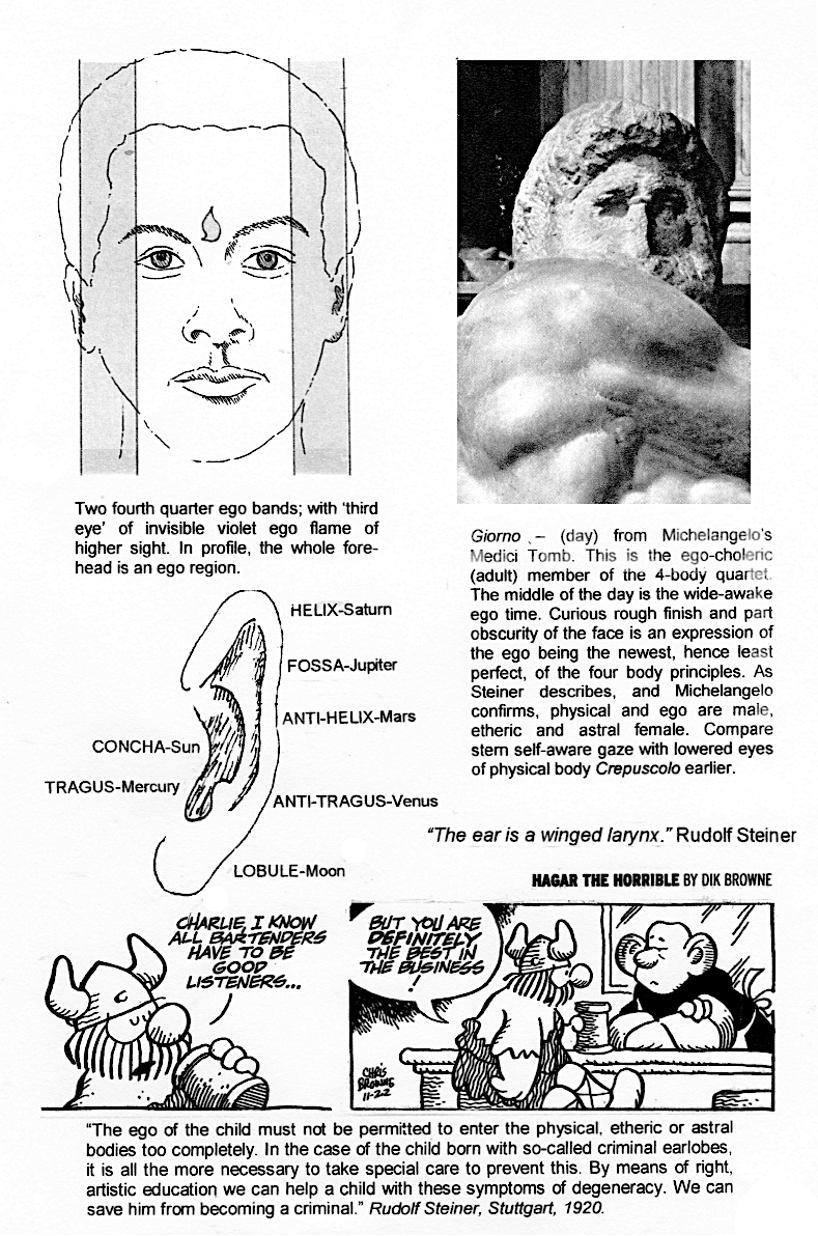
In the frontal view of the face, we find the ego expresses in the two vertical bands of the furth quarter around the temples and ear region. In the temples, man’s incarnational individuality truly dwells.
A blow to the temple, such as highbrow musician David delivered to lowbrow brute-strength Goliath, can dismiss the Self from the earth plane permanently. Indeed, this Old Testament story is an allegory of the in-streaming force of individuality conquering the old instinctive powers of the ego-weak, collective-consciousness ‘giant’.
This event culminated in the incarnation of a god in the form of The Christ, the supreme Ego principle – “of the House of David”.
A well-developed brow in the fourth quarter indicates active moral judgement, with a shiny protrusion giving even greater assurance that the individual is wrestling with the great good-and-evil questions of life. A groove in the same area is rather moral indigence. The ears are the representative organs of the ego (eyes astral, nose etheric, mouth physical). These are a world in themselves, separate little human beings indeed! Peter ‘the rock’ (earthly man) cut off the ear of the soldier, but Christ mercifully replaced it. After all, The Savior came to redeem the ego from the prison of matter, not destroy it! Van Gogh cut off his own ear when his power of individuality became overwhelming; when his struggle wit Self, largely revolving around moral issues, became unendurable. This was a vain attempt to still the silent whisperings of the great visionary’s Higher Self. These enter, not through the physical ear, but just below it, in the region known as Divine Will (self will, another ego area, is the chin). Here, higher worlds speak to the ego of man, guiding him as to their will – “not mine, but Thy will be done” being the guiding maxim for anyone pursuing a spiritual path.
The ego actually finds matter inimical, casting it off wherever possible; after all, this Self is the immortal, purely supersensible component of the human being. This rejection of the material is seen in the concave, hyperbolic (the hyperbola is the curve of subtraction, the ‘giving away’ mathematical principle) region at the side of the forehead. A person with this feature tends to be dismissive of possessions, wealth and the like. It certainly is not the ego in man that makes of him a materialist.
So, to wander round the face finding other ego features: in the eyebrows (and the eyes), the fourth quarter is the ego region. When raised, it is a sign of intelligence; raised even higher, of wisdom even – especially when after the rise, it curves sharply down again – wisdom applied to the world; a common feature I judges and statespersons of high esteem.
The center band of the lower lip is of the ego; protruding too far indicates self-assertion, sucked in, rather self-effacement. The area just below the lip is one, again when protruding, with little or no lip articulation, of ruthlessness. However, it is the fourth quarter of the top lip that is the ego region. Cute little cups, as seen in drawings of small girls in children’s books, are an expression of ‘love me’; or to be more formal, desire for recognition. 18th Century German composers often have this feature. After all, Germany is a strong ego nation; and music is the art of the ego (see David above).
An unpleasant upward curve of the lips, the so-called ‘malicious grin’, often evident in pictures of the Devil (or a secular version, Batman’s Joker) denotes capacity for evil. The normal pleasant smile lift is merely self-assurance, or ego-confidence. So, following the four-body invocations from the Lord’s Prayer for the top of the mouth we have – “Give us this day our daily bread” – center physical body; “forgive us our trespasses” – second quarter etheric body; “lead us not into temptation” – third quarter astral body, and “deliver us from evil” – fourth quarter ego.
The well-known region of the “third eye” is also one of the egos: as Rudolf Steiner so enigmatically described, behind this flickers an invisible violet flame (violet is the nominal ego color – astral blue, etheric yellow, physical red). This ‘ego body’, as he called it, is the center for the cultivation of clairvoyance: it is also the mansion of the 2-petal Jupiter lotus, the Ajna.
Ego forces increase with ego, relentlessly driving out the complementary life or etheric vitality of youth. This is indicated by the wrinkling of age. In the Caucasian especially, a grey pallor in the complexion is evidence of ego-dominance. In fact, greyness generally is a sign of ego approaching the crossing of the threshold to its rightful spiritual home. This goes for grey hair as well, the kind devoid of the color and life of youth. All is not lost, however, as this change can enhance one’s contemplative life.
Eyes, as a subordinate to their natural astrality, express the ego as well. When one focuses on something, there is a crossing, or ego consciousness. The left eye focuses on the right side of the object, the right rather to the left. From the eyes to the optic nerves at the back of the brain there is yet another crossing; righting the first, so to speak. Ego-consciousness can be perceived also in the awareness in a gaze; the confrontational ‘eagle eye’ being evidence of a strong ego, a vague straying of the eyes the opposite. The angle of slant of the eye off the horizontal is an indication of the number of lives the ego has actually experience on earth – how many incarnations.
The high slant up to the outside, as seen in Oriental guardian statues, show few incarnations (if any!); a lower slant, rather more than the – horizontal – average. A red flush on the fourth quarter of the cheek is evidence, as Steiner indicated, of an ego in shame; if white, of its antonym, fear.
Ego is often characterized by straightness, as in an upright posture. Grey eyes are an expression of ego dominance of soul, especially in relation to temperament. In a child, this is the melancholic, in the adult the choleric. The teeth, due to their mineral nature, are ego accessories. Those that are specifically of the ego are, aptly, the cube-shaped molars. The last of these, the so-called ‘wisdom (an ego faculty) teeth’, arrive with the newly emerging individualized Self at around the 21st year.
The vertical temple line is one responsive to the musical man; as mentioned, music is the “art of the ego”. In the lower third, the area of sentient soul, this expresses as musical appreciation, aptly of the senses. The rational soul second horizontal band of the temple line is the mark of the musical performer, one with the talent to rationalized (as in reading) music. Finally, the highest region of the temple line, in the area of consciousness soul, is one of music creativity, of composition – a center where the Music of the Spheres – the ‘will’ of the music itself – resounds.
The smile lines of the mouth, so prominent in good ol’ Alfred A. Newman, of Mad comics fame, are those of goodwill, a positive ego quality. If these are straight, they are known as the ‘bulldog lines’ of tenacity – the longer and more deeply incised, the more tenacious.
So, with Alfred above, it seems that we not only look to classical art for physiognomic enlightenment, but to the world of contemporary art as well, even (or especially) that of cartoonists. So old and new can be superb physiognomists, with both enshrining eternal verities in pictures rather than words. Here the influence is in the realm of the sub-rather than the normal conscious. The task of Spiritual Science is to unveil (like so many before it) this precious body of knowledge, but to make it accessible to the superconscious; to make it a meditative tool even – or as Rudolf Steiner described it in Helsingfors in 1912:
“When a mind trained to the second stage of clairvoyance takes in the physiognomy, gestures, and expressions of a person, this stimulates ideas that will gradually train it to observe the spirits of the third category in the Second Hierarchy. Here we take the facial expressions, physiognomy, and gestures of a person as gateways to a living experience of their inner soul life.”
This is no doubt what Leonardo da Vinci did when confronted by the task of representing Christ and Judas, in The Last Supper. But first an amusing – apocryphal – aside: when Leonard was irked by his benefactor’s complaints that he was taking too long to finish his great mural, he said – “I seem to have The Savior okay, but I’m having trouble with the face of Judas. It would go faster if you let me use you as a model.” – “Um, take all the time you need!!”
Whether the great man used his backpedaling benefactor or not is a moot point; however, his final solution was one of not only artistic brilliance, but profound spiritual insight as well. As every artist knows, if you place a circle in a picture, it becomes an instant focal point. This is aided by the fact that the circle is the form of the eye itself. If you place two circles, the larger one does likewise, with the eye then traveling instinctively to the second. In this way the viewer’s gaze can be led around an entire work by the judicious positioning of circles, part-circles, or similar forms.
The psychological problem for Judas was that he was torn between loyalty to Christ, and to the Establishment – a conflict between divine will and earth will, in fact! The archetypal form of the will is of course the circle. Leonard solved this dilemma by placing two equal circles on Juda’s jaw, or will line, one in the area of divine will under the ear, and the other on that of self-will on the chin – and both on the same horizontal plane! (see following).

So, not only Judas’s quandary is subliminally expressed through form and composition, but the viewer also is put in a similar (subconscious) emotionally conflicting state, the eye being unable to decide which circle to look at first, to choose between divine and self-will. Pure Genius!
Other accurate (negative – compare Christ on cover) aspects of Judas include conspiratorial nose droop then suppressed feeling lips; low fourth quarter anti-wisdom eyebrow; dominant lower brow sentient soul; bulging ruthless lower lip; obsession with evil inverted V over nostril; collapsed lower eye pouches depraved speech; no eyebrows lack of culture; short nose-top lip area lack of self-reliance; haggard cheeks depleted life forces; long nose judgmental; concave over eye hatred of world.
To physiognomists, the ear, Organ of the Ego, is the holy of holies.
Indeed, a whole Solar (Sun) System is embodied in this seemingly diminutive head ‘attachment’, to resort to e-jargon. While sitting on a bus, it is, more than any other feature, the auricles of my fellow passengers I tend to be interested in – and in this planetary element especially. ‘Auricles’? This is the technical term for the external, visible ear. The word means ‘sound’, as in audio, aural, etc. It is also akin to aurum, Latin meaning ‘gold’, the chemical formula being Au.
Gold is of course the Sun metal, and the Sun is the home of the Ego.
But so is Planet Earth, the only realm in the universe where this immortal aspect of man could find a material expression on its long quest to freedom. Hence the word ear is really a diminutive of ‘earth’ (the ‘th’ suffix being a Scorpio incarnational factor). So we have two little ear-ths growing from the side of our head!
But what of ‘sound’, meaning not only what can be heard, but of general wellbeing, as in a sound mind? Music and speech, the two highest aspects of hearing, are ‘sound’ indeed, in every sense of the word. Music is the art of the ego, with The Word dwelling in the mansion of St. John, the ego gospel. As a Solar System phenomenon, it is no surprise that the human auricle has seven distinct components, each related to one of the seven astrological planets.
The Sun, around which the other six ‘planets’ orbit, is represented by the concha (‘shell’), the central cave of the ear itself. The ridge around the top of the ear, the helix (‘spiral’), is the outer-most planetary orbit, thus related to Saturn. The concave area just below the helix is the fossa (‘a dig’, one in which fossils are found). This is the area of Jupiter expression. Close to the concha-Sun, the ridge surrounding it, in fact, is the anti-helix – aptly of Mars!
Crossing to the three inner planets we have Venus nestling close to the Sun, as she does in the sky in the modern dispensation as ‘Occult Venus’. Her feature is called the anti-tragus (tragus meaning ‘goat’).
Hence Mars and Venus can, once again, be seen as a complementary pair. The flat area below this (see drawing for all seven to follow) is the tragus, that of Mercury. Mercury and Jupiter are also complements. Finally, we have the crescent-shaped Moon area, the lobule; the earlobe in common parlance. This is the part of the auricle, like the Moon, nearest to the earth (Saturn-helix being furthest away, hence Saturn and Moon are also complements).
Not only can the ear be seen as a mini–Solar System, but as a picture of the heart (Sun) surrounded by the six nominal planetary organs: Saturn-helix spleen; Jupiter-fossa liver; Mars-anti-helix gall; Venus-anti-tragus kidneys; Mercury-tragus lungs; Moon-lobule brain.
In fact, the whole hearing system is seven-fold, this time relating to seven-fold man. These are not physiognomic as such, as most are concealed within the head, but for the record they are: auricle physical body; tympanum (ear drum) ether body; semi-circular canals astral body; hammer, anvil, stirrups (stapes) ego; round and oval windows – spirit self; cochlea life spirit; auditory nerves spirit man.
In the horizontal 3-fold division of the ear, the lobule is the area of will in hearing; the center is feeling in hearing, and the top third – the pinna (‘wing’) – is thinking in hearing. The wider these three sections are, the more emphatic the three representative soul forces.
Many Buddha statues contain will in hearing; curiously an earth-related faculty; though in his case it is a listening to divine earth-will.
In the same vein, a long center ear is divine love, and a long top divine Word. The Enlightened One’s whole ear length is often depicted as inordinately long (like Easter Island statues). This is an indication of listening to the silent whisperings of the past – short ears, uncharitably known as ‘philistine ears’, belonging rather to ‘present’ listeners.
So we see that the seven planetary components of the ear, these Songs of the Soul, are indeed a worldly expression of the Music of the Spheres. No surprise then that the ear is not only the most profound physiognomic feature, but also the most complex; hence only a few broad indications can be provided.
Backward slanting ears, ideally at twenty-three and a half degrees off the vertical, like Steiner’s are related to divine inspiration: forward slanting rather inspired by the affairs of the world. The sculpture of the ear in general is related to orientation: experiments where the entire ear is waxed over to a smooth surface (from form-etheric to surface-astral) result in the owner having no idea from where a sound emanates.
In broad terms the four shapes, round, triangular, s-curved, and square ears, relate respectively to an emphasis in hearing the physical (beat), etheric (rhythm), astral (melody) and ego (harmony) voices of both heaven and earth. A sharply tensioned ear is one of alertness (like a squirrel); hence one where the tissue is soft and indistinct (like a spaniel) is rather auditory indifference.
Ears set far back on the head suggest intelligence in hearing; those set forward rather artistic listening. High-set ears are an indication of a Luciferic auditory emphasis, low set of course being Ahrimanic. The first relates to the listening of ideas (ideals even), the latter to action or deeds. When the helix slants down, we have a listening to the earth, when the lobe folds upward, a heeding rather to the voice of the Spirit.
The ear lobe that joins the neck with no separation is known as the ‘criminal ear’. Steiner’s comments help clear up this potential slander.
He said that, as was so often observed at the time, many criminals did have this type of ear, indicating a deficit in them oral bank account.
However, the owner still had the choice, freedom indeed, to express this is a destructive way or not. In short, even though many criminals had joined lobes, not all people with joined lobes were criminals. In the best light, this feature is a sign of contempt for convention. The lobe that is simply truncated, as if snipped off with a pair of secateurs, indicates frustrated will.
There are three basic concha forms, related to the three soul forces of will, feeling, and thought. A round – will – concha denotes a propensity to nature listening (common in indigenous people); a harp-like – feeling – concha a capacity to hear the higher, more complex configurations of music; and the square – thinking – shape provides the same for speech, especially of the artistic or poetic persuasion.
A small ear hole is hypersensitivity to sound (like the small pupil in the eye, a hypersensitivity to light, of both the physical and psychic).
This is found, for instance, in people who can’t endue the barking of dogs (like your author!). An overly large ear hole is an equivalent aural insensitivity; found often in people who don’t mind living next to a highway! Small and large conchas are extensions of small and large earholes, the emphasis being more metaphysical than material sensitivity. A shiny ear (in various areas) is conscious hearing: ballet dancers often have this, as every movement must correlate to the music. Dull or blemished tissue is of course the opposite; they don’t even hear the first cuckoo of Spring. And speaking of Spring; the horizontal axis, the latitude of the ear, relates to more worldly aspects of hearing, the vertical – longitude – to the supersensible.
Architecture is, as Rudolf Steiner informs us, the art of the physical body, sculpture the etheric, painting the astral, and of course music is the art of the ego.
Therefore, it is axiomatic that the physical body mouth, including the beautifully domed palate, is the work of the Cosmic Architect, the etheric nose one rather of the great Sculptor in the Sky, and every eye can be seen as a delicate painting of the Astral Creation Gods.
How sublime then to think of every human ear as a divinely-inspired song – in stereo: a carnal manifestation of the seven-planet Music of the Spheres indeed! Inf act every single physiognomic feature bears the handiwork of the Divine, which is why all human countenances are not merely faces, but Sacred Faces.
“Architecture, sculpture and painting are related to Saturn, Sun and Moon, but music is the real art of our Earth evolution.” Rudolf Steiner, 1914
“The death of an old person is like the burning of a library.” Old African saying.
FROM: Sacred Faces: A Study of the Human Being in Light of Steiner’s Spiritual Science
Four Kingdoms Companion volume to: Sacred Places Minerals & Land; Sacred Fauna Botany; Sacred Fauna Zoology
Important Earthschooling Notes
Copyright Alan Whitehead & Earthschooling: No Part of this book, post, URL, or book excerpt may be shared with anyone who has not paid for these materials.
Alan speaks in a very symbolic and esoteric manner in some parts of his books. Although they can be read anthroposophically, passages speaking of Atlantis, archangels, gods, etc. do not need to be taken literarily to be meaningful. The more you read, the more you will realize he uses many different religions to express ideas in a symbolic manner and not in a religious manner. His writings are not religious. In some places his writings are meant to refer to religious events in a historical way. In some places he is using religious figures (from Christianity, Judaism, Islam, Buddhism, Hinduism, Paganism, Ancient Roman and Greek Religions, etc.) in a symbolic manner. However, at no point is he promoting a specific religion or speaking from a religious point of view.
I have kept the writing as close to one-hundred percent original so you will also find that he speaks of Australia often and some spelling or manners of speaking may be cultural. Any words I have changed are presented like this: <word>.
Also keep in mind that these books are written by a Waldorf teacher with decades of experience who also studied with a Steiner student himself, so he speaks to an audience that is dedicating their lives to the Waldorf method without exception.
Because of this, all of his views are not reflected in the Earthschooling curriculum and not all of them may be ones you want to embrace or are able to use. In all of Alan Whitehead’s writings the opinions are his own and may not align with Earthschooling or Waldorf Books. In some cases, we will be updating some of these chapters in the future with additional and/or updated information.
Ultimately, however, as I read through these passages I find I can distill wisdom from even those paragraphs that do not resonate with me.
We invite you to read with an open mind and heart and with eagerness to learn and discuss.
END NOTE
Alan has presented dialogue in his writings in an expressive form, where he tries to capture the accent of the person he was with to give his writing more authenticity and to allow the reader to “be with him” in his experience. In no place in his writings is he using expressive language to make fun of or demean the speaker. So, as a person with a linguistics and anthropology degree I find this enriching and informative to me as the reader. Thus, we have made the decision to leave all expressive writing in its original form.










Your article offers a profound exploration of physiognomy, delving into how facial features reflect the ego’s manifestation. The discussion on the interplay between the left and right eye in ego consciousness is particularly enlightening. Your insights into the spiritual dimensions of facial characteristics provide a unique perspective on self-awareness. The integration of Rudolf Steiner’s teachings enriches the narrative, making it a valuable read for those interested in the spiritual aspects of physiognomy.
Thank you for your feedback and insight. I adore Alan Whitehead’s work! He is so insightful! We were honored to purchase rights to his work and help it continue into a new era.