
Copyright Alan Whitehead & Earthschooling: No Part of this book, post, URL, or book excerpt may be shared with anyone who has not paid for these materials.
Alan speaks in a very symbolic and esoteric manner in some parts of his books. Although they can be read anthroposophically, passages speaking of Atlantis, archangels, gods, etc. do not need to be taken literarily to be meaningful. The more you read, the more you will realize he uses many different religions to express ideas in a symbolic manner and not in a religious manner. His writings are not religious. In some places his writings are meant to refer to religious events in a historical way. In some places he is using religious figures (from Christianity, Judaism, Islam, Buddhism, Hinduism, Paganism, Ancient Roman and Greek Religions, etc.) in a symbolic manner. However, at no point is he promoting a specific religion or speaking from a religious point of view.
I have kept the writing as close to one-hundred percent original so you will also find that he speaks of Australia often and some spelling or manners of speaking may be cultural. Any words I have changed are presented like this: <word>.
Also keep in mind that these books are written by a Waldorf teacher with decades of experience who also studied with a Steiner student himself, so he speaks to an audience that is dedicating their lives to the Waldorf method without exception.
Because of this, all of his views are not reflected in the Earthschooling curriculum and not all of them may be ones you want to embrace or are able to use. In all of Alan Whitehead’s writings the opinions are his own and may not align with Earthschooling or Waldorf Books. In some cases, we will be updating some of these chapters in the future with additional and/or updated information.
Ultimately, however, as I read through these passages I find I can distill wisdom from even those paragraphs that do not resonate with me.
We invite you to read with an open mind and heart and with eagerness to learn and discuss…
WHOLE-BODY PHYSIOGNOMY
It’s strange how conventional Christianity is so often in denial about its occult background, such as the timeless image of the tetramorph. For instance, throughout the 2000-year history of Christianity, the eagle, winged bull, winged lion, and winged man, have been highly visible symbols of the four gospels; John, Luke, Mark, and Matthew respectively. However, this four-fold Mystery, one that expresses the four ‘bodies’ of man, ego, astral, etheric, and physical, again in the same order, actually predates Christianity by millennia. Here, in just one instance, we see it related, exactly, to the four cardinal quadrants of the Zodiac. The St. Matthew impulse expresses through Aquarius, The Waterbearer; Luke is of course the Bull of Taurus; Mark the Lion of Leo – and John?
Well, we have to do a bit of sleuthing for this one. The Scorpion of Scorpio is a relatively modern symbol. In former times this enigmatic sign was represented by the eagle, or Aquila as it was called. Also, the Winged Man of Matthew may seem at first somewhat removed from The Waterbearer; after all, he hasn’t got wings. The drawings of him in women’s magazines may not, but in the spiritual reality, that which descends to enrich our esoteric treasure trove of myth and legend, The Waterbearer is certainly winged. In the Greek portrayal of the Zodiac, he is the beauteous Ganymede, a Trojan 14-year-old. Being a mere mortal, but reputedly the owner of the most perfect physical body on earth (both Matthew and Aquarius represent the physical body), Ganymede originally didn’t have wings; that is before the comely lad was sotted by the amorous Zeus, who abducted him in the form of a heavenly eagle; the quintessential ‘wings’ of the cosmos.
In his new heavenly home on Mount Olympus, the recherche Ganymede became the ‘cupbearer of the gods’. Here he solicitously served the lofty assembly their ambrosia in this new immortal role.
In short, the spiritualized – winged – physical body is ultimately destined to serve the Divine. This eagle element indicated the presence of the ego ‘living in’ (as Rudolf Steiner explains) the physical body; a profound Mystery symbolized by the square in the circle, the Tomb of Adam.
How similar this is to the human blood, which has the same occult symbol. The square represents the blood salt; that which crystallizes in the cubic (square) form. The circle is rather the blood warmth. Earth-dwelling salt is the ego element, warmth that of the physical body – the same as created on Ancient Saturn as a globe of heat. We see this esoteric truth embodied in sacred art; the square-in-circle is very clear in Leonardo’s Vitruvius Man. And this great initiate should know; as in his age he was the Grand Master of the Priory of Sion; one of the most well-informed of occult brotherhoods.
So the Physical Body Mystery was no stranger to the sagacious Leonardo, nor to his thorny contemporary, Michelangelo. His sculpture of the representative of the physical body in the Medici tomb, Crepuscolo(evening), has a round head surmounting a square-formed body. (The other three are Notte night, the astral body, Aurora morning, etheric body, and Giorno day, the ego; see pictures in following chapters.) But it is the blood, or vascular system, that is of special interest in these physical body deliberations.
The Waterbearer traditionally holds a vase (as in vascular!), an enigmatic image of the relationship of Aquarius with the blood. In the 12-fold zodiacal evolution of the animal world through the 23 phyla (‘tribes’), the lowly mollusks express primarily through Aquarius. How apt, as the mollusk (meaning muscle, or blood-bearing soft tissue) is the very first animal with a muscular, hence vascular, system. The seashells, octapodes, etc., are therefore the first animals with true blood; though in this primitive form, cold blood only. The Sense of Warmth, that ascribed by Steiner to Aquarius, is highly discriminating, with some seashells on the coral reefs actually dying if there is only a one-degree movement in water temperature – sense of warmth indeed! And the body region of The Waterbearer? The calf, that most definitive of muscles.
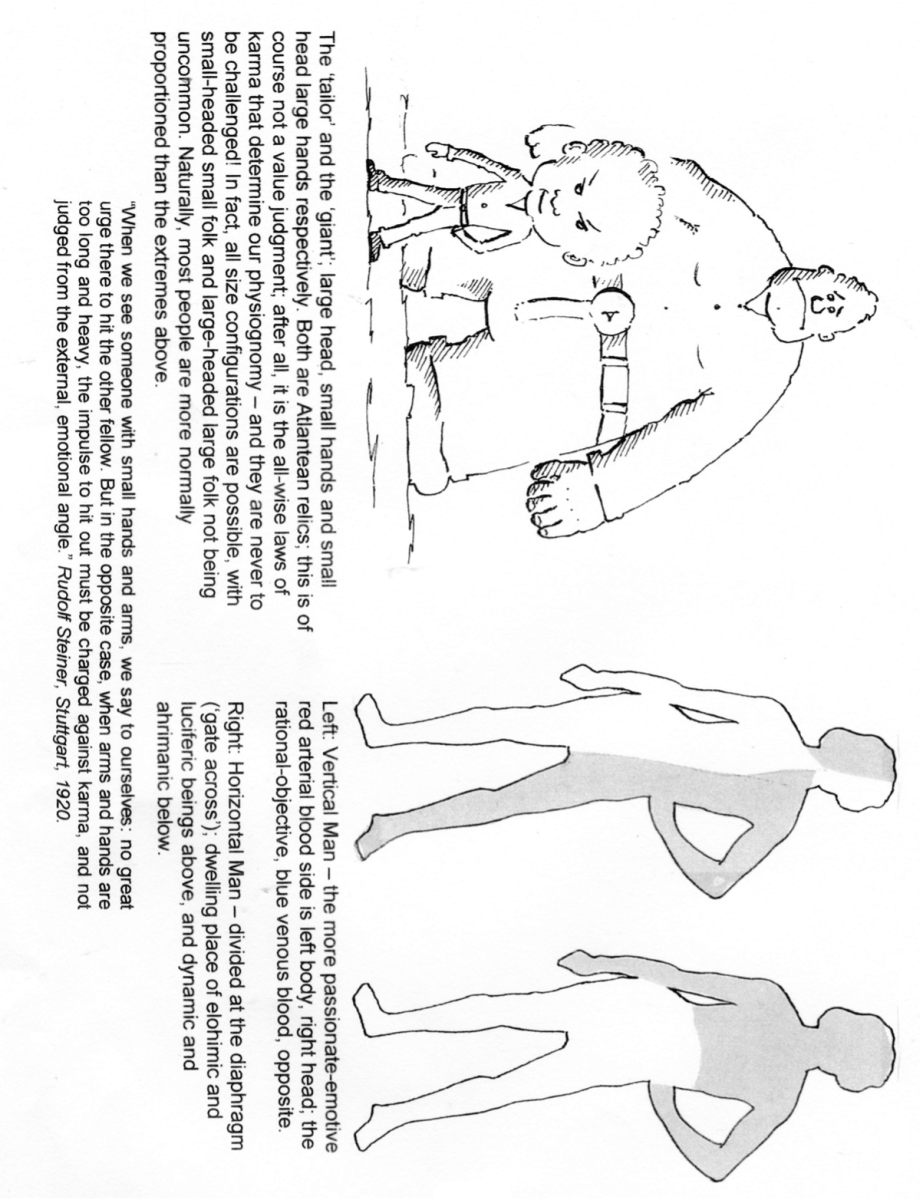
How astonishing it is that the ancient art of physiognomy is still alive (if not well!) in this age of skepticism. The very first things one notices about a person is the same for police eyewitnesses as for beginner physiognomists; the size of a person. Initially this is restricted to a simple comparison between small and large; the former nominally having a more ‘clever little tailor’ intellect, to borrow from the usually accurate fairytale imagery; the latter, the ‘giant’, is, alas, more often ‘cognitively challenged’!
Generically speaking, smaller folk, especially those with large heads and small hands, can certainly ‘stitch up’, conceptually at least, their larger peers with the small heads and beefy hands.
This parallel actually has its origin way back in Ancient Atlantis, a land of essentially three kinds of people, designated by their stature.
These were the Divine Messengers, of relatively normal size; they were the great teachers of mankind, like Noah. Then there were the Dwarfs, who later became the mass of post-Atleantean humanity; and finally, the Giants, beings who, to a large degree, died out. Very large, often somewhat vacant, people today are a relic of these Nephilim, as they’re called in Genesis; the word meaning ‘cloud beings’ (from Atlantis, Land of Mists). These biblical giants, also known as the Sons of Anak, tended to remain where they were, slowly drowning in the mist-shrouded, sinking continent.
Meanwhile, the clever dwarfs made their migratory escape!
Indeed, groups of little people even today are a direct reflection of their Atlantean origins, like the Japanese; or those astute though miniscule ‘Gnomes of Zurich’, they who hold the reins of world finance in their tiny, clever hands Their ancestors abandoned the misty continent, one which gave rise to a kind of indefinite, auric clairvoyance, for the clear skies of Post-Diluvia, both eat and west; one where the clarity of the outer rainbow was beheld; as the Noah story so poignantly attests. As well as big and little people – and those of normal stature of course, there are the left and right; a dichotomy everyone shares – but not in the same proportions, physically at least. Some people have a ‘right’ emphasis, a venous blue blood expression, while other are left dominant; governed, in the first instance at least, by the redder arterial blood system. The latter are more imbued with life rather than logic, with intuition rather than intellect. Of course, this Yin Yang man – in the same order – is opposite in the head, the right brain being the more willful, artistic, feminine side. The balanced individual will of course seek to live in the clear light of the center.
As well, there is a two-people realty on the vertical axis, with the diaphragm, meaning ‘gate across’, being the division of upper and lower man. Dwelling in the head and chest, we find an uneasy alliance of, as Rudolf Steiner tells us, Lucifer and the Elohim, the Spirits of Form.
It is the Elohim that contain or restrain the inspirational, idealistic, off-earth impulses of their co-denizens, the Luciferic beings.
Below the diaphragm, however, in the metabolic/limb system, the Ahrimanic hosts swell side-by-side with another lofty set of spirits from the Second Hierarchy, the Dynamis, Spirits of Motion.
The Dynamis liberate into movement the sclerotic, formative forces of the Dark Prince. Yet again the central or heart region sits as guardian between the opposing camps of Elohim/Lucifer and Dynamis/Ahriman; promising freedom from the retarding potential of both (Lucifer and Ahriman, that is).
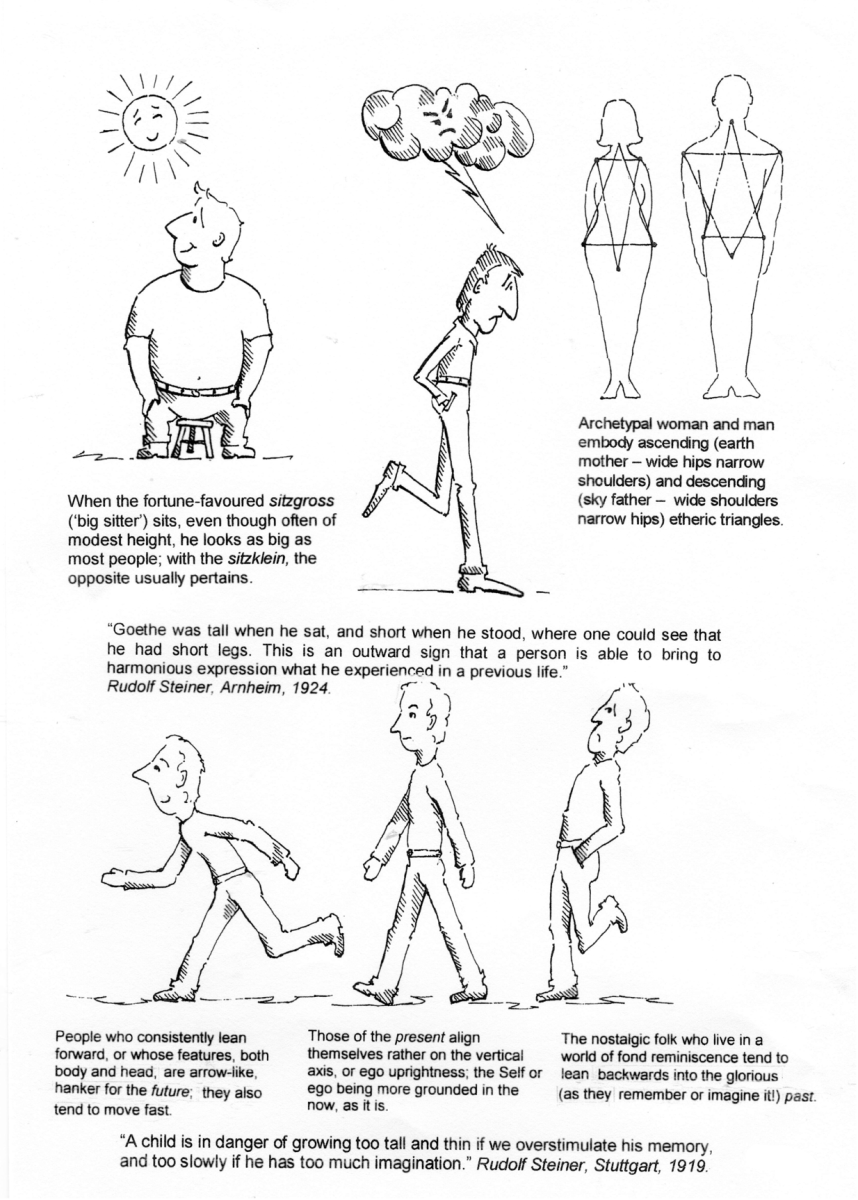
There is another aspect to this upper and lower division, one differentiated by men and women. The latter are generally structured according to the principle of the ascending triangle: they (along with some men) are, not to appear uncharitable, somewhat ‘pear-shaped’.
In short, they have large hips and narrow shoulders: this expresses a primal earth will or Mother Earth principle. Men are rather descending triangles, with wide shoulders and narrow hips, expressing, not earth will, but divine will, the Sky Father. In occult lore this ascending-descending will partnership is often symbolized by the Mystery of the Palm and Pine; due to these two trees, on tropical and other temperate, being manifestation of divine and earth will respectively. See details later in Etheric Body Physiognomy.
Then there’s the sitzgross. Steiner gives, as an example of this vertical man, the great Goethe, a person with a large boy and short legs. These people tend to have a harmonious incarnation; no doubt earned by many goods works in previous lives. Alas for the short body, lanky-legged folk – one often only has to be in their company for a short time to unwittingly share in their ill luck!
The four elements also play into physiognomy. Take the mineral: people with this dominance are often blocky, stocky – or if not, they are tall and thin, with contracted, hyperbolic, often stiff limbs. ‘Water people’ are rather curved; tending even to plumpness – and they often perspire a lot; or generally exude more liquid than the others.
‘Air’ folk have forms that are wedge-like, triangular; hence they are natural movers, often athletic. Finally, the ‘fire’ physiognomy; this comprises round forms, but firm and muscular, unlike the pudgier ‘waters. They too love activity, or rather productivity, which hopefully burns up the fire in a positive or constructive way.
This four-fold Elements Man is naturally connected to the four temperaments; in the same order; mineral-melancholic; water-phlegmatic; air-sanguine; fire-choleric.
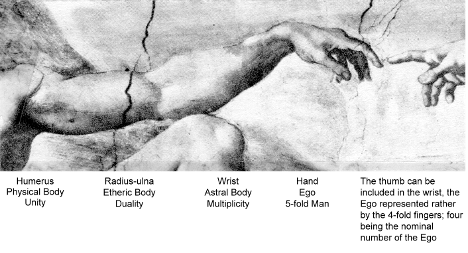
But there is yet another four-fold man; this is found in his horizontal axis, seen especially in the outstretched arms. From the center we have the unity principle in the upper arm (humerus) physical body; the dualityforearm (ulna-radius) ether body; the multiplicity wrist astral body; and fourthly the 5-fold hand (the number of man) ego.
As well as this four-fold division, there is the well-known three-fold ordering of man into head-thinking, chest-feeling, and abdomen-will. However, there is also the lesser-known three-fold man that expresses through the profile of the body. Our past is in the back; our present is the side (or center); and our future is forward, the front of the human being. This is also an image of the three degrees of consciousness, with, in the same order, the unconscious, the sub-conscious and the conscious.
And while on numbers, there are the Seven Aspects of the Physical Body. The first is that it occupies space; secondly, in its pure form at least, it expresses as redness. Thirdly it contains the laws of structure; after all, as Steiner informs us, architecture is the art of the physical body. Then there is warmth and following that is expansion – or ‘push’ to put it in intimate terms: the physical body male partner pushes in the sex act, the more etheric woman rather ‘sucks’.
Hence the sixth aspect is maleness. Finally, we have the seventh, the enigmatic will – with will, physical body and fire being synonymous terms. So, whenever we see one or other of these seven aspects manifest, we know that a physical body principle is present.
The physical body is largely an unconscious organ, like the mineral, really. It expands its forces during the day in support of the higher entities, the etheric, astral and ego. By day’s end, it is – or should be – tired. In sleep it is renewed to gather strength for the new day to come. Curiously, some people, not matter the energy expended during the day, require less sleep than others. Why is this so? Rudolf Steiner describes (Dornach, May 1924) that it is an outcome of how attentive one was to life in the last incarnation: a physical reflection of this can be found in the proportions of the thorax:
“Those who have the long lower trunk, and the short upper truck are of a type showing from the outset that they need a great deal of sleep. With the other type, who have a short lower trunk and a long upper trunk, this is not so, they do not need so much sleep … When you meet a man who is a sleepy head, then this is to be traced to a dull life in the previous incarnation. A man who is not a sleepy head has not been dull, but attentive; he has been active with his mind and his feeling.” Steiner, of course, only slept about three hours a night!
And on a more psychic level in relation to engagement in life in a previous incarnation:
“And now let us think of cowards, of faint-hearted men. They took no interest in anything during the previous earthly life. This is because a detached, inattentive character forms few links with its environment. The bones remain undeveloped, and the hair grows slowly. Whereas those who interested themselves intensely in life, and poked their noses into everything, have loose straggly hair in this life. Very often the person who remained disinterested in the last life has bowlegs or knock-knees.”
In relation to the seriousness of life across the incarnations, Rudolf Steiner says we can look at the type of ‘laugh life’ a person leads; again, there are two extremes, the sourpuss and the habitually jocose.
“A man who has a trait of gravity in his life, even if he can laugh too, has strong, steady forces working out of his previous incarnation … On the other hand, a man becomes an incessant chatterbox, laughing even when he is talking of the gravest matters, when past earthly lives – in which he has lived half asleep – are not working in him.” And in an allied field – “A man who ponders much in one incarnation, in the next will be a thin, delicately made man. A man who ponders little in one earthly life, but is more concerned with grasping the outer world, tends tin the next life to accumulate a good deal of fat, with soft, delicate flesh.”
FROM: Sacred Faces: A Study of the Human Being in Light of Steiner’s Spiritual Science
Four Kingdoms Companion volume to: Sacred Places Minerals & Land; Sacred Fauna Botany; Sacred Fauna Zoology
Important Earthschooling Notes
Copyright Alan Whitehead & Earthschooling: No Part of this book, post, URL, or book excerpt may be shared with anyone who has not paid for these materials.
Alan speaks in a very symbolic and esoteric manner in some parts of his books. Although they can be read anthroposophically, passages speaking of Atlantis, archangels, gods, etc. do not need to be taken literarily to be meaningful. The more you read, the more you will realize he uses many different religions to express ideas in a symbolic manner and not in a religious manner. His writings are not religious. In some places his writings are meant to refer to religious events in a historical way. In some places he is using religious figures (from Christianity, Judaism, Islam, Buddhism, Hinduism, Paganism, Ancient Roman and Greek Religions, etc.) in a symbolic manner. However, at no point is he promoting a specific religion or speaking from a religious point of view.
I have kept the writing as close to one-hundred percent original so you will also find that he speaks of Australia often and some spelling or manners of speaking may be cultural. Any words I have changed are presented like this: <word>.
Also keep in mind that these books are written by a Waldorf teacher with decades of experience who also studied with a Steiner student himself, so he speaks to an audience that is dedicating their lives to the Waldorf method without exception.
Because of this, all of his views are not reflected in the Earthschooling curriculum and not all of them may be ones you want to embrace or are able to use. In all of Alan Whitehead’s writings the opinions are his own and may not align with Earthschooling or Waldorf Books. In some cases, we will be updating some of these chapters in the future with additional and/or updated information.
Ultimately, however, as I read through these passages I find I can distill wisdom from even those paragraphs that do not resonate with me.
We invite you to read with an open mind and heart and with eagerness to learn and discuss.
END NOTE
Alan has presented dialogue in his writings in an expressive form, where he tries to capture the accent of the person he was with to give his writing more authenticity and to allow the reader to “be with him” in his experience. In no place in his writings is he using expressive language to make fun of or demean the speaker. So, as a person with a linguistics and anthropology degree I find this enriching and informative to me as the reader. Thus, we have made the decision to leave all expressive writing in its original form.









Leave a Reply