
Copyright Alan Whitehead & Earthschooling: No Part of this book, post, URL, or book excerpt may be shared with anyone who has not paid for these materials.
Alan speaks in a very symbolic and esoteric manner in some parts of his books. Although they can be read anthroposophically, passages speaking of Atlantis, archangels, gods, etc. do not need to be taken literarily to be meaningful. The more you read, the more you will realize he uses many different religions to express ideas in a symbolic manner and not in a religious manner. His writings are not religious. In some places his writings are meant to refer to religious events in a historical way. In some places he is using religious figures (from Christianity, Judaism, Islam, Buddhism, Hinduism, Paganism, Ancient Roman and Greek Religions, etc.) in a symbolic manner. However, at no point is he promoting a specific religion or speaking from a religious point of view.
I have kept the writing as close to one-hundred percent original so you will also find that he speaks of Australia often and some spelling or manners of speaking may be cultural. Any words I have changed are presented like this: <word>.
Also keep in mind that these books are written by a Waldorf teacher with decades of experience who also studied with a Steiner student himself, so he speaks to an audience that is dedicating their lives to the Waldorf method without exception.
Because of this, all of his views are not reflected in the Earthschooling curriculum and not all of them may be ones you want to embrace or are able to use. In all of Alan Whitehead’s writings the opinions are his own and may not align with Earthschooling or Waldorf Books. In some cases, we will be updating some of these chapters in the future with additional and/or updated information.
Ultimately, however, as I read through these passages I find I can distill wisdom from even those paragraphs that do not resonate with me.
We invite you to read with an open mind and heart and with eagerness to learn and discuss…
LAND OF MONSTERS!!
Australia’s Apocryphal Animals
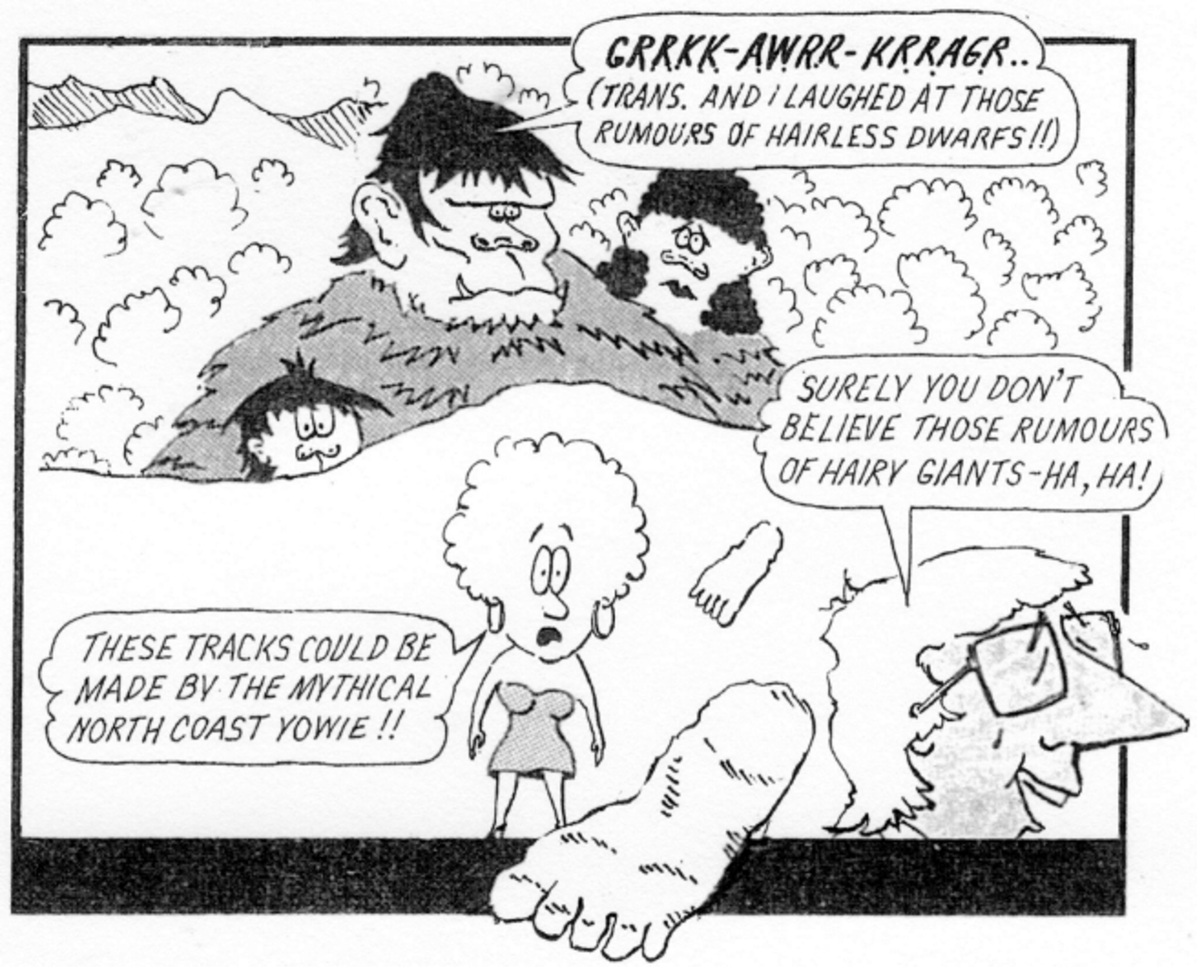
This headline reminds me of a TV show I saw a few years back: in a happy snap taken on ta NSW bush picnic, not only the holiday-makers’ familiar faces smiled back at the lens; but from behind them, a huge Yowie was accidentally caught peering from the shrubbery!
Australia is a mysterious land; the last discovered, the least uncovered – by its white immigrants at least. The Yowie (an aboriginal word) is our version of the Abominable Snowman, the Yeti, and other apocryphal half-human, half-simian creatures that/who, over the centuries, have left their Bigfoot-prints over at least three continents.
In Tasmania in 1998 another ‘monster’ made a brief appearance to confound the experts and excite the fabulists. A 5-meter ‘hairy lump of blubber’ was found washed up (not necessarily, see later) on a remote, windswept beach on the west coast of the Apple Isle.
Either I have an acute news memory, or a morbid fascination for the bizarre; because this story is an exact re-run of one that tantalized the nation’s imagination in 1962 – same place, same monster, 36 years earlier! I was puzzled by the obvious ambiguities then (as a 21-year-old); but I was downright suspicious in 1998. I was especially bewildered by the fact that the 1962 experts informed us that, due to advanced putrefaction of the huge corpse in the time it took them to get to it, no identification was possible. They were obviously in no hurry, as it wasn’t that far away. “It’s probably just a lump of whale blubber” we were gratuitously told. Hairy whales? A large carcass, even allowing for advanced corruption, takes months to render down to the unidentifiable. I was also disappointed that the story died so suddenly, without resolution or even intelligent speculation.
Zoologists know their animals, so it would take barely a glance – irrespective of the degree of rot – to tell the difference between the remains of a giant squid, a basking shark, and a whale (or part thereof).
We were initially informed that any of these three deep-sea suspects might be the current monster – with never a hint that it might be a newly discovered animal. But then professional reputation would be at risk if they proffered the same simple answer – “I don’t know” – on their specialist subject as would be given by a 5-year-old child.
Science politics, especially anything to do with evolution, are brittle indeed. A new genus of animal, especially one of behemoth scale, would require a re-writing of the book of life, rendering obsolete many fondly held and staunchly defended theories. It is far easier to say “It just can’t be”, and hope the conundrum evaporates, than “Eureka”. Science is, in spite of its frontier-busting P.R. image, highly conservative. Ironically, many of the truly innovative breakthroughs over the years have been made by amateurs, people thankfully less burdened by academic programming and reputation paranoia.
So, this ‘amateur’, your humble author, makes some observations of his own: regretfully from a distance. As in 1962, our 5-meter monster of some tonnage could hardly have been ‘washed up’, as stated, as it seems to be up near the dunes well beyond the water line. Hence it must have been ambulatory in some way. That scotches the whale blubber theory!
Secondly, photographs show clear anatomical (scalloped) structures, as well as integrity of profile – again shades of 1962.
With this clear evidence, how could it be confused with animals totally dissimilar? As mentioned, ‘hair’ is a problem, in this case white hair! Hair, as an evolutionary feature, did not arrive till the advent of the warm-blooded mammals. No invertebrates (spider hair is a completely different substance), cold-blooded vertebrates, or even birds have hair. Squids are invertebrates, and sharks are cold-blooded vertebrates. Instead of an exciting reconstruction of the animal on the assumption of the faunal miracle of a new species, genus, whatever, the scientists simply subjected it to DNA testing. This holds the mystery captive in the ivory tower of the esoteric, safe from public scrutiny. Well, evasion and deceit worked in 1962, why not now?
The subsequent glib media release was, predictably, ‘a lump of whale blubber’. It took DNA testing to determine this? DNA is an arcane science, especially in identification; that of a dolphin being only marginally removed from a human! Besides, what kind of ‘whale’ was it – we weren’t told! But to return to Terra firma.
“Big hairy Yowies live in them river gullies – we don’t go down there, no sire!!” exclaimed the local Aborigines early in the 19th Century to the skeptical but wary whites exploring the region south of Sydney – one subsequently called Yowie Bay! Sightings of these massive Neanderthals (males being some 2.5 meters tall in some reports) have peppered Australian folklore for over 200 years. Newspaper reports have usually ridiculed – or at least patronized – the wild-eyed witnesses, and in some extreme cases, the even wider-eyed victims!
Alas for Yowie-watchers, unlike the ‘blubber’, no remains have been found. Yet the similarity of detail in legion sightings of these formidable, forbidding creatures right along the rugged Great Dividing Range is uncanny; whether in looks, posture, habits, call – smell even: one lucky Queenslander who wrestled free from an attack describing the overwhelming stench!
I’ve never smelled them, but I’m pretty sure I’ve seen where they’ve been. Small family groups of Yowies have been observed tearing the bark off trees in search of termites. Not long ago on one of my regular bushwalks, I observed a swathe of such otherwise unexplainable bark tearing right across the ridge top. I even observed deep fingernail gouges. As this arboreal violence stretched quite a way up the tree trunks, no animal of which I am aware could have done it.
I also found the remains of a large kangaroo, where the previous night’s contents of the gut – not even the gut lining! – were lift in a neat line – nothing else, no skull, no foot, nothing!
I suspect I’ve also heard a Yowie; this was in the dense rainforests of northern New South Wales, a region of numerous sightings. Late one night when camping I heard a blood-chilling roar ring around the wooded hills. There is no native animal of my experience that could have emitted such a primal, terrifying sound, and certainly no human.
Then there’s the Hawkesbury River Plesiosaurus, a ‘Nessie’-type monster reported over decades surfacing beside astonished boaties in these tranquil waters As well, the New England Panther is apparently a regular predator on sheep properties. Local ‘experts’ always pass this Aussie big cat off as an escaped circus animal; but descriptions invariably have it with a dog-like head; more marsupial-like.
Years ago, country folk trembled at mention of the Australian Lion, a real man-eater this one. Much bigger than its African cousin it is apparently less common than the others; but the evidence is more compelling, including disappearing stockmen! Giant marsupial lions once ranged across the continent; perhaps it was one of these?
And what to make of the most fearsome monster of all, the North Queensland Tyrannosaurus! Okay, sightings of this fanged brute are few; with credibility stretching to breaking point on this one!
Australia is a vast and largely unexplored continent, in detail at least. It is highly possible that one or more members of this mysterious bestiary do exist. In some cases, credibility is due not to lack of sightings, usually by reputable people like policemen, but by the negligence of the scientific fraternity to give them even nominal acknowledgement. After all, legend world-wide is populated by such monsters, especially from the ocean, an even less explored realm than continental Australia. The Leviathan, a sea monster of Old Testament tradition, is surely true – that is if by scriptural definition the Bible doesn’t lie! “The dragon that is in the sea” God describes Leviathan in Isaiah. Could this, or something akin, be our mysterious Tasmanian?
And further on in Job “His scales are his pride.” Sorry, scales and hair are zoologically mutually incompatible. We naturally assume that our hirsute ‘Leviathan’ rose from the deep; however, in terms of simple physics, nothing that dies down there is likely to escape the pressurized black abyss. Besides, all hair-bearers breathe air.
But don’t get excited, the chances of a surface-sighting of an animal in the grey chop of the Southern Ocean is highly unlikely.
Being an optimist in the fascinating world of the undiscovered, I give the benefit of the doubt, in spite of spurious DNA evidence, to the creature on the Apple Isle’s lonely, windswept beach being a completely new animal to science. Then what have I got to lose? Certainly not my non-existent zoologist reputation!
Maybe if the experts could have suspended their fear of peer ridicule and/or theory reconstruction just a little, the ‘scales’ might have fallen from their eyes to reveal a 20th Century zoological discovery without, well, peer in this enigmatic ‘Land of Monsters’.
FROM: Sacred Fauna: Zoology in Light of Steiner’s Spiritual Science
Four Kingdoms Companion volume to: Sacred Places Minerals & Land; Sacred Fauna Botany; Sacred Faces A Study of Man
Important Earthschooling Notes
Copyright Alan Whitehead & Earthschooling: No Part of this book, post, URL, or book excerpt may be shared with anyone who has not paid for these materials.
Alan speaks in a very symbolic and esoteric manner in some parts of his books. Although they can be read anthroposophically, passages speaking of Atlantis, archangels, gods, etc. do not need to be taken literarily to be meaningful. The more you read, the more you will realize he uses many different religions to express ideas in a symbolic manner and not in a religious manner. His writings are not religious. In some places his writings are meant to refer to religious events in a historical way. In some places he is using religious figures (from Christianity, Judaism, Islam, Buddhism, Hinduism, Paganism, Ancient Roman and Greek Religions, etc.) in a symbolic manner. However, at no point is he promoting a specific religion or speaking from a religious point of view.
I have kept the writing as close to one-hundred percent original so you will also find that he speaks of Australia often and some spelling or manners of speaking may be cultural. Any words I have changed are presented like this: <word>.
Also keep in mind that these books are written by a Waldorf teacher with decades of experience who also studied with a Steiner student himself, so he speaks to an audience that is dedicating their lives to the Waldorf method without exception.
Because of this, all of his views are not reflected in the Earthschooling curriculum and not all of them may be ones you want to embrace or are able to use. In all of Alan Whitehead’s writings the opinions are his own and may not align with Earthschooling or Waldorf Books. In some cases, we will be updating some of these chapters in the future with additional and/or updated information.
Ultimately, however, as I read through these passages I find I can distill wisdom from even those paragraphs that do not resonate with me.
We invite you to read with an open mind and heart and with eagerness to learn and discuss.
END NOTE
Alan has presented dialogue in his writings in an expressive form, where he tries to capture the accent of the person he was with to give his writing more authenticity and to allow the reader to “be with him” in his experience. In no place in his writings is he using expressive language to make fun of or demean the speaker. So, as a person with a linguistics and anthropology degree I find this enriching and informative to me as the reader. Thus, we have made the decision to leave all expressive writing in its original form.










Leave a Reply