
Copyright Alan Whitehead & Earthschooling: No Part of this book, post, URL, or book excerpt may be shared with anyone who has not paid for these materials.
Alan speaks in a very symbolic and esoteric manner in some parts of his books. Although they can be read anthroposophically, passages speaking of Atlantis, archangels, gods, etc. do not need to be taken literarily to be meaningful. The more you read, the more you will realize he uses many different religions to express ideas in a symbolic manner and not in a religious manner. His writings are not religious. In some places his writings are meant to refer to religious events in a historical way. In some places he is using religious figures (from Christianity, Judaism, Islam, Buddhism, Hinduism, Paganism, Ancient Roman and Greek Religions, etc.) in a symbolic manner. However, at no point is he promoting a specific religion or speaking from a religious point of view.
I have kept the writing as close to one-hundred percent original so you will also find that he speaks of Australia often and some spelling or manners of speaking may be cultural. Any words I have changed are presented like this: <word>.
Also keep in mind that these books are written by a Waldorf teacher with decades of experience who also studied with a Steiner student himself, so he speaks to an audience that is dedicating their lives to the Waldorf method without exception.
Because of this, all of his views are not reflected in the Earthschooling curriculum and not all of them may be ones you want to embrace or are able to use. In all of Alan Whitehead’s writings the opinions are his own and may not align with Earthschooling or Waldorf Books. In some cases, we will be updating some of these chapters in the future with additional and/or updated information.
Ultimately, however, as I read through these passages I find I can distill wisdom from even those paragraphs that do not resonate with me.
We invite you to read with an open mind and heart and with eagerness to learn and discuss…
TALE OF A WHALE
Seven Planetary Vertebrate Classes
The young man’s heart was torn like tissue as he witnessed the pain in the slowly glazing eye of the female humpback whale as she was hauled up on the flensing rack. Even here she seemed to maintain her dignity, a curious soul purity common to all animals under all circumstances, especially the higher vertebrates. Her warm, red blood flowed sluggishly into the collection vats as the witless, and worse, heartless, crowd of onlookers on the whaling station viewing platform gaped in awe at man’s conquest over nature. Young Man sadly turned and walked away, his head reeling, his stomach nauseous. He paused to stare out to sea and, to his surprise, saw a dolphin surface briefly, just beyond the desultory bloodied wave line. Dolphin? No, it was an orphaned whale calf! Young Man wept into the pitiless wind.
Some weeks later in the small primary country school in which he taught, these tragic images still weighed heavily on his soul as he introduced his eager, animal-loving senior primary pupils to a brand-new Zoology unit; a subject that was always one of their favorites.
“But what can we do about the people killing the poor whales?” cried one little girl sadly.
“Let’s write to the prime minister!!” a blond, freckled boy with a powerful lion-like chest exclaimed angrily. And that’s just what they did. All happily contributed to a beautifully illustrated letter of protest – or should that be appeal? – signed by the whole class, complete with drawings, poems, and other sentiments, that was promptly dispatched to our great leader in Canberra. In just a few short months, whaling ceased in Australia forever!
***
Some years later, The Man, no longer so ‘young’, sat on a windy headland staring out to sea, as was his wont when ruminating over the ideas he was soon to present in a teacher-training lecture. The subject was Seven Vertebrate Evolution. The morning sun spangled the surface of the water as his soul ranged across the broad, introductory concepts:
The Archeozoic, or ‘first animal’, epoch in this fourth planetary evolution (Earth) is known in esoteric circles as Polaria. This is an earthly recapitulation of Ancient Saturn, the very first planetary incarnation or ‘manvantara’; that in which the human head, albeit still supersensible, was created. In the zodiacal unfolding of animal evolution, these Archeozoic-polarian ‘head’ creatures ranged from the simple single-celled protozoa (Cancer), all the way through the next nine-star signs to the little-known notochords (Aries), with their rudimentary nerve chords. So, the entire invertebrate world is contained in ten signs, with all seven vertebrate classes – fish to whales – sharing just one, Taurus. The anatomic region of Taurus, hence the vertebrates, is, aptly, the vertebrae! – or more precisely, the Atlas Vertebra.
Taurus, in the cardinal points quartering of the Animal Circle, is the Astral sing (Leo etheric, Scorpio Ego, Aquarius Physical body); The Bull, with its dominant metabolism, being the universal symbol of world astrality. It is the sign that is the bridge from the zodiac to the planetary spheres, from the body creative forces of the fixed stars to the soul creative of the planets. It was vertebrate evolution that poured the power of the soul into the evolutionary dynamics of the body.
The lowly invertebrates also have an astral body of course, as does every animal, but his soul force rather hovers around them, especially collectively as we see in the high level of psychic intelligence obviously manifest in an ant’s nest. In vertebrates, this numinescence rather bonds with each individual creature, increasing in expression and sophistication as the Seven Vertebrate Classes advance from fish through to placental mammals.
As a rain squall wept the brooding grey surface of the distant ocean like a leviathan broom, The Man considered the next stage of zoological unfolding. This was the Paleozoic, the ‘old animals’. Again, there is an indisputable spiritual scientific expression, Hyperborea.
If Polaria’s name is derived from its epicenter of creation, the region of the bottom of the world, the South Pole, Hyperborea relates rather to the north, or ‘beyond the north’, as the Greek word means. That is the area of the great sub-Arctic land masses, like Siberia, Scandinavia, Greenland, and Canada. The occult terms of Polaria, Hyperborea, etc. are not only more beautiful than their natural science counterparts, but they’re also more accurate. Hyperborea, a recapitulation of Ancient Sun – creation planet of the human chest – contained three sub-epochs.
The first was the Devonian – named after that great granite area in Britain, Devon -; then the Carboniferous – carbon or ‘coal-bearing’ -; and finally, the Permian, from Perm in, appropriately, Siberia.
The simpler terms of spiritual science for these three great zoological ages, again illustrations of zoological reality, are, in the same order, Age of Fishes, Amphibians and Reptiles.
These are the first three classes of the vertebrate world.
The Mesozoic, ‘middle animal’, is Lemuria, identified with the Indian Ocean region. This is a revisiting of the third planetary condition, Ancient Moon. Mesozoic-Lemuria also devolves into three separate periods: Triassic, ‘triad’ or ‘three-fold’, with its sandstone dominance; the Jurassic, from the Jura limestone mountains in Switzerland, a global ‘sacred place’ on which Rudolf Steiner’s Goetheanum stands; and the Cretaceous, meaning ‘chalk bearing’.
The equivalent ‘vertebrate ages; for the Mesozoic-Lemuria are the warm-blooded birds, monotremes and marsupials.
Finally, we have the Earth epoch, the Cenozoic, ‘new animals’. This is Atlantis, and the age of the placental mammals, the seventh and highest vertebrate class. This contains, as its most advanced member that breaching whale out there … whale?! The Man stood up and involuntarily applauded. Yes, it has a calf in tow. How his heart overflowed with love and joy as he remembered that her annual journey north to the breeding waters of the Coral Sea would be now safe from the bloody plunder of the harpoon. Over the last two centuries whaling has been mankind’s (‘kind’?) greatest shame; in relation to the animal world at least. The Man’s compassion seemed to take on a life of its own, surging out over the lazy swell to communicate with the two cetaceans. His soul quickened as he saw mother and calf wheeling around in response to approach the windy cape. A silent question welled from within his heart – “Tell me of your Being?”
As the loving sun warmed body and soul on the clear winter’s day, the whale’s answer was conveyed to him in a wordless but eloquent dialogue that went something like this:
Man: I already have knowledge of the sense world aspect of zoology; but I yearn for more metaphysical insight – not just of yourself, but of all seven vertebrate classes.
Whale: To know thyself, look without; to know the world, seek within; or a Goethe put it “O Nature. We are everywhere within her being nothing is within, nothing is without, what is without is within. Ask yourself first of all whether you are a kernel, or a husk.”
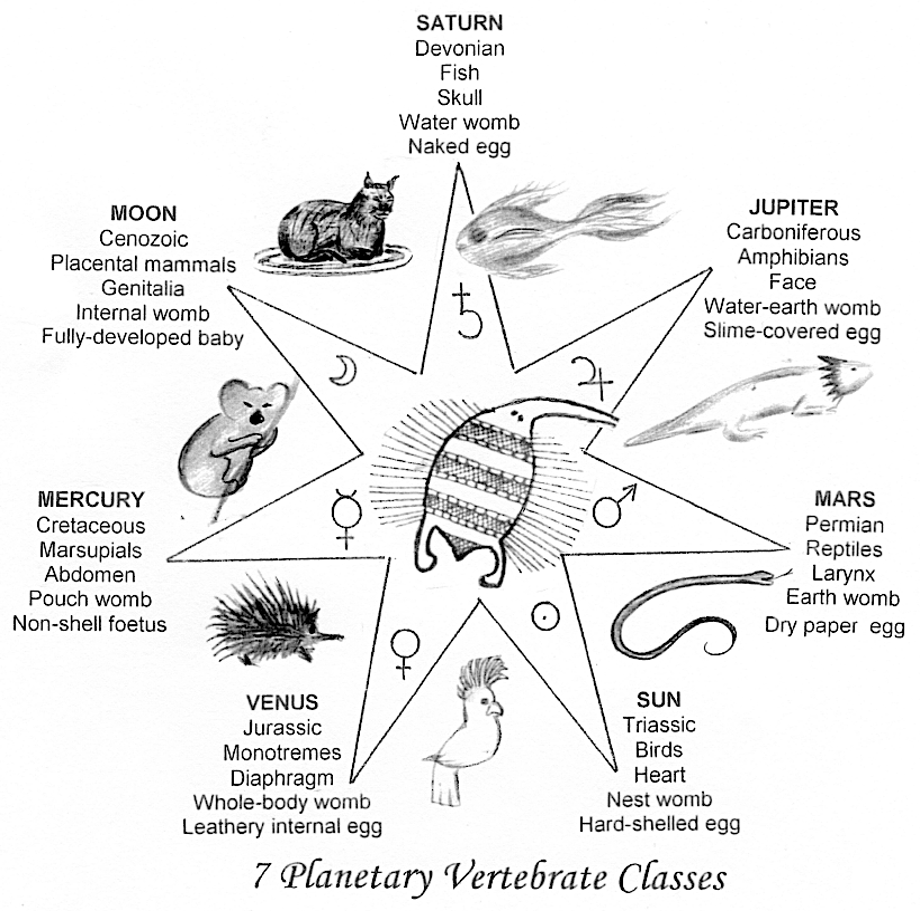
The Seven Vertebrates in their long evolutionary path provided a formative foreshadowing of the seven planetary aspects of man.
As we descended to earth, only gradually materializing, humanity watch from above. Indeed, we vertebrates are the cast-off soul residue (or ‘husks’) of man. However, in a profoundly sublime way, we express, in our form, the seven planets – just as you do. But we Magnificent Seven manifest only a single planet each; man is rather the composite of all seven. As well, we vertebrates are inspired, above all, by the zodiacal sign of The Bull …
Man: I know.
Whale: !
Man: I’m sorry, please go on.
Whale: The planet Venus (that’s ‘Occult’ Venus, commonly known as Mercury, not the Moring-Evening Star) live in the House of Taurus; as a consequence, the unfolding of the whole vertebrate world is under the governance of Venus – Greek Aphrodite. That is why love (the cardinal Venus quality) of animals is such a potent moral force in the world. Venus is a particularly ‘astral’ planetary principle (being the dominant planet, for instance, in the developing adolescent) – just as Taurus is in a zodiacal sense. So, inspiration from Taurus-Venus gives world fauna a double serving of astrality. This is no-where better observed than in the evolution of vertebrate reproduction, the slow incarnation of the universal womb onto the earth.
This seven-fold planetary begins, as usual, with remote and brooding, Saturn. He alone has the power to initiate both new life forms and processes into existence. The first of the seven vertebrates, the Fish, are essentially Saturn beings – according to Rudolf Steiner anyway, if you need human confirmation! Their melancholy and lugubrious natures yearn, as do human Saturn personalities, for a world beyond the physical. They seem to be on earth by default, but as the initiating vertebrates, their role in the incarnation of the soul in the great laboratory of life can never be underestimated. The first of the first were the lampreys; particularly odious creatures – parasitic in the worst possible sense, feeding on their victims, with the aid of razor-sharp ‘cookie cutters’, while still alive. In both looks and habits they express that cryptic occult image of Saturn (Greek Cronus) eating his own children. Don’t expect any milk of human (or animal) kindness from his far-flung planetary realm.
This cold detachment is expressed in the fish’s onanistic reproduction methods. Generically speaking, the female lays eggs, no more than simple ova really, on the seabed, rock, weed – wherever. The male then casually ‘spreads his see’ over them, much like the biblical Onan, or in some cases, only in the vicinity. The ocean itself is the ‘womb’. This is effective due to the Venus reproductive power infusing every body of water on earth, nurturing the limitless orphan fish eggs. Of course, there are exceptions to this casual parenting, some fish being very caring indeed. (Not as caring as whales, though!)
You see, Saturn is the region of the skull in man; evolution working, as it does, in a divine descent to…
Man: You’re joking! The next of the astrological planets, Jupiter, surely can’t express through the secondvertebrate class, the Amphibians? – a name meaning ‘two lives’. The frogs, newts and salamanders have such, stupid faces! We even have this in our vernacular, ‘as drunk as a newt’!
Whale: And that is the key. The face is the region of Jupiter, one step down from the skull of Saturn. This is not to be confused with the organ of Jove, which is the liver. Amphibians are, in a sense, just faces – that symbol of wisdom – the cardinal Jupiter quality – the owl, is just like a face watching you from its branch; no matter where you stand!
Frogs have always been represented in ancient lore and legend as hidden wisdom – as in the old tale of The Frog Prince. The face of man certainly reveals if its owner has wisdom – or its antonym!
But to ‘reproduction’; the great carboniferous swamps were the home of these ‘two lives’ creatures, consisting, as a swamp does, of two elements, earth, and water – mud. Their skins, mostly damp, still need a wet environment as do their eggs. Which, note, are now not ‘naked’ as with fish, but surrounded in slime or foam.
The ocean womb of fish has now contracted to the more modest dimensions of the swamp – or indeed the pond. These Jupiter creatures are not quite as passionless as fish; at least they copulate, in a manner of speaking. The male frog, for instance, does actually mount the female, but only to excite her into laying eggs, which he then fertilizes externally – Onan with an upgrade! In fact, the poor little chap doesn’t even have a penis – unlike the snakes!
Man: What have they got to do with amorous amphibians? Ah, the third vertebrate class. Snakes are, both in structure and legend, de facto penises themselves! So, the Reptiles are the first to really, um, do it, eh?
Whale: Well, yes. Not surprising, as they are the Mars vertebrates, their region, now below the face of the amphibians, being the larynx. We all know (well, we whales do, anyway) of the relationship between the sex organs and the larynx. The pubescent boy’s voice breaks as a sign of sexual maturity. His gonads are called ‘testicles’, meaning to testify, or speak. As well, one doesn’t need a third eye (like us) to observe this assertive Mars element in the savage reptile world.
The Permian was the Age of Dinosaurs, a period when the planet was contracting into dryness; the seas were receding, the vast swamps evaporating. This new desiccation was a perfect home for the saurian reptilian forerunners. Even human Mars types, apart from having a natural talent for oratory, are often ‘dry’, with skin like lizards.
Oh yes, and Mars couldn’t enter the evolutionary tableau without indulging in true copulation; after all, his timeless symbol is erectness!
Even the reptile egg is now dry, being sheathed in, not slime, but a leathery shell. And the womb?
Man: I know! The dry earth itself! Crocodiles, tortoises, lizards, and turtles all seek sand or soil into which to deposit their clutch.
Whale: Well done. Yes, the sun-armed egg chamber of the sea turtle is in effect a womb. So up to now we have had a sea mother, a swamp mother, and now a true ‘earth mother’. That concludes the three cold-blooded vertebrates of the Hyperborean-Paleozoic.
Man: I guess warm blood of the Mesozoic, seen first, ironically, in the warmest (average 105 degrees) of the vertebrates, the Birds, is from the realm of the Sun. As an aside, the modern idea that birds are merely feathered lizards is pure sophistry; they are a clear separate class of their own, as any taxonomist knows. The fact that one is cold-blooded, the other warm, is a huge evolutionary leap in its own right.
Anyway, the warmth and light that characterizes the avian world relates them to this pivotal ‘planet’ in the solar system. In fact, every bird can be imagined as a tiny sun; that’s the feeling they seem to express.
Whale: And you’re right (why does he need me?). Birds are indeed, before all else, Sun animals. They forever yearn to return to their solar home, especially the master of the bird world, the eagle. The Greek legend of Icarus expresses this cosmic truth. Also, the Sun (Ego) gospel, that of St. John, has as its symbol the eagle.
This solar principle is even expressed through the more advanced cardiac system of these Triassic archetypes. Birds have a perfectly centered, 4-chambered heart – a cross in fact. And for the first time color is pushed to the periphery, to the feathers. Fish, amphibians, and even many reptiles, can all have a variety of highly-hued – astral – skin.
But our feathered friends, and all creatures to follow, have done skin coloring. Most in a variety, some light, some dark, of the human incarnadine (‘flesh colored’) derma. The color of bird feathers are thought of esoterically as representing ‘thoughts of the sun’; each feather a single divine idea. That’s why American Indians, Sun-ego adepts extraordinaire, wear head feathers. The sun is a planet – or star – of white light embodying the whole visible spectrum. This is the kaleidoscopic world of feathers.
Back to ‘reproduction’: the egg is now in, not a soft shell as the reptiles, but a brittle, calcified one. This represents a further level of protection (a long way from the naked fish ova). It is incubated, in most cases, by the bird’s own body warmth. And a further long jump of evolution is the fact that the womb has contracted to become – the nest! Imaginatively speaking (the only true reality), the manifold nests of the avian world are all ‘wombs’, in many cases even in shape, like that of the weaver bird. But this time they are purposed-built by the owners.
What a beautiful image this is to present to children, freeing them from the tyranny of smut and misinformation. The Aves, with their new-found Sun influence, are also the first to properly feed their young, who are the first to be born utterly helpless. I guess, generically at least, one needs warm blood to really care!
Man: Wow! The sun in man – and birds – is the heart; birds, like roosters, puff out their chests to sing their sun songs to welcome the golden orb of morn. We simply take deep breaths!
But from the Triassic sandstone of birds, it’s hard to see the Monotremes, the fifth vertebrate class, that of the Jurassic, as Venus animals? Gosh, there are only three species left in the world (compare that to birds!), two echidnas and the platypus. All are restricted to what’s known as the Australasian Faunal Zone (Australia and New Guinea). Like fish, frogs, lizards, and birds, monotremes still have only one ‘hole’ – so to speak – which is what the word means.
Whale: Yes, the great creation gods showered their population largess on all six of the other vertebrates. But Venus bestowed upon the monotremes something very special none of the former had – milk.
With the lowly monotremata, this is still only in secretin form; the mammary glands being dispersed across the skin surface – in the upper abdomen Venus region I might add! Oh, and the echidnas and platypus are also the first animals with a diaphragm; again the epicenter of the Venus region in animal, and especially man.
The now-familiar egg has taken another leap forward (a curious metaphor?), the shell being now neither papery nor brittle, but with the rubbery consistency of thick skin, like a uterine membrane. Even more remarkable, the fetus is developed in the egg whilst still in the mother’s protective oviduct, where it remains for some time; hance there is already an embryo inside when the egg is laid, not mere yolk and albumen as with former egg-layers. This in itself is unique enough to raise the monotremenes to a new evolutionary plateau.
To continue our ‘womb’ metaphor, the whole animal is now the womb, with most embryological unfolding occurring, for the very first time, within the mother’s body. Even when hatched, the egg is protected by the womb-like curve of the mother as she carries it, again unlike birds, with her everywhere. And wouldn’t you know it, the platypus burrow and nest is constructed in a uterine form, into which the animal snugly curls. Being Venus creatures, monotremes are also very gentle, having no teeth and few attacking weapons
Man: I understand that the monos have, opposite to birds, the lowest body temperature of any warm-blooded animal. Though this is an unstable blood-warmth mainly determined by the animals’ kinetic behavior, rising, and falling rapidly in response to active or passive movement. I suppose this lower mean-temperature was to allow the Venus-milk factor to enter evolution; the energy being now devoted to lactation at the expense of blood warmth?
Whale: Quite: but the siren song of the tropic calls, and baby and I soon have some movement of our own to attend to. So, onward to the Marsupials; the ‘pouched animals’, as the word means. This class is a Mercury(Gk. Hermes) zoological dispensation. The marsupials – also mainly from the Australasian-New Guinea Faunal Region, adjacent, aptly, to Lemuria – have further developed the mammary glands to include the first proper teat. Though this is still a fairly simple affair hidden inside the pouch, which, incidentally, is in the lower abdomen Mercury region! So much divine synchronicity!
We also find in the marsupials the first external genitalia; albeit pouched also. So, here we find the pouch to be an external womb; an advancement on the whole-body womb of the ‘monos’, as you so casually call them. Being Mercury animals, there is a logarithmic explosion of movement potential. For instance, with the kangaroos; their hopping is thought by many zoologists to be the most energy-efficient mode of travel of any creature in the terrestrial world.
Some others may be able to run faster, some longer, some can even jump higher, but none are as fast, long, and high at the same time as the mighty red kangaroo – a mercurial Olympian if ever there was one!
Even its aboriginal name, kangaroo, one born of folk wisdom rather than mere intellect (like ‘marsupial’ – ugh!), is a wonderful movement word, expressing in the K, G and R the great leaps and bounds of this wonderful creature You should do in in eurythmy, then you’d see what I mean! Indigenous Australia’s intuitive lexicographers usually got it right because they truly knew how to observe, with heightened sentient soul, the essence – or spirit – of nature. The order to which the kangaroo belongs is called macropod, another tired Latinism meaning ‘big foot’. Not much movement there: in fact, the word is even inaccurate, the actual ‘foot’ being relatively small.
Man: I think I’ve got the picture. Let me try this on you. The seventh vertebrate class, the Placental Mammals, is inspired by the next and last planet on the astrological path, the Moon. These mainly evolved (there’s always some overlap, nature isn’t a machine you know) in the Cenozoic, the fourth great epoch – Atlantis. This is a singularly Earth phenomenon, the place and time that firm matter eventually incarnated.
The eponymous placenta, that which at last marks a internal womb as a possibility, is aptly lunar-shaped. The Moon region in man is the genitalia, with its uterine extension. These forces even extend to the limbs, especially the lower limbs. This brought about the incredible specialization and variety of the limbs of the placentals; from hoofs to pads, to flippers – to wings even!
Whale: Very good! As the womb internalized – including the mammaries – the placental mammals’ (I’m one of those!) babies now feed on demand; unlike the kangaroo joey, which is permanently attached to its in-pouch teat.
All this suggests that the soul has now really bonded with the earth; an example being that we ‘placentals’ are the first to be truly epimelitic – we help each other. Also, we can now form stronger relationships with you, with man. This really began, in a rudimentary way, with the birds, but all the truly loyal and yes, even loving, animals are the placentals; the dog probably being the most familiar.
The descent, or ‘fall’, of the genitalia, which are now fully exposed, as in male humans, is hinted at in the Adam and Eve story. As the two were banished from the Garden of Eden (Lemuria), for the mineralized ‘dust of the earth’ world of Atlantis, they first knew shame.
Well, that wasn’t always, or will be again; the genitalia, still organs of putative shame for humans to this day, will one day be redeemed – elevated to a higher realm. This will be aided mostly by the cultivation of the arts, especially the speech arts (remember the larynx-genitalia connections?). Human reproduction will ascend back to the region of speech where it belongs; a new parthenogenesis will prevail, one activated by divine tone. But don’t worry; it’s still a long way off – so enjoy the present nether-method while you still can! However, as is mandatory on all higher paths, it is good to begin early; so, a cultivation of speech is recommended.
Oh, by the way, thanks for that help you gave all those years ago in getting whaling banned in Australian waters – and by extension, in many other jurisdictions as well. The children’s lovely package of artistic and other goodies to the prime minister actually tipped the balance. This was due to is appeal to the heart mainly; and that’s exactly what was warmed in those who hold the power over life and death, especially of the faunal world, in their hands.
Hands? Unlike the lower limb specialization (Steiner states that all animals’ limbs are really ‘lower’) of we animals, the world-serving hands are yours alone. This unique possession puts the human being in a class all its own, though ostensibly still a placental mammal.
As such, man is a compendium of all seven planet-soul-vertebrates, the divine hands being the most sublime expression of this Mystery.
Use them well!
***
With that, the whale and calf gave a wave of their elegant, fluked tails – again lower limbs of a kind – and, well, I guess it’s the end of this tale as well.
FROM: Sacred Fauna: Zoology in Light of Steiner’s Spiritual Science
Four Kingdoms Companion volume to: Sacred Places Minerals & Land; Sacred Fauna Botany; Sacred Faces A Study of Man
Important Earthschooling Notes
Copyright Alan Whitehead & Earthschooling: No Part of this book, post, URL, or book excerpt may be shared with anyone who has not paid for these materials.
Alan speaks in a very symbolic and esoteric manner in some parts of his books. Although they can be read anthroposophically, passages speaking of Atlantis, archangels, gods, etc. do not need to be taken literarily to be meaningful. The more you read, the more you will realize he uses many different religions to express ideas in a symbolic manner and not in a religious manner. His writings are not religious. In some places his writings are meant to refer to religious events in a historical way. In some places he is using religious figures (from Christianity, Judaism, Islam, Buddhism, Hinduism, Paganism, Ancient Roman and Greek Religions, etc.) in a symbolic manner. However, at no point is he promoting a specific religion or speaking from a religious point of view.
I have kept the writing as close to one-hundred percent original so you will also find that he speaks of Australia often and some spelling or manners of speaking may be cultural. Any words I have changed are presented like this: <word>.
Also keep in mind that these books are written by a Waldorf teacher with decades of experience who also studied with a Steiner student himself, so he speaks to an audience that is dedicating their lives to the Waldorf method without exception.
Because of this, all of his views are not reflected in the Earthschooling curriculum and not all of them may be ones you want to embrace or are able to use. In all of Alan Whitehead’s writings the opinions are his own and may not align with Earthschooling or Waldorf Books. In some cases, we will be updating some of these chapters in the future with additional and/or updated information.
Ultimately, however, as I read through these passages I find I can distill wisdom from even those paragraphs that do not resonate with me.
We invite you to read with an open mind and heart and with eagerness to learn and discuss.
END NOTE
Alan has presented dialogue in his writings in an expressive form, where he tries to capture the accent of the person he was with to give his writing more authenticity and to allow the reader to “be with him” in his experience. In no place in his writings is he using expressive language to make fun of or demean the speaker. So, as a person with a linguistics and anthropology degree I find this enriching and informative to me as the reader. Thus, we have made the decision to leave all expressive writing in its original form.








Leave a Reply