
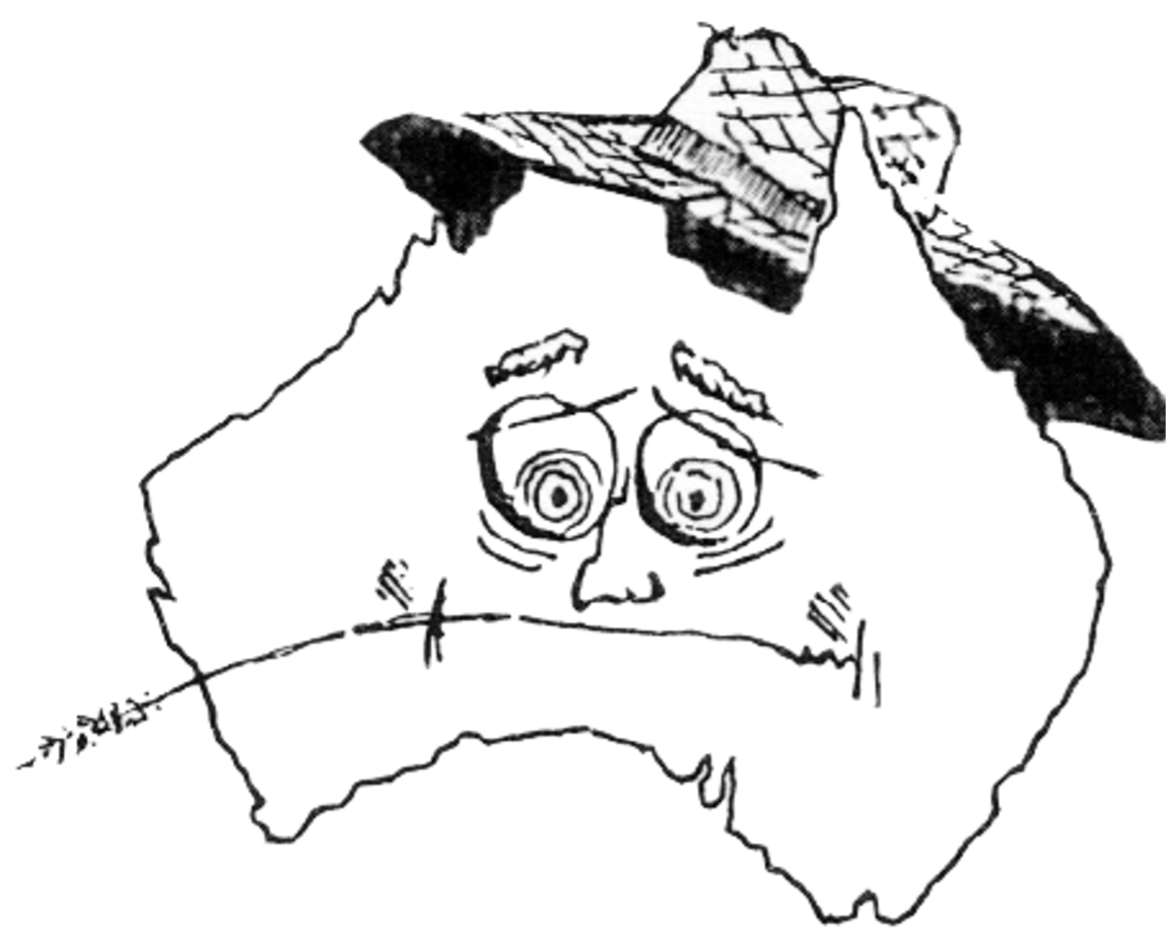
 AUSTRALIA CALLING
This article was written for an overseas readership
G-day, I’m an Australian (we don’t mind ‘Aussie’), and I thought that it was time to expand your cultural horizons with an exposition on language Down Under. And talking about horizons, ours are very wide indeed – we’re not called the Land of the Never Never for nothing. (this epithet also means buying on hire purchase, but never mind).
Australia, Oz, was as the name suggests, the original Land of Oz – if nothing else, we’re wizards with words. But hang on a minute – a myth I want to fillet and feed to the crocs is this ‘down under’ business. Wea re not down under, you are. As Australia is the oldest continent on earth, hence the first, we have always been on the top! And ‘down under’ sounds a bit tautological as well; Australians would never make a grammatical error like that – well, not very often anyway. One day a true-blue was asked on a quiz show “What is tautology?” the answer came as quick as the flick of a lizard’s tongue “Repeating the same thing twice!” – we’re no mugs (fools).
Lurking beneath our national language, English (which we’ve perfected actually), there is a dialect by which we communicate – especially when overseas. This is Strine (Australian). You will not that the word ‘Australian’ has four syllables; translated into Strine, this has been reduced to one – compact, simple and sensible!
Aussies overseas you ask? We do occasionally leave our golden shores, though it beats me why? (‘bets me’ is Oz slang for ‘I don’t understand’ – hardly ever used of course, there’s not much we don’t understand down – er, I mean, up, here). One day somewhere ‘over there’, at some quaint ethnic concert, a group of loud Europeans were ruining it for the rest of us (overseas is full of foreigners!), when a bull-roarer call in Strine put them in their place – ‘Aysitup’llya!?”. The meaning (not the tone) may have been a bit obscure to the gaggling miscreants, but every Aussie knew the translation ‘Ace it up will you?’ – or in snob’s English ‘Could you please keep the noise down?’ Just doing our bit for cultures as usual!
A common greeting in Strine is ‘Owyergoanawrite?’ – ‘How are you going, all right?’. Any old professor of linguistics can see that this is a natural and inevitable process of simplification from the cumbersome, archaic English used in other less advanced countries. In the example above, we not only have reduced syllables, we have made a clumsy four-word sentence into one word! Think of the potential for Strine, with Australia leading the way – words to letters; sentences to single words; whole paragraphs to single sentences; chapters to paragraphs…!
Strine guarantees an export film industry for Australia; a non-Aussie has Buckley’s chance (the name of a bushranger, one of the few who never had a chance) of speaking Strine. Even Meryl Streep’s accent in the film Evil Angels sounded laughable to our sensitive ears – and she’s the best there is! Not like our Mel Gibson, his yank accent is as American as Bugs Bunny – though not quite as polished perhaps (we’re modest too).
Our slang forms a kind of sub-culture when Aussies want to communicate without some big-ears silvertail gettin’ the gist (‘without some patrician eavesdropper understanding what we are talking about’). Some slang terms> ‘blue’ means fight; we don’t post a lookout at an illegal gambling venue, we have a ‘cockatoo’; we don’t eat sausages and potatoes (yes we do!), we enjoy ‘snags ‘n’ spuds’.
This list goes on, including a form we’ve, sad to say, borrowed but perfected from our Cockney refugees … er, immigrants. (Anyone coming from a bad to a good place is a refugee surely?) This is rhyming slang, and gives us ‘Joe Blake’ for snake; ‘plates of meat’ for feet; ‘butcher’s hook’ for look.
Our town names are a bit puzzling to visitors (Visitors are not refugees, they’re tourists; they spend their money and go home again – can’t imagine why?) The tour coach might pass through hamlets like ‘Dunedoo’ (dunny is an outside toilet); Man Arm Creek, no doubt the scene of some grizzly find now immortalized on road maps. And then there’s Lightning Ridge, the site of the richest opal fields on earth. Legend has it that said Ridge is a lightning rod, attracting numerous direct hits; these transform the silica-in-solution held in pockets of white clay into stunning gems – nice eh?
Refined ladies should shield their eyes as the bus wizzes past the sign to Bastard Bore – or is that boring bastard?; and a very large question hangs over the naming of Answer Downs!
Speech-exercise games are played as the bus refuels at places like Abadabada Creek, and Albamgurdeedna Waters. (Don’t let on, but I suspect that the Aborigines are the real inventors of Strine!) As the bus bounces across the washboard corrugations at Bang Band, our thoughts stay with Black Australia’s nomenclature. Their use of onomatopoeia is ubiquitous, especially in bird names like ‘kookaburra’, ‘currawong’ and ‘eechong’. The avian owners of these resonant names have calls exactly like the word.
The Aboriginal language have virtually no fricatives – the ‘fire’ sounds – like v, s, h, f, z; strange in a ‘fire’ country, with ‘fire’ people! Perhaps one doesn’t need to externalize what one deeply is? Yet their words can be powerful and expressive, words like ‘Uluru’, the name of that great, red igneous heart of this vast continent – and of Aboriginal spiritual life – Ayer’s Rock.
Early Europeans did not give their dark brethren the same dignity accorded them; they kept the ‘blacks’ in their place by giving them the names of pets – Pigeon, Jacky Jacky, Mulga Bill and Tiger to name few. What a contrast to the ringing epithets reserved for our bushrangers; like Captain Moonlight and Thunderbolt for instance.
Australia is more than the Outback, we also have a vast coastline. James cook left a legacy of beautiful place names on his voyage up the East Coast in 1770. Names like Glasshouse Mountains; Solitary Islands; Mount Warning; Smokey Cape – even Botany Bay is evocative. These are names with pictures, images that manifest the Spirit of Place.
Not like those that followed Cook – most British-inspired places were named after some drunken governor or other. Early mariners seemed to have a hard time of it, judging by their geographical nomenclature; we lament over the events which led to the naming of: Disaster Bay; Repulse Bay; Cape Tribulation; Anxious Bay; Buccaneer Archipelago.
The euphemism is an ever-ready tool in Aussie talk, especially with food; we would not be caught dead eating rabbit, but ‘underground mutton’ mmm! We certainly wouldn’t touch octopus (yuk!), but ‘calamari’, yes! (the influence of our Mediterranean visitors/refugees can be felt here.)
No self-respecting gourmand would eat shark with his chips, but ‘flake’ is highly prized; the fish marketers hoped it would be confused with hake, an expensive import – and it was. But after discovering the terrible truth about the above delicacies, some Australians might go for the ‘rainbow yawn’!
We don’t start work, we ‘strike a blow’ – nor do we finish work (yes we do, as early as possible), we ‘drop the oars’. This use of figures-of-speech is often as colorful as the yawn previously alluded to: a person leaves hurriedly ‘like a rat up a rope’ – or if there is trouble, we’re ‘up a gumtree’. And if all faculties are not functioning, we are like ‘stunned mullet’.
We have our working class, and our… not working class! These cultured souls obviously influence many of our street names; the good burghers gave one town a poet’s theme: Wordsworth Avenue; Byron Close; Keats Cr … Sadly most of the residents wouldn’t read a line of doggerel a year, let alone be transported by the great wordsmiths immortalized on their flaking street signs.
Australia, with its vast distances and isolation, has obvious advantages in resisting invasion. This capacity to repulse extends even to language; Americanisms have broached shore defenses all over the world, but in Oz, ‘trash’ is still only garbage; a ‘faucet’ is still a tap; and the ‘sidewalk’ remains a footpath. Sadly the word ‘guy’, in a behind-the-lines action, is slowly replacing our own bloke – and our golden belles, sheilas, are becoming ‘chicks’. (I don’t know which is worse)
We may be losing a few battles, but victory in the Word War is assured; Australia is flavor of the decade in many countries, and having dropped their guard, foreigners will take on some of our rich phrasing. Japanese tycoons will soon refer to their less-adept trading partners as ‘drongos’ and ‘galahs’ (both Oz birds) – or will that be ‘dlongos’ and ‘garahs’! Hong Kong race callers will include the Great Australian Adjective, ‘bloody’, at the beginning, middle and end of every sentence, just like we do: “… and bloody Ming Vase is setting a cracking pace – and Rice Pudding is finding the bloody track sticky – and the winner, Tiannanmen Square – bloody hell!”
Ennyowigoddagonowseeylada.










Leave a Reply