
“VORKIS LOVE MADE WISIBLE!”
“I’m German,” said the be-suited businessman, leaning on the lectern like one born to public speaking “that’s vhy I chose to speak on the 4th Punishment Principle – Punishment with Vork, To get the most out of our factory vorkers, ve threaten them vith even more vork. So vhy use other more primitive methods vhen the perfect punishment mechanism is already in place. If the little scamps don’t do as they’re told, or go slack on their writing or vot not, give them twice as much. If they muck up on the bus give them 100 sums – they hate it hee, bee, hee. It vorks in our factory anyway. Vhen I vas a kinderling I had to chop the vood, feed the cows, rake out the stables – I vas only saying to my chauffeur this morning, that Is vhy I’m the self-reliant man you see today.”
Herr Kraft adjusted a snow-vhite – I mean white – cuff and assessed the impact of these revelations on his audience. A tall, Silver haired teacher rose, her manner polite. She removed her spectacles.
“I don’t want to appear to contradict Herr Kraft, but my experience of work in schools .is somewhat different; I would not give schoolwork as a punishment at all. I spend the greater part of my teaching day trying to build positive attitudes in my pupils towards work. I don’t want to destroy these by creating the indelible impression in the children’s minds that work is ‘punishment’, is onerous – a painful thing to be avoided!” Miss Silver walked purposefully down the center aisle; she was a woman who attracted respect without even trying; the kind of teacher who, if she appeared in a room of brawling adolescents, would cause them to instantly freeze-frame, their faces red with shame.
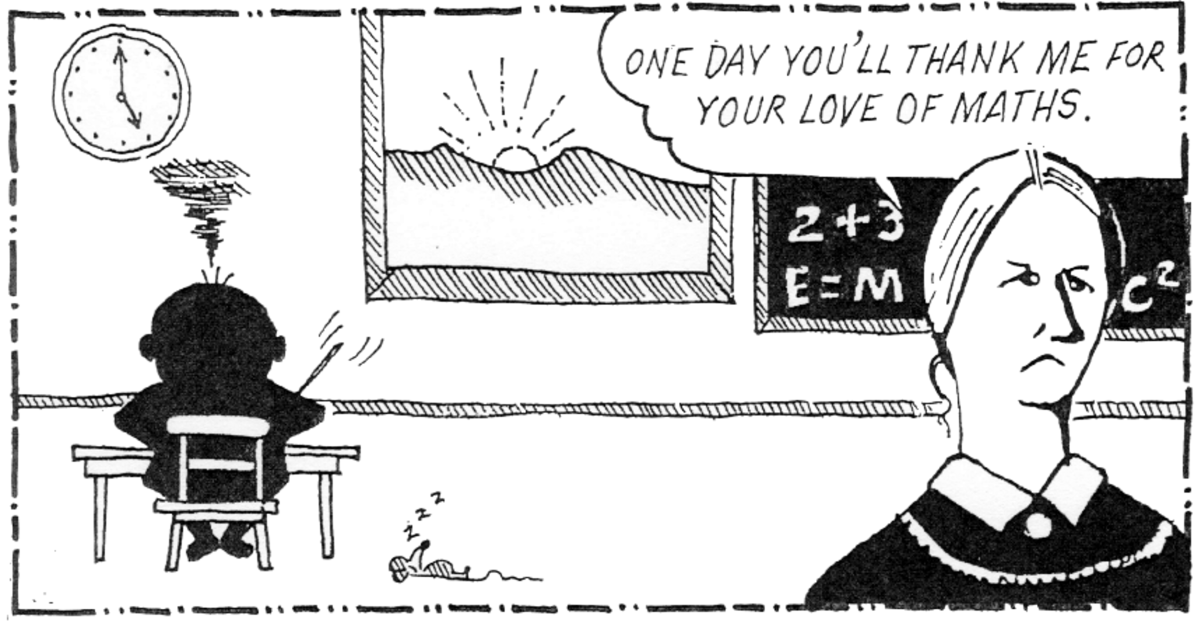
“Maths would be the least popular subject in school, yet just that subject which one struggles to gain some appreciation for – affection even – with the less able children, is the one most often used as an instrument of punishment; damning it forever in the eyes and hearts of many of them, condemned by this poor attitude to be relatively innumerate for life.
“No, the human being treasures that which is hard to get, not that which is thrust upon him, especially as punishment. If a child is showing disrespect for the lesson, I may actually take the ‘work’ away from him – remove the lesson book; make him (or her, it’s so much easier to use the ‘him’ convention when alluding to all or any children) clear the desktop and just sit there. At first, under old pre-conceptions, he may think ‘Great! I don’t have to do any work – wheee!’ But after a short time (remember, the child is NOT allowed to do anything else) he grows restless, showing a passing interest in a neighbor’s work, which by this time may have moved onto being a drawing from the story. He likes drawing, drawing isn’t really work, is it? By the end of the lesson our deprived child may tentatively be asking when he can have his book back. ‘Nothing doing – it’s just too sad to see ‘work’ treated so poorly – perhaps you’ll never be allowed to work again?’
“The next day our non-worker is feeling decidedly uncomfortable as everyone else gets out their books. Oddly enough they sense his disquiet and are silently glad that they are allowed (a good attitude this) to work. Unlike yesterday, when a touch of envy might have raised its little green head. By the middle of the lesson, the child is in a state of ennui, bored and frustrated – simple requests become pleadings. There must be careful judgement on the moment of relenting – too soon, and he will realize that the whole thing was a bit of a game – too long and he may have moved into a defensive mode of resentment – hatred even! However, genuine pain must be felt, after all, pain and punishment are synonymous …”.
Ms. Uncial had interrupted, Chairman James tried to intercept but failed “It does seem a privilege to be 1allowed’ to work, increasingly so as machines take over so many traditional tasks. There are too many idle hands these days. (To be made use of by the devil, as the saying goes.) A sense for the sanctity of work sounds like good educational practice to me.” she got busily back to her own.
“And to me too, thank you. The book is grudgingly returned with the stern warning that treating work with contempt again might result in losing the right to work forever! This really works on the individual as well as the rest of the class. The whole idea of ‘loving’ the work one must do – even if one doesn’t like it – is based on the moral imperative of the necessity of earning our ‘daily bread’. Those who do not work, or serve the world in some way, diminish morally. Those who despise work, but do it anyway, struggle continuously against this decline. And those who love work, grow. More and more menial, inhuman occupations are becoming redundant; process workers become floor supervisors, and garbage men become ‘disposal engineers’. Our children must be encouraged to seek for the creative element in their vocation which transforms work to task, and on a continual upward curve to the Spirit, task to mission.
“These things can occur in almost any industry; the graduates from our schools must be encouraged to seek careers which serve Man and the planet, which are constructive and future- oriented – which heal.
“How morally justified is it to earn one’s daily bread say, repairing the machinery of death in a cigarette factory? How much better to devote the same skills maintaining a solar energy plant. The moral element in work is the most pressing in the world today, because so many earn their living in exploitative or destructive industries, the living earth dies. And morality begins at school, firstly by example, secondly through a subliminal instruction through stories. And thirdly, in accordance with Socratic principles, through direct instruction (Socrates said we enter the world in an amoral state and hence have to ‘learn’ morality’). These three principles relate to the infants, primary, and high school respectively. Through work the children learn ‘Right Deed’; we never expect them to toil at something that is not morally justified. The results of their labors must do no harm – must be constructive.
“Perhaps the most important thing we can teach is Love of Task, and this will never occur if we use work as punishment.
“‘And what of the early mark?’ I hear you say (she didn’t but never mind). This infers that work is something one escapes from, again a dereliction of duty on the part of the teacher. The job mandate is to teach all of the children all of the time, not all of the children some of the time. Using reduction-of-work as a reward is almost as impoverished an idea as using work as punishment. The message is the same – work is something to be avoided. We must inculcate in our young a true work ethic, not one based on the mere material – on wealth creation but one which serves the world. Scamming with early marks and so on leads to a ‘feather bedding’ mentality, one of perks and loopholes. No, the children should feel privileged to be able to squeeze the maximum out of every
lesson. We’re talking ideals here I must admit, but ideals we must have to continually improve reality. Early marks are a lazy teacher’s way of getting rid of children (and hence responsibility) sooner than they ought. To do what? Hang around in the playground reinforcing the attitude ‘We got out of work!’
“The same goes for work incentives, children should not need gold stars and such to strive for excellence. Teacher and peer approval should be just-reward for a job well done – indeed joy in the work is reward enough. This is also _the case with incentives to behave, fancy fating the children to be good! I have seen a teacher offer boiled lollies to scheming little scamps so that they will allow the lesson to proceed calmly! This is of no benefit to their souls – or their teeth! Even subtle ‘gifts’, like giving the class troublemaker the best seat in the bus in the hope that he will behave is a dangerous precedent – their demands, like those of The Mob running a ‘protection’ racket, only increase. Children behave best when we EXPECT them to; positive expectations, within the child’s capacity to produce, are rarely disappointed.
“Of course, work can work the opposite way – against a child’s interests. We might opt for a selectivesyllabus, based on our perceptions of a child’s talents. His karma may be to become an artist, but we see him as a carpenter; so, we don’t teach him art, we give him a heavily weighted program of technical subjects. Luckily when they leave school disenchanted, they often re-arrange their lives accordingly. A universal curriculum overcomes this problem, one where ALL students (this mainly applies to the high school of course) study all subjects. A lot of high school discipline problems arise from the frustration of the inappropriate work the students are funneled into through too-early specialization – but perhaps this is a subject for The Great Curriculum Debate?
“An unbalanced work program, where Thinking, Feeling, and Will are not equally catered for, also creates unhappiness, and its odious relative, bad behavior. Children happy in their work rarely want to misbehave and ruin a good thing.
“Many schools indulge in ‘keeping in’; this, as usual, is easy but ineffective. The learning day is structured on the principle of breathing – we ‘breath in’ the Main Lesson for about 2 hours – breath out in relaxation for half an hour at break – in again for 1½ hours in Middle Lesson – out again for an hour at lunch time. This 60-minute period is important, corresponding to sensitive biorhythms; 45 minutes just doesn’t fulfil our psychic/physical needs. Then we breath in again for 1½ hours in the afternoon Block Lessons – before the big outbreath, going home; To interfere with this natural rhythm by keeping in, is a …”
“Er, thank you Miss Silver, but dinner will soon be served, we wouldn’t want to interfere with that important rhythm, would we? Like in school, where the teacher of the say Middle Lesson keeps a child in through lunch. It is the teacher in the afternoon lesson who pays, as the grumpy child-exacts his not- so- sweet revenge. The children must have their 1½ hours relaxation during the day, not only to recuperate, but .to advance social skills that can only be acquired in the free space of the playground. Keeping-in and early marks are in the same sorry category really, both attack the Rhythmic (Life) System of the child – both are anti-life. A child in the playground is a ball of energy – one kept in at his desk is a wet rag, hardly a laudable achievement on our part.
“Keeping children after school is actually a kind of theft; the teacher is stealing private time, and probably liable if something goes wrong – such as the child missing his bus and being hit by a car as he walks home. We must work tirelessly to serve our children in the time allotted us – and let them fly like birds when that time is up. If a child’s behavior is so appalling: that, f or the protection of the other children for instance, he must be separated from his playmates, then the answer is not keeping in – but keeping with. Insisting that the rascal becomes the teacher’s shadow, for an hour soon convinces him that the company of his more agreeable friends is preferable – he soon makes amends. What? Yes we’re coming, we’re coming.”
“I look more closely at a teacher who has passed an examination than at another who, through his purely human attitude, shows me that his individuality is that of ~ true teacher.” Rudolf Steiner, Anaheim, 1924
“When. a teacher is not inwardly permeated by what lives in the children, they then immed1ately get up to mischief and run around … It is then impossible to go on with a teacher like this … With the new teacher, the whole class is a model of perfection – from the very first day!” Rudolf Steiner, Torquay, August 1924
Important Earthschooling Notes
Copyright Alan Whitehead & Earthschooling: No Part of this book, post, URL, or book excerpt may be shared with anyone who has not paid for these materials.
Alan speaks in a very symbolic and esoteric manner in some parts of his books. Although they can be read anthroposophically, passages speaking of Atlantis, archangels, gods, etc. do not need to be taken literarily to be meaningful. The more you read, the more you will realize he uses many different religions to express ideas in a symbolic manner and not in a religious manner. His writings are not religious. In some places his writings are meant to refer to religious events in a historical way. In some places he is using religious figures (from Christianity, Judaism, Islam, Buddhism, Hinduism, Paganism, Ancient Roman and Greek Religions, etc.) in a symbolic manner. However, at no point is he promoting a specific religion or speaking from a religious point of view.
I have kept the writing as close to one-hundred percent original so you will also find that he speaks of Australia often and some spelling or manners of speaking may be cultural. Any words I have changed are presented like this: <word>.
Also keep in mind that these books are written by a Waldorf teacher with decades of experience who also studied with a Steiner student himself, so he speaks to an audience that is dedicating their lives to the Waldorf method without exception.
Because of this, all of his views are not reflected in the Earthschooling curriculum and not all of them may be ones you want to embrace or are able to use. In all of Alan Whitehead’s writings the opinions are his own and may not align with Earthschooling or Waldorf Books. In some cases, we will be updating some of these chapters in the future with additional and/or updated information.
Ultimately, however, as I read through these passages I find I can distill wisdom from even those paragraphs that do not resonate with me.
We invite you to read with an open mind and heart and with eagerness to learn and discuss.
END NOTE
Alan has presented dialogue in his writings in an expressive form, where he tries to capture the accent of the person he was with to give his writing more authenticity and to allow the reader to “be with him” in his experience. In no place in his writings is he using expressive language to make fun of or demean the speaker. So, as a person with a linguistics and anthropology degree I find this enriching and informative to me as the reader. Thus, we have made the decision to leave all expressive writing in its original form.










Leave a Reply
You must be logged in to post a comment.