
“YOUR SECRET’S SAFE WITH ME … WITH ME … WITH ME … ”
The speaker for the after- supper session of The Great Discipline Debate was Michael Roechipp, a computer whizz kid who had perfected the art of record-keeping for various security agencies. Well Michael wasn’t actually there – he had installed a two-way audio-visual surveillance system so that he could present his contribution in living color, without appearing in the living flesh.
“Hi!” beamed the large wall screen to the impressed gathering “We all belong to a community which expects us to co-operate and contribute. Malingerers and obstructive are a drain on society; so, it’s imperative that we quickly identify these and record an in-depth biographic and psychological profile on them. (‘About time!’ ‘Keep an eye on them.’ ‘lf they didn’t have something to hide … ‘ – from the right.) Discipline is after all about control – and control is based on knowledge. The fullest picture is the best one, and with limitless bytes at our disposal, we can deliver quite a bite ourselves – ha, ha, ha. (The laugh was hollow, but it could be construed as a sense of humor I suppose.)
“We start even before the birth of the ‘subject’ (Was his father a commie?) in our compilation of facts; right up through childhood (Was he rebellious at school?); and into adolescence – especially adolescence (We’ve a note here on possible homosexual activities’). And of course, right through adult life. To protect society, it must become possible for one of our operatives to radio in a vehicle’s rego number and within seconds know a wealth of detail about the car’s owner. One can extract no end of good behavior from a person if you confront them with, for example, their poor school record ‘What if your boss found out that you stole the white-elephant money when you were 15?’
“Naturally you people must play your part, you are in control of the person for perhaps 14 years of life – and very interesting years from our point of view they are! From the first day of school, detailed computer records must be kept of things like test results; breaches of conduct; sexual proclivities; psychological obsessions etc. You will find that you have a powerful weapon, to extract compliance – for the common good of course! Accurate records help us to help you – how can a…
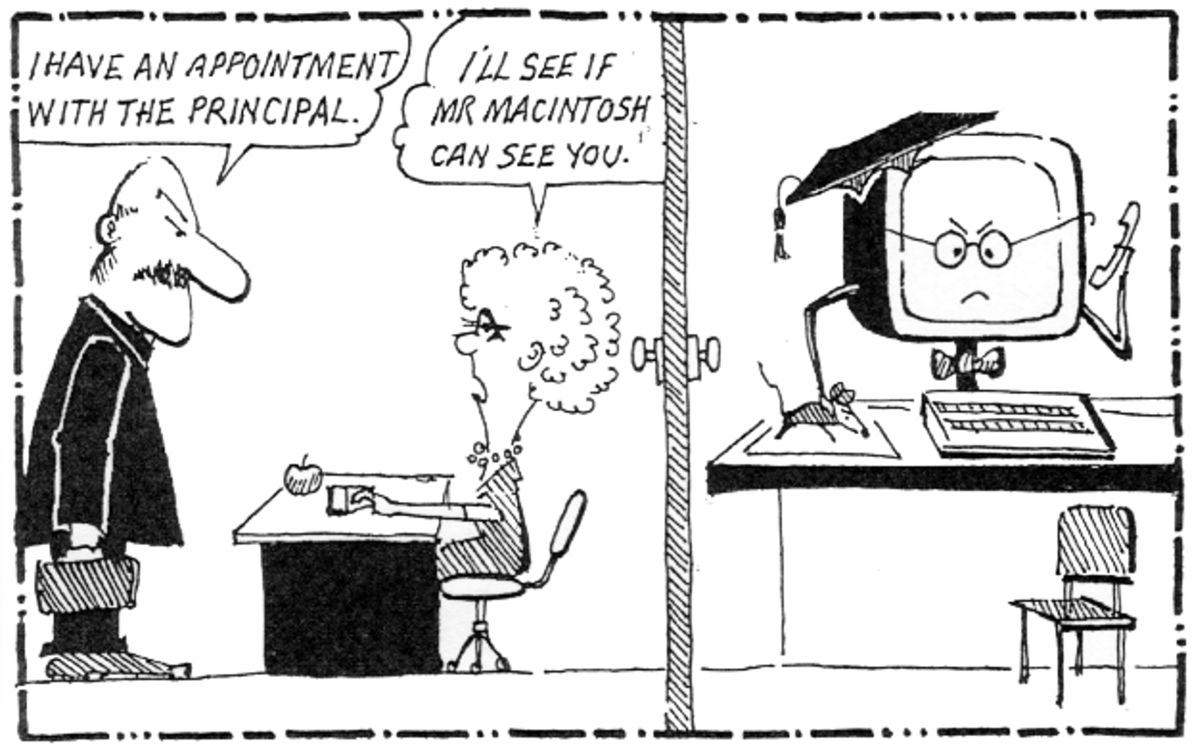
…careers advisors direct a student to a suitable vocation without comprehensive records? “What a nonsense it is if the student has his heart set on the travel industry but, according to our records and computer analysis, is patently unsuited for it.
“We can so much more easily dissuade, indeed prevent, this unwise course. With the hard facts and watertight statistics, we can obtain from our Employment Suitability Program, we are fortified in our re-direction response. And if he doesn’t comply? ‘This might just have to go on your record son’. You’ll see an attitude change quickly enough – oh, but place the ‘problem’ on record anyway, you never know when you, or someone else, may need it. What he doesn’t know won’t hurt him right?! This presentation was sponsored by Keyhole Surveillance Corp.”
The screen went blank; a man at the rear rose to his feet, his face, of many summers, was care-worn and lined “I must say Mike’s technology is impressive,” he began slowly “you could almost reach out and touch those gleaming ivories. But his message is not equally breathtaking. He is right about one thing, discipline is based on knowledge, but Knowledge of Man, not the cold facts stored in the computer.
“Many discipline problems arise because the teacher has not unraveled the mystery of the individual before him – not found his key, to mix the metaphor.” Care-worn seemed to travel inwardly for a time before returning “How often we offend children because we have not for instance worked out the complex pattern of Temperament. The Temperaments are especially relevant with the primary ages, residing as they do in the Etheric Body. They were known to the Greeks as the ‘Humors’. A person reveals his Temperament by not just what he laughs at – but how he laughs!” (Ha, ha, – giggle, cough, sorry.) It was Ms. Uncial. “Then there is the labyrinth of Personality that is unfolding in the soul of the high school student. How many mistakes we make against our charges when we don’t even know their fundamental physiognomic characteristics. A student may have the long upper lip of self-reliance, but we continue to offend by insisting on assisting! Driving him into the arms of at first Miss Frustration, and then Madam Misbehavior.
“A study of human nature; and especially the spiritual background of child development, is a necessary firststep in maintaining a happy, well-behaved learning environment.
“As usual, we take the opposite from the conventional view of the 6th Principle of Punishment – control through record-taking.
“We take no records at all! We may have as individual teachers (never the abstract noun known as ‘the school’) temporary notes on the individuals in our care. These are for gaining clarity only – and when this is achieved, they are destroyed. Say we want to get an over-view of the Temperaments of our, say Class 2; we may write a list of information down, like eye color (the one ‘absolute’ in determining Temperament); hair and skin color and texture; body and face shape, etc. From this we determine that one child is say, a choleric (blue-eyed – dominant Astral Body, hence choleric) with fair hair (light-filled or sanguine thought- life); rather chubby (phlegmatic behavioral type) and so on. This is not a conference to unfold the mysteries of human nature in general, or the Temperaments in particular; perhaps a Great Debate on Child Development can be planned?”, Care-worn looked round at James, who had regretfully just at that moment dropped off.
“Ugh – er, yes – what was that again?”
“Never mind! It must be emphasized that without this specific information we can only partly help our’ children. Many teachers work on an intuitive level, but how much more effective are we if our good intentions are informed. And how fewer mistakes we make: like unthinkingly confronting the said choleric child during a moment of passion and frustration. How surprised we are when he turns on us, flame-faced, and kicks us in the shin for our efforts!”
“Naughty? Not so, merely responding, in the circumstances, the only way his cholericism allows. How much better to calmly and without judgement, separate him from the cause of his rage – and later, say next day, sit him down quietly and discuss the incident. This is handling a choleric problem according to the dictates of its nature, ensuring, not irrational rebellion, but co- operation. In many cases with children, we make a rod for our own backs. One of physiognomic ignorance.”
Ms. Uncial looked puzzled “Did you say ‘physiognomy’? That study which ascribes aspects of human nature to physical features has long been canned.
“I read once – ha, ha, – that those heavy eyebrows of yours, meeting as they do over your nose, is an indication of a vile temper – and you’re obviously such a serene person. I think …”.
“I don’t give a tuppenny what you think!” barked Care-worn “Now where was I? The reason that we destroy our temporary notes on individual children is that the human being undergoes perpetual change. Looking at written observations even one year hence subjects one to error, due to the inevitable changes on all levels. One way to gain clarity on a child is, in the privacy of our own ‘closet’, to use a biblical term for meditation, draw up a profile from the fragments of meaningful information we have.
“We begin with a large sheet of paper and write the child’s name – a child suffering difficulties of some kind. (We don’t bother to do this with untroubled children, we must somehow be muddling through with them.) Then we spontaneously write (in apparent random) every fact which may be relevant to understanding the situation and hence solving it. Facts as widely flung as: birth details; Grandma’s interference; diseases suffered; incidents with friends; trouble in the home, et al. This mosaic builds up piece by piece; we work more or less as a detective might to solve a crime. Slowly unseen relationships, ‘co-incidences’ and correspondences appear – our knowledge increases and therefore our capacity to solve the problem.
“More important the effort, combined with a meditation on the child, activates, through the generous offices of the Spirit of Goodwill, the catalyst for change and healing. Our labors call in the spiritual cavalry so to speak! Again, this sheet is destroyed almost immediately (it may contain some very sensitive information) – in a case like this, the child’s situation can change overnight, making the info obsolete. The relevant facts remain in the mind of the teacher anyway.
“How often is a ‘difficult’ child helped by being brought to the consciousness of the whole collegiate of teachers? Here again the Spirit of Goodwill assures progress, if not always a total solution. A group of people earnestly seeking to help a child actually improves things just by the focus, without necessarily doinganything!
“Applied Spirituality, a growing imperative in nurturing our young.
“Not all record-taking is potentially harmful – in the high school, a system of continuous reporting takes place from Class 8 to 12. Here a positive assessment is given for each 20-to-30-hour lesson unit.
“This is combined with a precis of the lesson content and becomes, not only a valuable and voluminous document for job-seeking, but a permanent record of virtually everything the students learnt in their 5 years of high school. These reports are an excellent (again positive) incentive to behave as well as learn.
“An area somewhat allied to the sinister practice of record-keeping is dobbing. Here the student is warned that if he doesn’t toe the line, his parents will hear of it. In most cases this is counterproductive.
“The child’s father might have a brutish streak (which may have contributed to the bad behavior in the first place); he may use this tell-tale information to deliver yet another flogging to his cowering offspring. Or mum may nag the kid to death over a complex educational issue she can’t even begin to understand. A growing trend in schools is to throw corrective responsibility back on the home – this must be opposed. A good teacher can provide caring discipline for a child with no home support whatever! Or from the worst kind of domestic scene.
“The excuse ‘I know the father too well for that’ is threadbare. People behave quite differently (and usually worse!) in the privacy of home. Many children are violated physically, sexually and/or emotionally without anyone suspecting – least of all the teacher, who meets the smiling parent at…
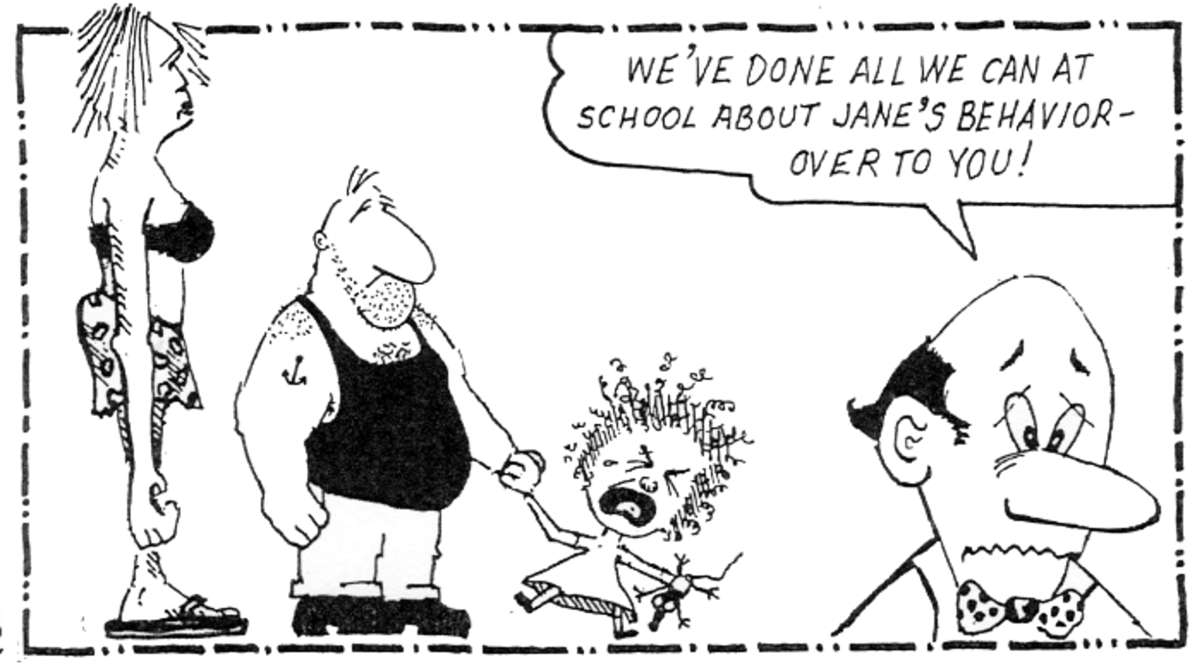
…the fete just oozing gentility. It is the whole school’s responsibility to deal with educational problems in children, not the parent’s – after all, we are the professionals!
“Positive assistance from home is of course a good thing, like cooperating in reducing the child’s T.V watching; but to load the negative onto the parents – often so ill-equipped to do the most important job in the world – raise children – is folly, Teachers live, breath, think and even dream about their charges; this qualifies them as the best of a bad lot (humanity) in child problem- solving. Parents? Well, they’re often involved with other things.
“A good policy in relation to home is, when talking to a parent about their child, selectively mention its positive (that word again!) achievements – this may at first seem duplicitous, but it prevents a lot of clumsy interference and suffering.
“The comment at the dinner table that night might be ‘Your teacher said you did a lovely painting today’ is encouraging to the young artist, who the same day may have also spilt the paint water accidently on purpose! The child’s expression on hearing this unexpected compliment might be a cross between surprise and relief!
“The old system of the annual Report Card has to go too; here the teacher ‘assesses’ the pupil’s progress (A suspect exercise at best.) and, according to his disposition and bias, gives the parent ammunition, sorry, information as he sees fit. The stereotype image of the cringing child waiting for the arrival of the ‘Report’ is changed when they receive something positive, intelligent, and hopefully artistic instead. This tangible recognition of a year in the child’s life may take the form of a short poem or story written specifically for that child; or a large photograph; or a drawing. A presentation limited only by the teacher’s imagination – which we hope is unlimited.
“The principle of off-loading our disciplinary responsibilities to someone else (‘special class’ teachers, and the lesser evil, parents) applies even to colleagues. It is such a common and ineffective practice for a teacher to send a child to a ‘higher’ authority. (There should be no higher authority than the Class Teacher for the child.) In so doing, he erodes his own standing in the eyes of the Class in general, and the wrong doer in particular. This makes it even more difficult to maintain order next time. In my role as principal, children are sometimes inadvisably sent to me for correction. My manner is invariably not one of castigation, but – ‘Ah, your teacher has asked you to come up and help me – thank goodness. Here, stick the stamps on these envelopes.’ With an Oscar-winning performance, I might even convince the now-puzzled child that this was really the case – he had just muddled up the plot down in the classroom! Anyway, it minimizes the damage all round. Teachers grow in direct relation to their efforts to solve children’s problems. Those who palm them off onto someone else, stagnate.
“Though this is not as bad as the advice of one ‘special lesson’ group when consulted about a difficult boy – ‘I know he’s only in Kindy, but as he’s already a problem, it shows that his karma is to be somewhere else – get rid of him!’. And, to their shame, they did – the karma copout this is called!
“Mind you, one of the greatest threats to good order is colleague subversion. Say your class is acting up a bit – the teacher next door sticks his head in ‘Will you children behave this instant!’. Any shred of control the struggling teacher may have had is now lost in the slough of humiliation. This white-anting of one teacher by another is even more effective at the criticism level, here a teacher might demean a colleague’s work or character to the child/ren. One must be eternally vigilant on this one; of course, we are at times critical of our colleagues, but if the children sense it, they often bait their line to see what little poison toad they can catch ‘She makes us draw in lead pencil all the time.’ How painful it is not to retort ‘Hasn’t she ever heard of color!’ But we mustn’t. There are other ways to deal with our fellow worker’s shortcomings – all of them hard! ‘Adults in Schools’ – another Great Debate? Oh, forget it.”
James Boanerges woke (it’s not the first time a Disciple had a problem staying awake!), rose, gathered his loose white garments around himself and addressed the company “Now that concludes the agenda, we’ve spoken on the 6 Conventional Punishment Methods and debated them – to the loss of any credibility they may have once had.
“Now I have a request for a Question Time; this is outside the mandate of the Great Discipline Debate, but if we continue on an informal basis, we may be able to fit it in. As it is now late, if anybody wishes to leave, please feel free to do so.” Chairman paused, 6 people rose, gathering up folders, bags and briefcases.
Corporal Adamantine left first; marching briskly to the door, he turned on his heel, tapped jodhpurs with cane, gave the hall a last withering look – and departed.
Vicar Xavi er Ausize scruffled around, stepping on people’s feet as he moved along the aisle. He looked neither left nor right, ignoring the assembly completely. Ms. Uncial said later that she heard him muttering something like ‘Let them all rot in hell.’ before disappearing into the night.
Governor Sol Eatary jangled his keys meaningfully as he stood and slowly looked around the wide-eyed audience . His bulky frame oozed menace as did his voice when he issued his valedictory “One day poor teaching will be recognized for the crime it really is worse than fraud or possessing – or speeding even. When that day comes – see you inside!”
Herr Kraft brushed a mite of dust from his dark suit as he regarded the hall not unkindly “Vork is character- building you know, vhen teachers’ holidays and minimal vork hours reflect those of the wider community, ve may see improvement in ah, you’ll have to excuse me.” Herr Kraft’s chauffeur had appeared at the door, his look deferential “Are we ready Sir?”
“I’ve got the impression that you teachers are a pretty unstable lot; I’d like to recommend our ‘biography’ games sessions …”. Doctor Barbara Biturate had an unfortunate twitch, hardly perceptible at times, but as she was about to wax lyrical about the new child-control wonder drug, she had a rather severe attack. Her head jerked so hard, her hair – I mean wig – was displaced. She ran from the hall, groping in her bag for her ‘medication’.
Michael Roechip didn’t leave exactly, his equipment did though. The hire company men, er, persons, carried out the Telstar toys to their waiting van. Michael was last seen in a new self-discipline program he’d been developing. There was a computer error of some kind in which the image of Mike had been confused with the reality!
Important Earthschooling Notes
Copyright Alan Whitehead & Earthschooling: No Part of this book, post, URL, or book excerpt may be shared with anyone who has not paid for these materials.
Alan speaks in a very symbolic and esoteric manner in some parts of his books. Although they can be read anthroposophically, passages speaking of Atlantis, archangels, gods, etc. do not need to be taken literarily to be meaningful. The more you read, the more you will realize he uses many different religions to express ideas in a symbolic manner and not in a religious manner. His writings are not religious. In some places his writings are meant to refer to religious events in a historical way. In some places he is using religious figures (from Christianity, Judaism, Islam, Buddhism, Hinduism, Paganism, Ancient Roman and Greek Religions, etc.) in a symbolic manner. However, at no point is he promoting a specific religion or speaking from a religious point of view.
I have kept the writing as close to one-hundred percent original so you will also find that he speaks of Australia often and some spelling or manners of speaking may be cultural. Any words I have changed are presented like this: <word>.
Also keep in mind that these books are written by a Waldorf teacher with decades of experience who also studied with a Steiner student himself, so he speaks to an audience that is dedicating their lives to the Waldorf method without exception.
Because of this, all of his views are not reflected in the Earthschooling curriculum and not all of them may be ones you want to embrace or are able to use. In all of Alan Whitehead’s writings the opinions are his own and may not align with Earthschooling or Waldorf Books. In some cases, we will be updating some of these chapters in the future with additional and/or updated information.
Ultimately, however, as I read through these passages I find I can distill wisdom from even those paragraphs that do not resonate with me.
We invite you to read with an open mind and heart and with eagerness to learn and discuss.
END NOTE
Alan has presented dialogue in his writings in an expressive form, where he tries to capture the accent of the person he was with to give his writing more authenticity and to allow the reader to “be with him” in his experience. In no place in his writings is he using expressive language to make fun of or demean the speaker. So, as a person with a linguistics and anthropology degree I find this enriching and informative to me as the reader. Thus, we have made the decision to leave all expressive writing in its original form.










Leave a Reply