
A PRISON OF OUR MAKING
Plant Stories – Living World Middle Lesson– Class 1
The dying furnace of a Kimberley sun promised the relief of a purple night; a flock of Pied Geese over-flew the straggling line of chained Aboriginal men – the birds mocking in their freedom.
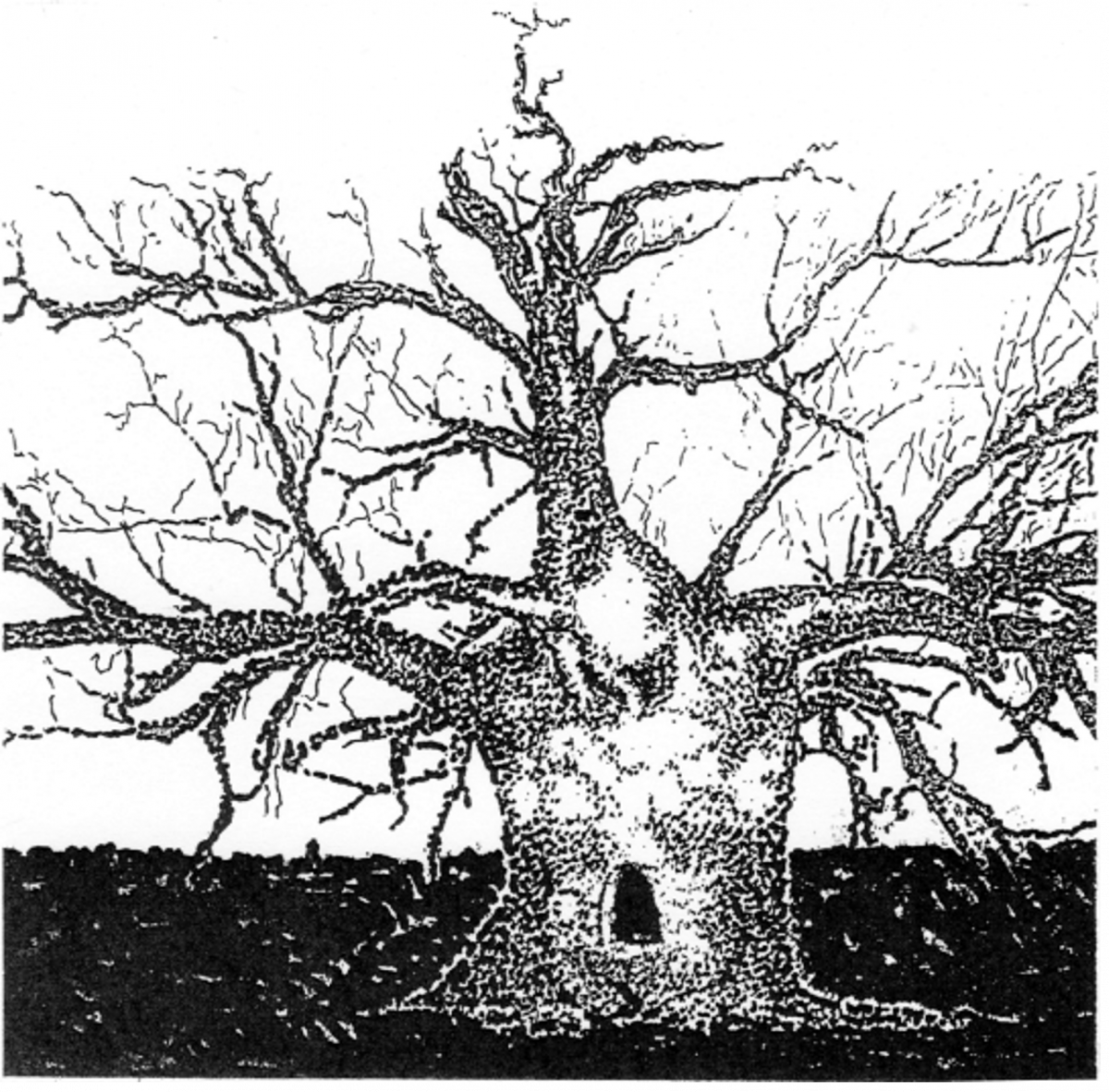
The line stopped beside a gnarled, old bottle Tree; its branches a long-suffering skeleton against the golden sky.
“Okay, get inside – I’ll bring your tucker later.” Growled the weary Patrolman as he eased himself out of the saddle. Desultory looks turned to puzzlement – ‘Inside what?!’
“the tree, the tree. Round the other side!” he said with exaggerated patience, ”There’s a door.” He proceeded to set up his bedroll in front of the ‘door’. At least tonight he would get some sleep; even if these wild Myalls slipped their manacles. (Which some of them could do, no matter how tight he made them!) There was no way that they could sneak past him tonight and race off into the embracing darkness.
Bottle Tree was hollow, its cavity large enough to contain 4 men. The Prisoner’s Tree as she was called. Was on the last stage to the lock-up at Wyndham, in north-west Australia. Bowed and cowered with her dusty, dusky tenants; she sighed in sympathy, her boughs heavy with sadness.
Oh, how many obsidian-skinned ‘criminals’ the tree had held over the years, when white Mounted Patrols brought them in? ‘Criminals’? – in the ear of the behearer only, more likely warriors enacting a sacred and ancient code; like retribution spearing of tribal enemies – or feeding from the hoof, rather than this pad!
The biography of The Prisoner’s Tree began long before even that; when she was deposited as a seed in a bird dropping – ‘At last I’m out of there!’. She fell to earth on good ground, in a good season; and with the singular Will of the infant, grew into a globe-shaped treelet – about as high as a wallaby. She soon became tall and triangular, spearing skywards, with youthful enthusiasm, to a safer height.
She slowed up in middle age, developing spreading branches, shady arbors – lunettes of green coolness. And today? Her cruciform shape is a memorial to her great age. She had seen wet and dry seasons alternating with cosmic predictability; she had withstood drought, flood, and even lightning – ‘Ouch!!’. She was a welcoming apartment block and supermarket for a wide range of bird and animal life – ‘I don’t mind you Flying Foxes dining here, but do you have to argue all night?!’.
Tribal elders of high degree eventually regarded Bottle Tree as sacred, and over some hundreds of years, she became the site of many a ceremony.
Then the white men came.
These sclerotic souls regarded nothing as sacred and seeing the hollow inside of this most obese of trees, hacked a small door into it; mainly to protect their provisions from ‘those thieving blackfellas’. They regarded Bottle Tree as curious or useful – never sacred.
The biography continues beyond the horse era, to the motor vehicle – from the change of land use from hunter/gatherer, to vast cattle stations. The Prisoner’s Tree saw it all – without moving from the spot! Today she is happy to tell her story to those who will listen – not so! Only to those with an open mind and a pure heart.
7-year-olds qualify in both areas; to them there is no doubt that The Prisoner’s Tree has Being – they don’t question the personification used by the story-teller. But there are many such stories – what about the spectacular Curtain fig on the Atherton Tableland? Or the Dig Tree of Burke and Wills? Or even the Explorer’s Tree on the highway west of Katoomba? I’m sure there’s a special tree (or plant in your area!
Each tree has individuality; a separate and unique life story – a story which throws light, not only on botanical phenomena, but on the history of a region, country, homestead, etc. This history, or in the case of bottle Tree, Herstory, can stretch from one year to thousands. ‘Individuality’ moves from the soul realm, to the scientific, it is the 12th Classification.
Linnaeus did a tolerable job of pigeon-holing the living world into 11 major groupings – from Kingdom, through Division, Order, Genus and so on; right down to sub-species – but he left off the 12th, the most important (from a child’s perspective at least), the Individual Plant. By telling these colorful stories of floral individuals, we teach a wide range of factual material in a subliminal way – the best way for young children. These images are enshrined into the sub-conscious, to be reborn as enthusiasm for the study of Botany when the children are, say, 14 or even 18 years old. The stories do not have to be about important or historical trees, they can be about any individual plant.
‘Botany strengthens the life of ideas.’ – so saith our mentor on things spiritual/natural, Rudolf Steiner. Ideas based on dead concepts or cold definitions, create a desolation of Spirit, and hence impoverish the world. Ideas born of imagination and creativity do the opposite.
The plant world, with its burgeoning life, enriches the life forces of the person who enters its magic garden with affection and intelligence. How necessary to begin this love-knowledge process in childhood; plant stories can be about any aspect of the botanical world – take the 4 major flower types, those created by the 4 Elements. Speaking in broad generalizations; large, red, round flowers are lovingly crafted by the element of Warmth. These express themselves most perfectly in the Tropics, with flowers like the Hibiscus and Poinsettia.
Smaller triangular petal types, with yellow-white hues, like daisies, employ Light-Air as their dominant creative element; as found in abundance in cool deserts and alpine meadows.
Bule, curvaceous flowers, like violets and bluebells, hide shyly among shady riverbanks and other moist situations. These are predominantly fashioned by the Water Element.
Finally, flowers with a square, or cruciform nature, often with tertiary hues like olives and browns, often cling to the trucks of high trees, aloof form the earth. They are often epiphytic or even parasitic, feeding on, and from, the Mineral element, like the orchids.
Orchids seem to be unhappy with their floweriness; more than any other bloom, orchids seem to want to be something else! Many are named because of their similarity to other things; like Slipper Orchid; Old Man’s Beard, etc. A story here could be about finding the answer to a riddle (shades of the Sphinx) – ‘When is a flower not a flower?’ A journey to the flowers of the various Australian geographical regions at last brings the hero/ines to the green canopy of the rainforests of Northern N.W.W. –
Inordinate Orchids
Hey! Can’t you see, we’re way up here,
We’re hanging on tight – we have no fear.
We shun the earth, we don’t need soil,
We struggle not, nor do we toil.
We copy the world of small things and great,
With its manifold colors and forms –
“I’m shaped like a Tiger.”, “I look like a Duck.”
“They call me the Gingerbread Man.”
“I mimic the Spider with spindly legs.”
“Like a prim Ballet Dancer I am.”
On mighty limbs, we’re close to the sky,
We live in the sun on the canopy high.
We wish we could sing – we wish we could fly;
Oh how we would love to be…
Well, anything other than orchids, really!
Children love to learn when artistry is used to help assimilate the knowledge with their souls; poetry, song, drama, painting – can all help express the amazing plant world.
Stories could also be framed around the 4 major disciplines of botanical study: Morphology, the ‘logos’ of the physical body of the plant; Physiology, the plant’s functions, its life processes – the etheric; Ecology, the relationships of plants with other plans, animals and man – astral; Systemics, classification and identification, the human ego, factor. If used al all, these should be quite dramatically transformed into acceptable images, the temptation to let a little soul-deadening intellectualism creep in here is high. In fact these 4 disciplines are taught in their own separate and comprehensive units, one per year from Class 5 onwards. This forms part of a 12 year magical mystery botanical tour, containing major learning experiences in each year; some imaginative, some conceptual, and some practical (like flower growing!)
The final botanical unit is Class 12 could be on the mysteries of transubstantiation, The ‘magic’ in Class 1 finds its reflection 12 years later in the magic of soil-friendly farm practices (a unit on bio-dynamic farming) which produce such marvels of taste and beauty. The seemingly impossible fact that a seed can become an orange tree is magic indeed. True transubstantiation, thought to be the province of obscure occultism, is with us every day in every growing plant.
This respect for the mystery that is botany, should be the golden thread running through the multiple strands of the 12-year curriculum.
The greatest of the arts in the education of primary children is the story. We might bring, in transformed images, the broad 7-fold classification of the plant kingdom. Here we may need a link character – say a bee. Bozeyneezeynozeybeezey is an inexperienced honey bee, on a sharp learning curve. Making lots of mistakes, she visits the kinds of plants in which qualified bees have no interest – like the Mycota, or Fungi.
Bozey mistakes Frilly Brolly’s spores for pollen – ‘Back you go!’ says the guard bee at the hive door. Through Bozeyneezeys’ eyes, we learn not only what a fungi is, but what it is not.
She continues in this vein right through the 7 groupings; the Tallophyta, or seaweeds. (These dreadful names should never pollute the ears of our eager listeners.) Actually Bozey nearly drowned here, but was rescued by a kindly surfboard rider who gave her a thrilling lift back to the beach on White Waver! Then there is the Bryophyta, the mosses; the Pterydophyta – Feather leaf Fern as the word means; Gymnosperms, the ‘naked seed’ pines; Monocotyledons; and finally the Dicots. By the end of this saga, the little bee sure knows the broad strokes of her plant world – and so do the children!
Plant stories can also be used in a healing or corrective way; a little boy many be hyperactive, running about like a blowie in a bottle. A tale of say the Lantana, the plant which refuses to stay contained in the garden bed, can have a salutary effect on both the lantana-like child and the class – neither of whom know that this seemingly innocent story has its human counterpart right under their noses! To know would cancel out the powerful sub-conscious realization which can heal the situation – if the facts are accurate that is! Naturally the story climaxes with a solution – effective for both child and plant. Loping Lantana found his rightful place among the other flowers by the judicious ‘trimming’ of its excess – by regular haircuts if you like – given by The Great Gardener (guess who!). He it is who prunes Loping back when he trespasses into his fellow-flower’s space – or spills over the garden edging to intimidate Layer Lawn; or up the stops; or through the fence – not the Great Gardeners’ peace of mind! Even the other ‘flowers’ co-operate in this ‘trimming’ – and they don’t even know why! Such is the power of metaphor.
Stories of plants and gardeners are not new of course; in some ways 7-year-olds are like Adam and Eve, they have feasted on the Tree of Life, but having entered the world of formal learning in Class 1; they must eat of the Tree of Knowledge. They too must leave The Garden and enter the ‘real’ world, living more and more by the sweat of the brow – the sweat of obligation and responsibility. We need not deny them entirely of the sweet fruits of the Tree of Life. Stories, art and enthusiasm for learning the wonders of these ‘sense organs of the plant’, the plants (as Rudolf Steiner called them), will save the ‘sweat’ from evaporating into life-destroying salt. Our teaching can instead become a sacrament of life – the enriching of Earth’s Garden into a ‘sacred place’.
Perhaps then Bottle Tree, and the dispossessed spirits of the ‘Elders of High Degree’ can forgive us – perhaps we can forgive ourselves.
“Up to about the ninth year, when telling stories about the fir tree and the oak, the
Buttercup and dandelion, one speaks in fairytale fashion about Nature, in this way
Leading the child into the spiritual world.” Rudolf Steiner, Arnheim, 1924.










Leave a Reply
You must be logged in to post a comment.