
TARA AND THE CANE TOAD
4 Kingdoms Main Lesson – Human Sciences – Class 2
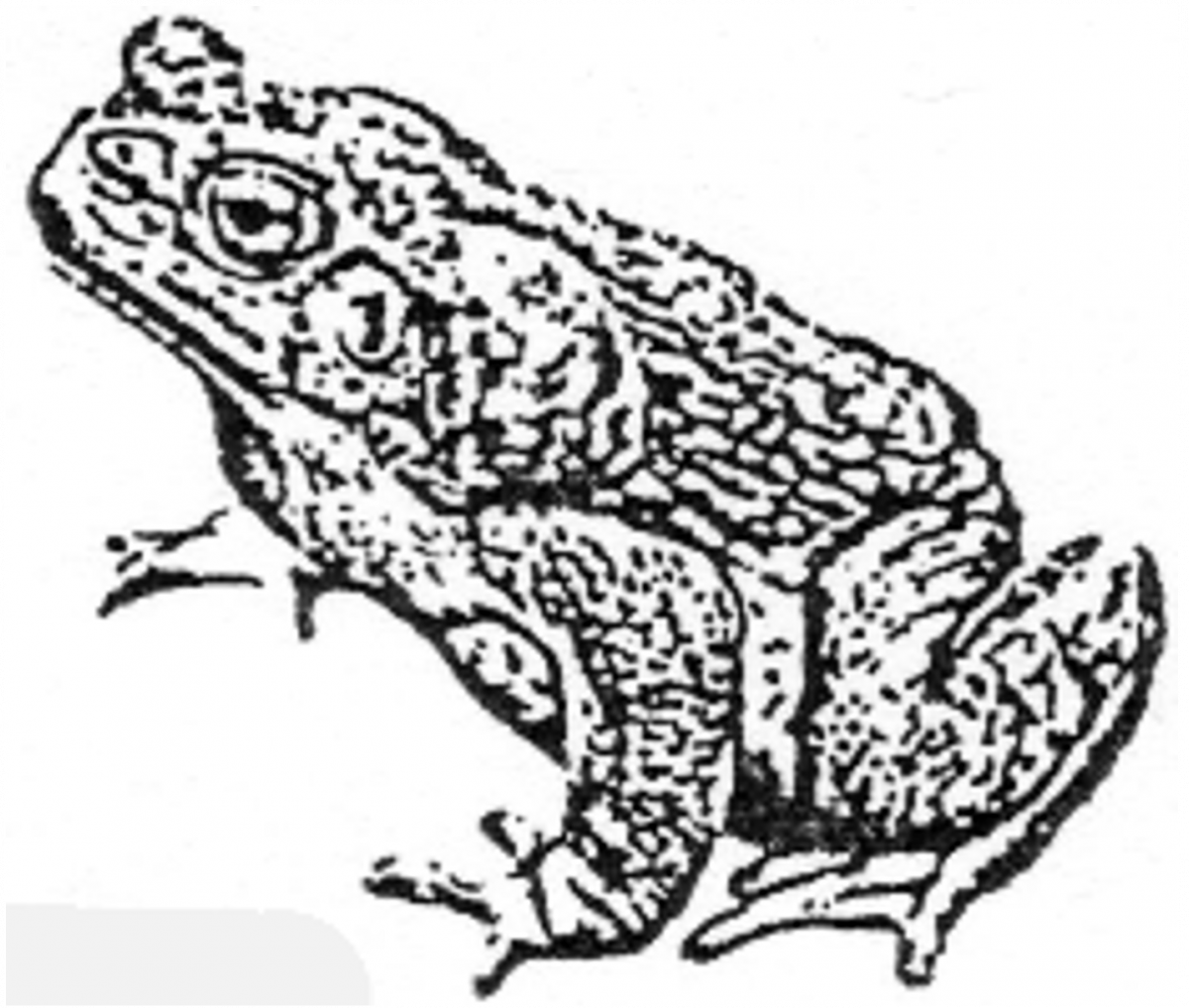
“…and then the boys got a baseball bat out of the bus and ran back to the public toilets. The fluorescent lights attracted the cane toads. Anyway the boys began belting the ugly amphibians all over the place – ugh – disgusting creatures!”
“Who, the boys?” said the Teacher Educator quietly.
“No silly, the toads! Oh, I know it’s a bit cruel, but the toads are a pest; and they destroy wildlife and, and they’re not even native you know. By the way, why does nature let things get out of hand, like plagues of toads? One boy – ha, ha, ha – poured metho on one and…well it wasn’t funny really, he burnt himself, quite badly!”
“Too bad.” Replied Teacher Educator without sincerity “Actually nature doesn’t let things ‘get out of hand’ – or balance. Man creates the imbalance, and nature desperately tries to right it. Take the humble cane toad – a sacred symbol in some ‘fairy’ tales – it is the loathsome body the young ego (prince) is condemned to incarnate into.
Anyway, the farmers raze the tropical forest, and act of indecency without equal – there’s the imbalance to start with. The original ecology of a region was held in fine balance, with all four kingdoms – mineral, plant, animal and man – enjoying a seeming eternity of mutually-supporting nurture. Then the farmers plant thousands of acres of sugar cane – mono-culture. Nature never creates mono-culture – so, imbalance again.
Then they poison the fields, eliminating almost all animal (astral) life – a whole kingdom exiled – more imbalance. And the cane toad appears; he’s one of the few that can survive in this desolation. He is an animal with powerful astral forces, and is welcomed by the now soul-deprived earth, which encourages his prosperity – balance at any cost. And by the way, cane toads do not invade pristine Australian wilderness – they only spread in plague proportions into other areas of imbalance – like public toilets!”
“Save the cane toad!” chirped a skeptical Class 2 teacher “But we weren’t here to talk about that; I want some help on the teaching of my 3rd Science main lesson: The Four Kingdoms – Child in Nature.”
“Okay,” replied Teacher Educator, his eyes fixed on the little garden statue of Tara, Goddess of Compassion, as she contemplated a pink waterlily. “firstly, the equivalent main lesson in Class 1 was the Four Elements – Child in Home and School. Remember that one? Good, so this is the next step out, from home into nature. Both nature and man first appeared in tier present forms only in this earth incarnation – and only into hard, mineral form in Atlantis. Nature preceded man in its descent into matter; at first in a manner of unspeakable brutality – the Age of the Dinosaurs being only one example.
For about the first half of this earth’s life – the ‘Mars Earth’ – wilderness held sway, the pitiless but infinitely wise nature forces have intimidated little mankind for most of his sojourn on the planet. The earth was a tooth-and-claw expression of these wanton Mars forces.
But as we proceed through the 2nd half – the ‘Mercury Earth’ – the kaleidoscopic currents of civilization will increasingly hold sway; turning the tables on nature – taming her! Mercury was the God of Culture, of Arts and Sciences. Even now we witness the global demise of creatures of a savage, primitive disposition, from sharks to tigers. Centuries ago, our first priority was protection from the beasts – now we legislate to protect them.”
“That’s all very well, I belong to the conservation movement; but what’s all that got to do with teaching my class?” The Teacher’s eye was caught by the gilded flash of a goldfish as it darted from beneath a lily pad – Tara saw it too.
“It’s really a matter of attitude;” replied Teacher Educator “you see, man was exhorted in Genesis to ‘subdue the earth’. Well we’ve certainly done that! But this only refers to the Mars Earth I mentioned, the ‘before Christ era’. The invocation for the planet’s 2nd half-life, the Mercury Earth, is, from the same book, to ‘replenish the earth’. Your children are the new generation of stewards of this planet-under-siege; let’s hope they do better in the replenishment stakes than we did – though from our public toilet story, they haven’t really made a good start. If they go into life with the moral conviction that they are responsible for the 3 lower kingdoms, then life will flourish once more.
Your conservation movement, in spite of their hearts being in the right place, make 2 serious errors. The first is that the utopian view of an untamed world of endless wilderness is possible, even desirable. It is not in the destiny, or nature, of the Mercury Earth to return to wilderness, and the amoral savagery it engenders.
The second error is the contention, born from the materialistically polluted well-springs of a university education, that man is an animal. In short, that there are only 3 kingdoms!
An animal cannot assume responsibility for other animals; but a 4th kingdom, the human, can – and must. The taming of nature advances all of its members; the modern dairy cow is a more highly evolved animal than its wild-eyed progenitors.
In the story of Noah – a prophetic picture indeed – the old Atlantean separates ‘clean’ from ‘other’ animals. The taking on board the ark of pairs of each species only refers to the ‘others’. Of the ‘clean’, or domesticated animals, he took 7! A whole herd, a soul number – read it!”
Class 2 Teacher shifted uncomfortably in her seat, wondering shy Noah bothered to take cane toads on the ark in any case; after all, they could swim! Tara observed the turbulence in her soul.
“It sounds like the 2 gardens of the Prometheus story,” she said thoughtfully “the Mars Earth is the wild, life-filled exciting but dangerous garden of Prometheus – ‘the god that goes before’. And the Mercury Earth garden is the manicured lawns of his brother, Epimetheus – ‘the god who follows’. How did the Greeks know these things?!”
“You know them.”
“Hmmm, I see; well I’ve done the homework you set me, to describe the biography of an ecological region of some kind, containing the interaction of the 4 Kingdoms. I wrote a story of my own property; when we bought the place, it was just degraded cattle country, poisoned and lifeless. So we began planting gardens of all kinds, even before we built. We had fruit trees, tropical exotics, deciduous trees, a vege patch – and we left some open space for lawn. I represented the mineral, the 1st Kingdom, in the landscaping.
Each type of plant attracted its own social group of animals, which in turn supported other animals up and down the food chain.
The we designed our house to harmonize with this ordered but seemingly ‘wild garden’. The house was built using the same principles employed in temple architecture in the Orient – the building actually enhances the mineral, plant and animal environment, not detracts from it. These Feng Shui, or ‘wind water’, geomantic laws have the same wisdom base as the wilderness.
But I see what you mean, man is an inescapable part of the nature equation – one 4th in fact – the 4th now responsible for the flourishing and indeed survival of the other 3 kingdoms.” Student Teacher rested back in her chair, her burden lifted.
“That’s good; weave those concepts into story images, personifying various important aspects (giving them names, speech and so on), and the children are not only learning significant lessons – they are enjoying it!” The sun had moved, and a bright halo rested on the head of the Tara statue. She glanced up at this mention of imagination in teaching.
“There are lots of story ideas for this main lesson,” continued Teacher Educator “one can create a different 4 Kingdoms environment tale each day; or keep the same characters in a serial. Two kinds should be represented though, the human/wilderness theme, and the human/domestic. A few comments on the former:
These stories are often about journeys – usually of folk about a year older than your young audience. Here the adventures communicate with members of the other 3 kingdoms, and are invested into their mysteries.
Very often, it’s the theme of the cruel or ignorant, learning compassion by being saved by their former ‘victims’. A story of someone showing charity to a cane toad might be a good start!” Tara smiled at this, but no-one noticed. Class 2 Teacher inspected her sandals.
“One of my favorites as a child” continued Teacher Educator “was Leslie Rees story of Digit Dick – digit means ‘finger’ as you know – finger Dick doesn’t sound right somehow…er…!”
The Teacher was relieved that the mantle of embarrassment had shifted onto his shoulders. After checking the small statue again – she was sure it smiled that time – she went on.
“I know that one, Digit was so small that he slept in a matchbox. I loved his adventures in The Great Barrier Reef. Come to think of it, it wouldn’t be so hard to craft a story like that, taking in aspects of one’s own children too, which is what makes it better than the book.”
“Yes, dependence on book stories is a hazard, diluting one’s own creativity. I know one teacher of littlies who reads the same banal tale to her glaze-eyed children every day – for 3 weeks! This is educational lunacy of the first order. There is a very firm proscription against reading for young children of anything at all, let alone the same story over and over again. Steiner enjoins us never to give primary to the written over the spoken word – even for adults, let alone children. This mindless repetition is a sinister kind of brainwash – or should that be soulwash? – and usually with the most appalling, morally destitute material you can imagine! It is a combination of cultural incompetence and creative indolence.
Sorry to get distracted…um, environments can be described as living beings, especially in relation to their biographies: islands; volcanoes; valleys; a single tree; climate zones – but be careful to include all 4 kingdoms in the tale.
The second type of story, representing the Mercury Earth, is the human/domestic natural world. I had a story about 2 children being shrunk (even small than fingers!) and taken into a beehive. There even went with the bees on their blossom visits. The story had its share of dangers, with near escapes from enemies like spiders and bee eaters (Rainbow Birds)! The children, on their safe return home, longed to keep bees themselves; which they did with success, due to the valuable ‘inside’ information they had acquired.”
Class 2 Teacher sat up with interest “That could be combined with an afternoon block lesson in the agriculture program – apiary care! What practical reinforcement of the concepts taught in then main lesson.”
“Yeeess – good idea.” Agreed Teacher Educator smiling to himself, and then to Tara “Bees were particularly apt as they are a visible expression of cosmic Love – lust as she is.” He nodded in Tara’s direction, her enigmatism a shield against the profane “The mission of the Mercury Earth is to incarnate love into life. Love to animals or humans can hardly be described as having been the over-wheening virtue in the pre-Christian Mars Earth! Love is the power of the in-streaming ‘T’ of the divine; that which nurtures the ‘D’ of the living earth. These are the mysteries of Leo, or as the Greeks portrayed this same force, Apollo – the revelation of life. I’m sorry, I do go on…concepts, concepts! But art redeems this, so get busy on a story, song, poem, play – or whatever you feel expresses these ideas. Leo is the Class 2 sign.”
“All in good time – yes, bees are a good image of this Mars-Mercury changeover; bees were once wild and horrifically vicious. Today a beekeeper, himself in an unconscious way initiated into the Love Mysteries by virtue of his sweet associates, can handle these potentially dangerous creatures with impunity – aided by immunity no doubt! But what story did you choose for, say, the mineral kingdom?”
“Well, there’s a lot of waffle talked about Gaia, Mother Earth – Demeter to the Greeks, who really knew her nature. ‘Waffle’? Only because the concepts are not grounded in esoteric knowledge – a great Astarte (Sumerian) is a supersensible principle yes? Unknowable to the limited perceptions of natural science, who, as Rudolf Steiner tell us often, can only know the corpse of anything, the physical body. Anyway, I went in search of her blow the earth, in doing so, following Steiner’s indications, we went on a journey which found more just Ceres (Roman), but much more of a supersensible nature, 9 other realms in fact! Most esoteric schools teach about he 9 Layers of the Inner Earth (even Dante); but only one is Gaia Layer!
The children in the story entered through a wombat hole into the physical body of the planet – the true mineral earth, the crust. Then they staggered through the life-inimical Fluid Earth – down to the Gaseous Earth, where feelings were annulled. Then through the Form Earth – to the Halls of Gaia herself, the Fruit Earth. This is a realm of unbridled growth forces, held in check only by the sandwiching of the other layers above and below.
These are the nature forces we must be conscious of, harness – and civilize – for the future well-being of Earth and Man – and even the Spirit! The story proceeded to the 6th realm, the Fire Earth – a region of mindless mineral passion – yes, things are different down there! – which is influenced by like excesses of humanity far above. This can result in earthquakes and volcanoes! Then on to the reflective Mirror Earth (all Seiner’s terms); and then the Divisive Earth as the ‘Cain’ layer.
Finally the earth core, which our little heroes were mercifully prevented from entering. The were returned to their country schoolroom by a winged, white stallion – a symbol of cosmic intelligence – a faculty which will be increasingly necessary to inform the well-meaning but often ignorant love impulses. Only then can they redeem a dying earth.”
“And this 4 Kingdoms main lesson is a tiny droplet of that faculty in an ocean of evolution,” cut in Student Teacher, her heart pounding with enthusiasm “But what an important droplet! It is a lesson concerned with the dichotomy of knowledge and love traveling in tandem into the sunrise of the future…” How she could wax lyrical when excited! She rose to take a closer look at the Tara Statue “It’s funny how the moving sunlight plays tricks with your eyes; I could have sworn that she was looking straight at me then, her expression grave. But now her eyes are resting on the waterlily. Her left hand is by her side, the ‘digits’ are circled – what does that mean?”
Teacher Educator took a deep breath before answering, his task almost done “Her left hand is at the region of the Moon Chakra, the Mulhadara – the realm of earth knowledge, the wisdom of nature – the 4 Kingdoms! The right hand is interesting also, it…”
“I know, I know,” she did get impatient with ponderous explanations “but what’s that white foam in the pond near her fee? She seems to be protecting it.
“Can toad eggs.”
“Gulp!”
“Now children today we’re going to have a story in our 4 Kingdoms main lesson called, Tara and the Can Toad: Once, it could have been here, there, or anywhere; a sad little can toad called – un, Claude! – looked back at the cold fluorescent light of the toilet block. He could hear the harsh, pitiless laughter of the group of boys as they sauntered back to their tent, baseball bat swinging. Claude had escaped – just; he turned back to the dark night. What future could there be for one so friendless and alone…and so ugly, or so everybody said – almost everybody…
JOURNEY TO THE CENTER OF THE EARTH
A mineral vault, a hall of stone,
Of lime of coal – a world of gnomes.
We’re going down, we’re far from home.
But back we cannot go.
The terrible damp, the wet, the cold.
We grew so tired, we grew so old.
The ground beneath us seemed to roll.
But back we cannot go.
The breezes round us seemed to play,
We felt so light, we felt so gay –
And then we felt the other way!
But back we cannot go.
In ‘substance’ we were all around,
No longer to ourselves were bound.
We moved our shapes along the ground.
But back we cannot go.
A lovely garden lush and green;
The largest fruit we’d ever seen.
The plants grew over where we’d been.
But back we cannot go.
A seething sea of lava hot,
Eruptions roar, a rain of rock.
The key to open up the lock.
But back we cannot go.
Now green to red – now black to white.
We could not even trust our sight.
We’d say ‘Good-day.’, we’d mean ‘Good-night.’
But back we cannot go.
Now here we skip, we’ve quarreled so,
We’ve come a long, long way below.
Put fear to sleep, let courage grow.
But back we cannot go. (we hope!)
The blackest hole !!! a stallion white.
It saved us from the terrible sight.
A magic ride up to the light.
Now back to school we go – Yo!
Full music notation in my book 33 Sun Songs.




Leave a Reply
You must be logged in to post a comment.