
 JEWEL IN THE CROWN OF THE BLACK PRINCE
A large olive grasshopper flew in and landed on the window sill of the sunny breakfast nook at the Family Foresight’s. “Ooh!” said Mother “Look at the size of his legs – I bet he can jump high.”
“They’re not just legs, there his fiddle bows as well; see those golden thorns and washboard ridges – he can play the Grasshopper Rhapsody louder than Al Grasby’s ties.” Replied a jovial Dad.
It was Saturday morning, the mood was relaxed, the work/school week over. 14-year-old Michael looked up from his cereal. “Talking about loud, my science teacher talks loud. I have to put my hands over my ears sometimes. Why does he do that?” Mother glanced up from the World News section of the newspaper, grateful for yet another release from the tedium of coups, elections and political posturing. “Maybe he’s slightly deaf,” she proffered “that makes some people speak loudly.”
“He’s not deaf – he hears everything, he’s got invisible antenna!”
“Antennae – the plural is antennae; like a moth.” Butted in Clio with the full weight of the authority of her 18 years. “Moths haven’t got ears, they sense the wing vibrations of other moths of the same species with their delicate fringed antennae. Butterflies are visual rather than aural creatures, relating to color rather than tone. My history teacher told us that the reason every species of moth has a different wing design, is to create a specific frequency which can only be received by moths of the same frequency who are ‘tuned in’. At least I think that’s what she said; you can hardly hear her sometimes.”
“Your history teacher, what would she know about science?! But that’s similar to cicadas – ouch!” said Dad, juggling hot toast onto the plates “Like all other invertebrates, cicadas don’t have ears either.”
“So if they don’t have ears, why do they make such a racket?” queried Michael “anyhow, when I said ‘antenna’, I meant like radio.”
Dad looked up in interest “The first radios were called crystal sets, because a chip of quartz crystal, of silicon …”
“A silicon chip! Now you’re talking my language” crowed Michael.
“Yes, silicon was the resonating element in early radio, just as it is now in computers. Silicon vibrates at specific frequencies. Hey Son, what do you notice about a cicada – say a Greengrocer?”
“I know, it’s got a crystal in its head. Black Princes are by favorite!”
“Right, now you know why the jewel of crystal is there. Peanut butter?”
“So Black Princes only receive the sound frequencies of other Black Princes” sang Clio “I like Yellow Mundys best. The exterior sound-creating organs of the on-hearing invertebrates are like… external larynxes” she continued hesitantly “and the various mechanisms for receiving like-species sound are actually exterior ears. But how does sound production work? In human I mean.”
“Ask my science teacher, he’s the sound expert – loud sound anyway.”
“Michael, keep your… voice down” snapped Mother in exasperation “Besides, I don’t need to ask him; I’ve already asked my singing teacher. She said voice production is broadly divided into 3 sections – the Syrinx, Larynx, and Pharynx. Syrinx means ‘pipe; or ‘pan pipe’ form the Greek due to the main element being the pipe of the traches.” A soft rustle distracted her, she had sensitive hearing, her concha was very large indeed! The grasshopper had moved right onto the table, as if he wanted to join the conversation. “Trachea means ‘rugged’, due it its very strong construction. The Syrinx, in its broad interpretation, is the will aspect of speech. It extends right down to the source of the motive power of human vocalization – the diaphragm. Then it works its way up through the lungs and the bronchial tubes right to the voice box, the Larynx. The Syrinx give speech power – or Volume!”
“My science teacher packs a Syrinx Sockeroo – like the Great Crusoe, that opera singer.”
“It’s not actually what you say Michael – it’s how you say it. You’re right though, the big-volume voices are the big-chested people. And the name if Caruso!”
“That’s not my history teacher, she’s built like a bird” said Clio.
“An emu I bet – ha, ha, ha!”
“And your science teacher’s a dodo! So button up Michael. Go on Mum, tell us about the Larynx.”
But Michael would not button up. “I thought syrinx meant ‘sphinx’ – my science teacher told us that the ancient Egyptians built a stone larynx into the mouth of the Sphinx, so that when the air inside heated up and expanded, the Sphinx went ‘Whooooo!’ Pretty scary eh? He also said something about the sound making crops grow better – ha, ha, ha – sound can’t make things grow better – can it?”
“Very interesting Michael” said Mother smoothly “The larynx is comprised of a cartilaginous box with muscle attachments. These tighten and loosen the 2 vocal chords stretched across the windpipe.”
“What do they do?” said the two siblings.
“They control pitch – tighten the chords and we raise the pitch – the voice becomes high and tense.”
“Like yours when Michael irritates you Dear?” said Dad, with model modulation.
“If you insist – yes! Of course loose chords create low frequency, or deeply-pitched sound. Something like your father’s, grrrr!”
My secretary says that I have a voice like fine old port wine.” Rumbled Dad mellifluously.
“She would! I’m sorry, I’m sure she’s a very nice person.” Riposted Mother, damning with faint praise “Pitch is related to the feeling element in sound – here we find our major and minor scales. The pitch of a baby’s cry is designed to aggravate a mother’s pitch ear, so that attention to the problem – wind or whatever – is prompt. Remember Michael Dear? Talk about wind!”
“Ha, ha, good one Mum,” laughed Clio “So what’s changed?!”
“Anyway, a piece of music written in minor scale stirs the soul with feelings of pathos and nameless yearning.”
“That’s nice Mum;” Clio looked pensive “it gives me an idea for a song I’m writing about two lovers who are forbidden to consummate their …”
“Yuk! What’s consummate mean?”
“Michael!” barked Dad “go on Clio.”
“No, it doesn’t matter – besides its personal. But Mum, what about the 3rd element of voice production, the Phalanx – or whatever it’s called?”
Well, above the Larynx is the Pharynx – again in our broad terns, this included the soft palate, nasopharynx (nasal passages), epiglottis …”
“Ah, that little dancing bit I see when I open my gob.”
“No Michael – sigh. I bet your science teacher didn’t tell you that. The epiglottis is a yellow sheet of tissue which closes the trachea when you swallow. It prevents food and drink going down the windpipe. What youmean is the uvula, which means ‘greek’ in Grape … I mean ‘grape’ in Greek!! The uvula creates that trilling sound you hear when the Zulus welcome the Afrikaans Security Forces into their villages.”
“Very funny! I’ll make the coffee – besides, my science teacher doesn’t teach anatomy, our history teacher does that.”
“What?! Never mind – the top section, the Pharynx, also contains the tongue, hard palate, teeth and lips – even the Eustachian tubes and middle ear cavities. These all modulate Tone; you know, the clear bell-like tones everyone comments on when they hear our choral group perform. Our singing teacher has a voice like crystal one minute, syrup the next.”
“Yum!”
“You’re so single-minded Michael” continued Mother “The head is really a complex sound box, resonating and giving quality, Tone, to the Volume and Pitch from below. As a ‘head’ activity, and because of the conscious control we have over it, Tone is associated with thinking. Flat tones, flat thinking yes? What is it they call your secretary at the office Dear – The Race caller isn’t it?”
“All right you two,” said Clio the conciliator “but it’s funny isn’t it, that those same three principles are found in almost every musical instrument? – my guitar for instance. My hands create the motive power of the Will, like the syringe … what is it?”
“Syrinx Dear’ a syringe is a pipe too – same word root.”
“Yes the Syrinx – and the strings are tuned to a certain scale and pitch, just like the vocal chords. The sound box of the guitar is its ‘head’ – the tone is so dependent on the shape; the timber used; the craftsmanship … er, craftspersonship?”
“That’s pretty smart,” perked up Michael “see Dad, you should have been a musician and not an architect – here, stir your coffee yourself.”
“Why? You’ve been stirring aplenty. Anyway I was thinking, architects often call the great Gothic cathedrals ‘musical instruments’. I’ve even heard them referred to as ‘stone larynxes’.”
“Then why don’t they make a noise?”
“Oh but they do; of course the buildings need people – as guitars do. Some of the most beautiful sounds ever created by Man occurred in those great structures – both choral and instrumental. Without people, they’re just colossal cicada shells – lifeless and silent. But I was thinking of the plan of a typical cathedral. When you enter, you take a Will impulse with you ‘I will go into the building.’. You proceed down the aisle – a ‘syrinx’ if you like – till you arrive at the transept …”
“Don’t get too technical Dear, remember Michael – um, what’s a transept again?”
“The cross on the plan – you remember Hopscotch? That’s based on the plan of a cathedral. The transept is the cross, where the two arms go out from the altar. The altar’s where the action takes place; where the sound is created – the Larynx of the building. Sounds of marriages and masses; consecrations and confirmations; valedictions and christenings …”
“What’s the apse for then?” broke in Michael sententiously; ‘apse’ was one of the few words he actually remembered from his Art History.
“Well, er, the apse? Right, the sweet sounds then travel back and up into the apse – the dome at the back of the cathedral. The apse is a symbol of the Unity of the Spirit. And the design certainly determines the quality of the sound produced. It often contains the glorious stained-glass ‘rose window’ – an acoustic marvel in its own right, a massive tensioned sheet as it is – like a glass drum-skin! This divine realm behind the altar is the Phalanx of the building.”
“Pharynx!” three voices corrected.
“I know!” said Dad crossly “the Pharynx is a sound box where the various sacraments are committed to the Spirit. I can’t figure out the doors on the ends of the transept, the ‘hands’ of the cross …?”
“I know!” yelled Clio “They’re like those tubes which go to the ears – the, the, Eustace Station tube or something?”
“Eustachian tubes – named after Eustachius, the great Italian antagonist … Anatomist (Now you’ve got medoing it!) who discovered them.” Mother began tidying up the cups.
“Yes, the Eustachian tubes – the transept side entrances are the ‘ears’ in the allegory!”
“More than an allegory,” said Dad “A reality more like it – you wouldn’t call your guitar an allegory would you? The only difference is that the human vice is infinitely more complex than any building – or guitar!” he concluded “That’s why no two human voices are exactly the same; human speech is dependent on human Spirit – that’s why no animal can speak – that’s why …” well, almost concluded!
“My singing teacher says that the most perfect human voice is a child soprano – high, soft and smooth” said Mother sotto voce.
“And arguably the worst voice is a pensioned-off heavy metal head-basher!” added Clio with distaste.
“I kike heavy metal – and you can make your own tea next time!” retorted the obviously injured 14-year-old H.M. fan.
“Will you two stop arguing!?” said Mother impatiently “Now it’s time we all got moving. Goodness, I’ll be late for choir practice – and your father has to prepare his – hee, hee – ‘deep throat’ lecture for the Architect’s Guld. Any ideas Dear?”
“… and the sound escaping latitudinally through the transept is bestowed unto the world… but what about the ambulatory? What? No, nothing special.”
Clio got up, addressing no-one in particular “I’m going to my room to finish that song .. um, to do something.”
“I can’t wait for tonight – the Steel Virgin concert – yea!” said Michael “Hey?! Why do I have to do the dishes?”
The Olive grasshopper slowly walked along the window sill, bathing in the after-tones. His antennae touched the sunlit air – listening to a different frequency no doubt? He stretched his dappled cellophane wings and flew off into the arm ether.
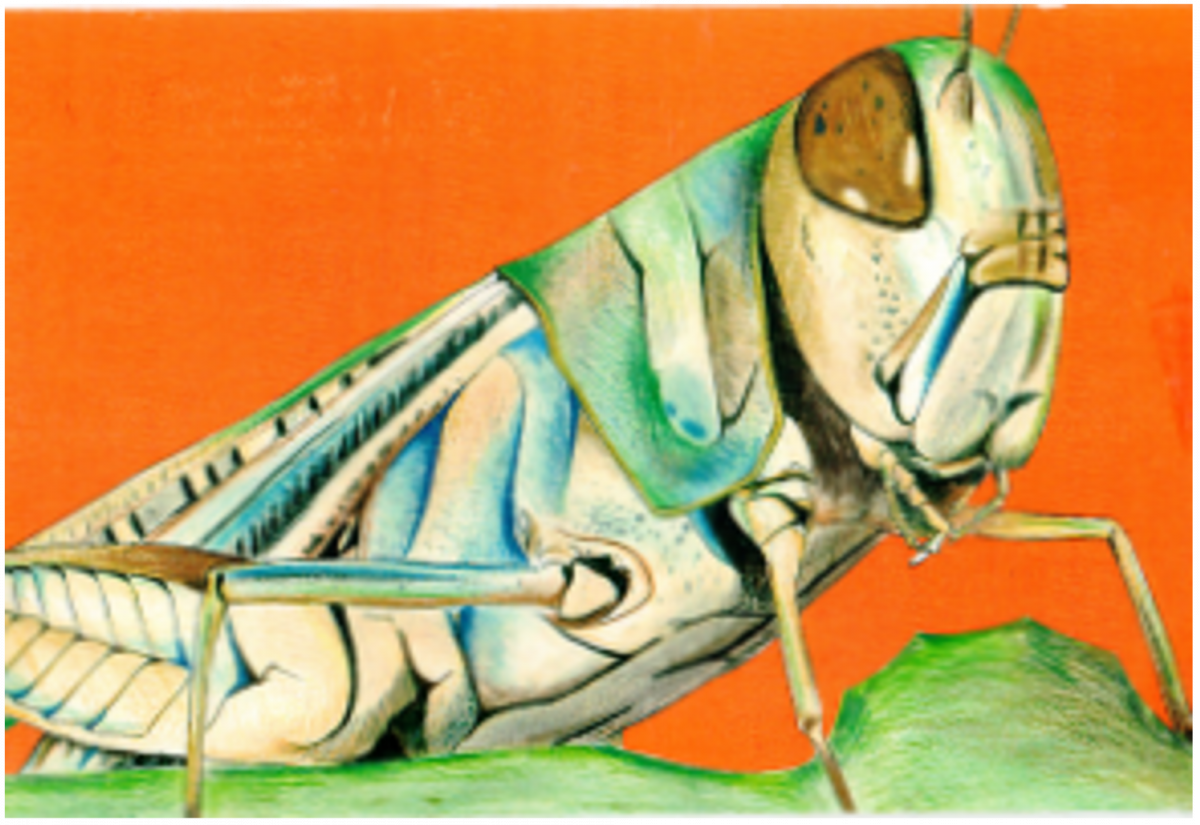
Colored pencil drawing by Stephen Whitehead, Class 10 Lorien Novalis School, 1983
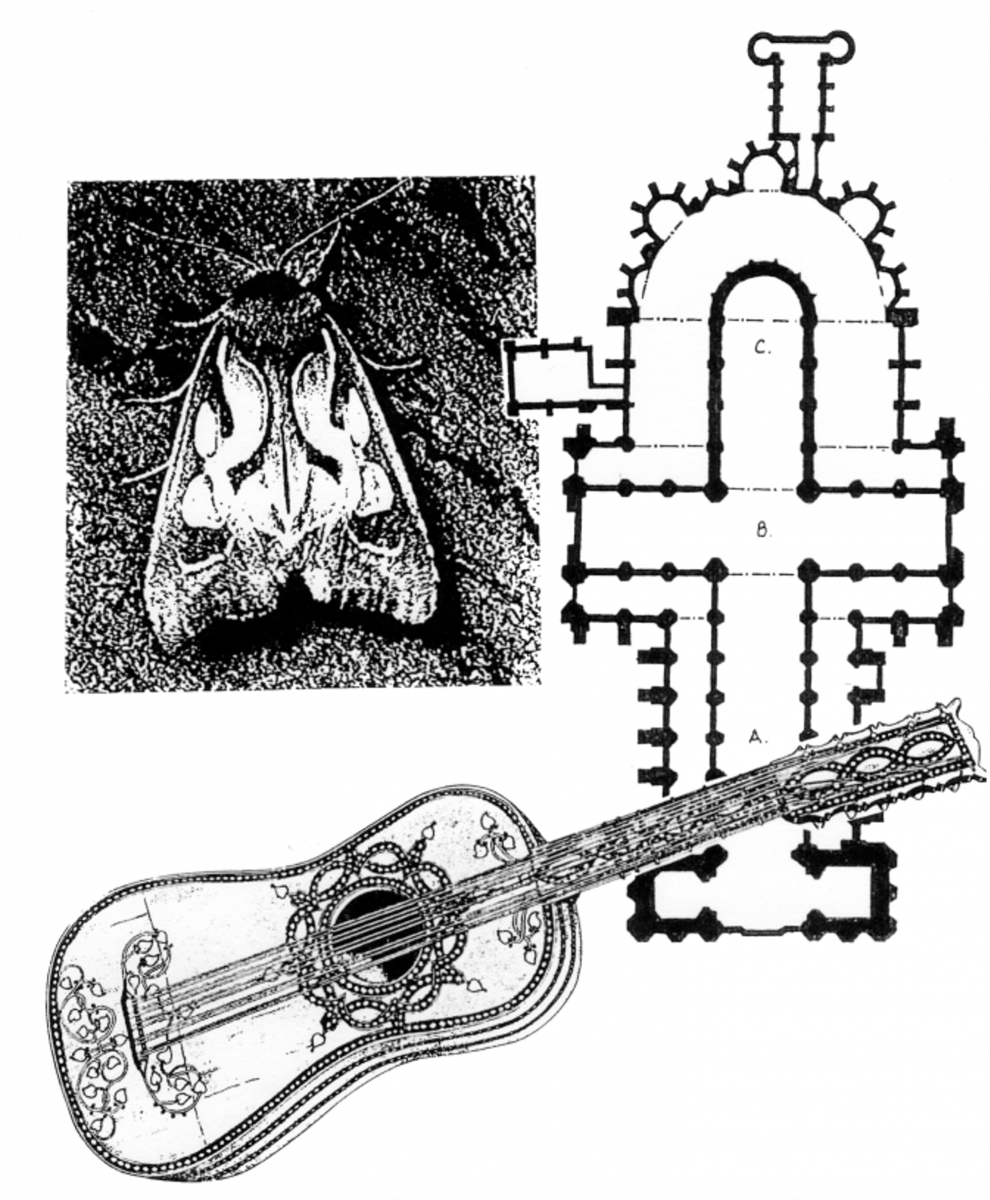
THREE LARYNXES
Left: One of the multitude of Australian moths, each with its distinctive wing-shape and antennae.
Right: Chartres Cathedral with – A. Syrinx B. Larynx C. Pharynx.
Below: the instrument of the 20th Century – the guitar is a microcosmic man, or a macrocosmic larynx.










Leave a Reply