
Copyright Alan Whitehead & Earthschooling: No Part of this book, post, URL, or book excerpt may be shared with anyone who has not paid for these materials.
Alan speaks in a very symbolic and esoteric manner in some parts of his books. Although they can be read anthroposophically, passages speaking of Atlantis, archangels, gods, etc. do not need to be taken literarily to be meaningful. The more you read, the more you will realize he uses many different religions to express ideas in a symbolic manner and not in a religious manner. His writings are not religious. In some places his writings are meant to refer to religious events in a historical way. In some places he is using religious figures (from Christianity, Judaism, Islam, Buddhism, Hinduism, Paganism, Ancient Roman and Greek Religions, etc.) in a symbolic manner. However, at no point is he promoting a specific religion or speaking from a religious point of view.
I have kept the writing as close to one-hundred percent original so you will also find that he speaks of Australia often and some spelling or manners of speaking may be cultural. Any words I have changed are presented like this: <word>.
Also keep in mind that these books are written by a Waldorf teacher with decades of experience who also studied with a Steiner student himself, so he speaks to an audience that is dedicating their lives to the Waldorf method without exception.
Because of this, all of his views are not reflected in the Earthschooling curriculum and not all of them may be ones you want to embrace or are able to use. In all of Alan Whitehead’s writings the opinions are his own and may not align with Earthschooling or Waldorf Books. In some cases, we will be updating some of these chapters in the future with additional and/or updated information.
Ultimately, however, as I read through these passages I find I can distill wisdom from even those paragraphs that do not resonate with me.
We invite you to read with an open mind and heart and with eagerness to learn and discuss…
LIFE BEHIND THE SCENES
Microbiology – Class 11 – Main Lesson
My introduction to this 3-week main lesson with Class 11 took the form of a discussion on dimensions, or scale. The word micro means “very small”, and molecular, “minute particle”. Humankind’s perception of size – or space – in the last few hundred years has changed dramatically; more so than in the whole of history. This is due to two inventions, both arriving in the world – and equally altering our dimensional consciousness – at about the same time. They are the telescope and the microscope.
Mankind sought in vain to find God in His (Her…It’s?!) heavenly home. Instead we just discovered more and more of the same – space and stars! In line with a religious outlook of God above and the Devil below, we should have found the latter with the rapid advances of the microscope; leading in time to the powerful electron microscope. Actually we did find the Devil down there, or his demonic hosts at least, in the form of disease-bearing bacteria and viruses.
Curiously God was also there, as most of these “minute particles” discovered actually support, and are indispensable to, life. We could not even digest our apple pie and cream without ta veritable armada of intestinal “germs”. This minute world is incomprehensibly complex, and a mere 15-hour unit cannot hope to more than overview this fascinating area of science. As such, a Lesson Plan is a good idea to invite a degree of formality to the study (or for any subject for that matter).
My lesson plan went something like this: Monday: Introduction; history; microbes; plague; microbiology. Tues.: Animals, whole organism, function, energy production, photosynthesis, classification. Wed.: Excursion C.S.I.R.O.). Fri.: Bacteria. Mon.: Viruses. Tues.: Animals, whole organism, classification. Wed.: Cellular structure; protoplasm. Thurs.: Protists. Fri.: Metabolism; food chemicals, proteins, vitamins. Mon.: Enzymes. Wed.: Health and Illness; drugs; pollution; resistance. Thurs.: Test essay. Fri.: Read essays, finish work.
This structure of study areas (mine or yours) should not be thought of as a prison; or as restricting the spontaneity of the learning community in any way. Rather it provides a scaffold of security and confidence for the teacher; and a vision of the coming three weeks for the students. No plan can lead to serious sins of omission. From this road map of learning, one can always deviate and return, or if necessary abandon all together if better idea eventuate as the Spirit of the Lesson manifest.
I deviated and addended often; though I generally find that I adhere fairly closely to my lesson plan. This is probably due to experience; I usually know what I want to achieve before I start. After all, the above is the body of content I want the students to be exposed to. This fits into an even larger plan, the whole year – and larger still, their entire high school science stream. Within this there are three sub-plans, based on the three science strands of Physics, Chemistry and Biology. These evince from our young learners’ powers of (all in a cognitive context) the three soul forces of will, feeling and thinking – in the same order.
Microbiology is of course programmed in the third. This Biology strand began in Class 8 with Botany (see my book La Pleroma); Class 9 Zoology; 10 Physiology (both in A spiritual Science); and in Class 12, Genetics (see later in this book). This Life Sciences 5-year path is also size-determined, with Botany containing the largest living things, like mighty trees such as Australia’s own record-holder, the Mountain Ash. Zoology is next with its many huge animals (whales); the human scale follows with Physiology; the “minute particles” of this unit are next; and finally to an even smaller “behind the scenes” world with the mystery of Genetics in Class 12.
Microbiology is the best lesson in which to introduce the microscope. Nothing fancy is necessary at this stage; but it would be good if the students, on an excursion to a hospital or research center, could at least look through an electron microscope. This is done with prudence, as Rudolf Steiner describes the microscope as a creator of illusions. He based this once again on the scale principle. When we see, say, a polio virus enlarged, we invest it with a different status in the order of creation.
Part of elephant-ness is its bigness, an inch-high elephant is not an elephant, it could not move like an elephant, nor embrace elephant habits. A virus is on millionth of a millimeter; when we observe it as large as, say, a small insect, is to have a distortion of reality. This is not to say we don’t use microscopes, but we must take into account the effect of this deception, which is to blind us to the metaphysical reality behind polio. The virus is not the disease, nor does it even cause the disease; it is merely an expression of it. The disease is a spiritual entity.
It is instructive to expound on another Life Sciences formula, the Seven Life Kingdoms. These are related to the Seven Planets, with man representing the Sun around which the other six orbit. The inner planets of Moon, Mercury and Venus provided the creative impulses for the three visible kingdoms, Animals, Plants and Mycota (fungi), in the same order. The more enigmatic outer planets guide the destinies (yes, every living thing as a destiny, even a germ!), of the Bacteria, Protists and Viruses – Mars, Jupiter and Saturn. This cosmic-to-earth association provides a wealth of insight on the nature of the myriad organisms in the world.
Using the scale principle, I began the lesson with the Plants, providing an overview of the seven great floral division: Mycota; Thallophyta; (seaweed, algae); Bryophyta (mosses, lichens); Pteridophyta (ferns); Gymnosperms (‘naked see; – cone bearers); Angiosperms, meaning ‘enclosed seed;, these are the glorious host of flowering plants, both monocotyledons (like palms) and dicotyledons (roses et al). Some Spiritual Scientists order these seven slightly differently; combining, say, mycota and thallophyte in one, and separating mono and dicotyledons.
This lesson is however not on botany, the quick revision above serving merely as a prior-studied foundation upon which to build the new edifice of Microbiology. This should rather highlight the history of the unseenworld of ‘minute particles’, or microorganisms.
In 1680 Robert Hooke, with his new microscope, was the first to behold a living cell. It was 150 years later, in 1796, that Edward Jenner, in studying milkmaids (or the health thereof!) observed that they were virtually immune from that scourge of the age, smallpox. Jenner used the less lethal cowpox in his vaccination experiments.
Then there was the British surgeon Joseph Lister, who first used antiseptic surgery in 1865. Another giant among the Molecular Biology giants was the Frenchman, Louis Pasteur; he launched his illustrious career by studying diseases in silkworms, but whose name became immortalized in the term ‘pasteurization’.
Of the plants, the fungi are the threshold between the visible and the invisible (macrobiotic) worlds. Again it was Pasteur who, in 1861 revealed this remarkable world; one which included algae and bacteria. This was incidentally the year of Rudolf Steiner’s birth, an investigator of another, a higher, invisible world. Most of the bacteria etc. are heterotrophic, they require their food to be made by one or two other processes. The first is death; the Saprophytes, in devouring dead material, assist in decay. A body will not rot in a sterile environment.
The second group feed on living tissue; these are the Parasites (‘beside food’), and many induce disease in their hosts. There are 50,000 known fungi species in both groups, but many more remain undiscovered, as is the case with most organisms (except the higher animal and plant genera or families). The fine threads of a fungi are the main body of the ‘plant’; the visible part, like the mushroom, being merely devoted to spore production. These threads emit enzymes, which enable the plant to digest decomposing matter. Normal air is laden with invisible fungi spores – you’re probably breathing some in right now! Some fungi are autotrophic (‘self-nourished’), while other are heterotrophic, organic feeders. The first are capable of manufacturing complex nutritive compounds from simple organic sources, like C02, H20 and nitrates.
The Mycota include yeasts, rusts, smuts, mildews and molds; they are the basis of the antibiotics (“anti-life”) discovered by Fleming in 1929 as they invaded bacteria in his culture dish. Our own Howard Florey shared the 1945 Nobel Prize for Medicine for his subsequent work on penicillin. St. Andrew’s Fire is fungal-based as well. This was a disease sans cure in which otherwise docile peasants would run raving through the try to do battle with the Devil! They had eaten rye bread, which was infested with ergot, in the form of hard, purple fungal claws (sclerotica). Today this is used to produce LSD (lysergic acid diethylamide). Other uses for fungi include wine, bread and cheese production.
As fungi disintegrate organic matter, they release four gases, carbon, oxygen, nitrogen and phosphorus. Strangely these are vaporous expressions for the four ‘bodies’ of earth and man; in the same order – physical, etheric, astral and ego (phosphorus is the Sun chemical, the sun is the mansion of the Ego). Climatically fungi favor warm, wet conditions; the largest being tropical puffballs which can reach 1.5 meters in diameter. These giants release trillions of spores into the humid ether.
Most fungi are, like humans, mesophilic (“middle lovers”), being only able to survive between 20°C and 30°; though some are thermophilic (“hot lovers”, er, “Love heat”!) living in natural ovens up to 50°C.
Lichens are a combination of fungi and algae; their grey-green being evidence of this symbiotic relationship. When Biodynamic farmers observe lichen on their fruit trees, they know there is an invasion of death forces (the grey). The first thing is to scrape the offending growth off; the second to find the reason for the tree’s decline; the third to rectify it.
In ideal conditions, fungi are immortal; there is simply no natural again process built into their cells. They like acid soils (like pine forests), and most are aerobic, needing oxygen and hydrogen. Some are even, by virtue of their unique digestive processes, phosphorescent. Others are actually animal-like, being predators. They use either a sticky substance to capture their small invertebrate prey, or a cunning loop trap.
A few species of ants get their own back on the animals’ behalf by being fungi farmers. In fact in this again symbiotic coupling, the fungi can’t grow without their arthropodic husbanders. To the gardener’s vexation, sooty mold thrives on honeydew aphids, another species exploited by ant farmers. Fungi are used in the production of organic acids, enzymes (as biological catalysts) and vitamins. Two examples of fungal diseases in humans are Athletes Foot and Ringworm. They reproduce both asexually and sexually; the first by fragmentation, fission (cell division), budding or spores. The sexual procreation however is complex, and better left to try and explain in the equivalent Genetics lesson in Class 12.
Strangely, for such a supposedly primitive plant, only about 500 fossil species of Mycota are knows?! Another cryptic link with the animal world is that some fungi produce chitin, otherwise only found in the cell walls of insect skins. But now to the microscope proper.
This is to study the esoteric world of Bacteria. These are single-celled organisms which spend most of their time, like fungi, breaking down organic matter. Yet they are constructive as well, building nitrates (salts), as in legumes. Here they fix atmospheric nitrogen in those nutritious white nodules. As well as aiding in metabolism, bacteria produce all-important Vitamin B12; as well as acetic acid, indispensable in cheese-making. At the final outcome of this delicious creative phase, they return to their destructive role, and purify the sewage the cheese creates!
The food range of bacteria is vast, the most bizarre being the oxidation of ammonium compounds. They also utilize sunlight to form carbohydrates from C02 to create H20. Iron bacteria also oxidize ferrous compounds.
Many bacteria also exist inside living organisms; but those which can survive in the outside world do so by producing protective coats. Reproduction is by division only, which can be single, double, chain or bunch methods. An example of a double bacterium is Diplococcus, which causes pneumonia; chain – Streptococci – tonsillitis; bunch – Staphylococci – influenza. Pathogenic bacteria can be taken into the body via eating – dysentery; insects – plague; wounds – tetanus; breath – measles.
Aerobic bacteria live only in the presence of free oxygen, as in open wounds, in the nose, or on the skin surface. The anaerobic however love a non-oxygenated home, as in gangrene and deep wounds. Their pathogenic attacks are of two kinds only. The first is by direct cell destruction; the second by the production of toxins. Many bacteria are short lived, other long; tuberculosis bacillus can survive for months in dark, dusty places.
A remarkable therapy most people don’t know about is that many bacteria (and fungi) are killed by just ten minute or so exposure to the sun. An unholy host of rashes, itches and other skin plagues can be cured with a good sun bath! I’ve cured my psoriasis (Gk. ‘itch’) this way. Rudolf Steiner made a profound observation: when normally benign bacteria for some reason migrate to a different region of the body, they can become pathogenic. For example, TB bacilli are harmless if they remain in the head, but become morbid if they trespass into the rhythmic system.
To understand the form implications of this, we must study the three different kinds of bacteria. The Bacilliare rod-shaped (L. baculum – ‘walking stick’). This square, rectangular or right-angles form is nominally that of thinking. Most bacilli diseases are of the chest, like whooping cough, diphtheria (Gk. ‘Leather’) and typhoid fever; the rose-colored spots of typhoid appearing first on the chest, and only later on the abdomen.
The self-evidently shaped Spirilla are related rather to feeling, and dwell – naturally – not in the head as the bacilli, but in the central system, primarily the lungs. That’s why errant Spirilla wandered south can create syphilis (formerly known as the ‘The French Disease’); and those venturing north to the head, the dreaded cholera.
The third bacteria are the Cocci, the round ones (Gk. Kokkos – ‘berry’). These will entities this time are particularly virulent when they migrate up into the head from their abdominal home; where they express as meningitis or scarlet fever. In the latter, the inflammation starts in the hear (even the head-senses system of the unborn, making them blind!), and only later returns to the nether regions.
This remarkable synchronicity, this psychosomaticism of circle-will-stomach-cocci, spiral-feeling-chest-spirilla, square-thinking-head-bacilli is one of Steiner’s deeper insights into human health and disease. The information is a guidepost leading to greater – especially metaphysical – understanding of many diseases, leading to effective, safe treatment. Bacteria are all tiny, from 0.2 to 2 microns; they can reproduce each 15 minutes, and create millions of themselves in hours. They have characteristics of both animals and plants; hence cannot really be classified as either: ‘plantimals’? – ‘animants’ perhaps?!
Even more secretive are the Viruses, again difficult if not impossible to classify (a problem shared in some degree by all the life sciences). The easiest way is to make a comparative study with minerals, especially of their crystal structure. However viruses combine features of both bacteria and minerals. They are much smaller than bacteria, being measured, not in mere microns, but millimicrons – one thousandth of a micron!
The polio virus is a geometric solid, like many common crystals; yet it has a protein-nucleic acid content, like a bacterium. Viruses can however be purified into crystals. Wendell Stanley (1946 Nobel Prize for Chemistry) first did this with the potato virus in 1935; apparently a stupendous scientific achievement!
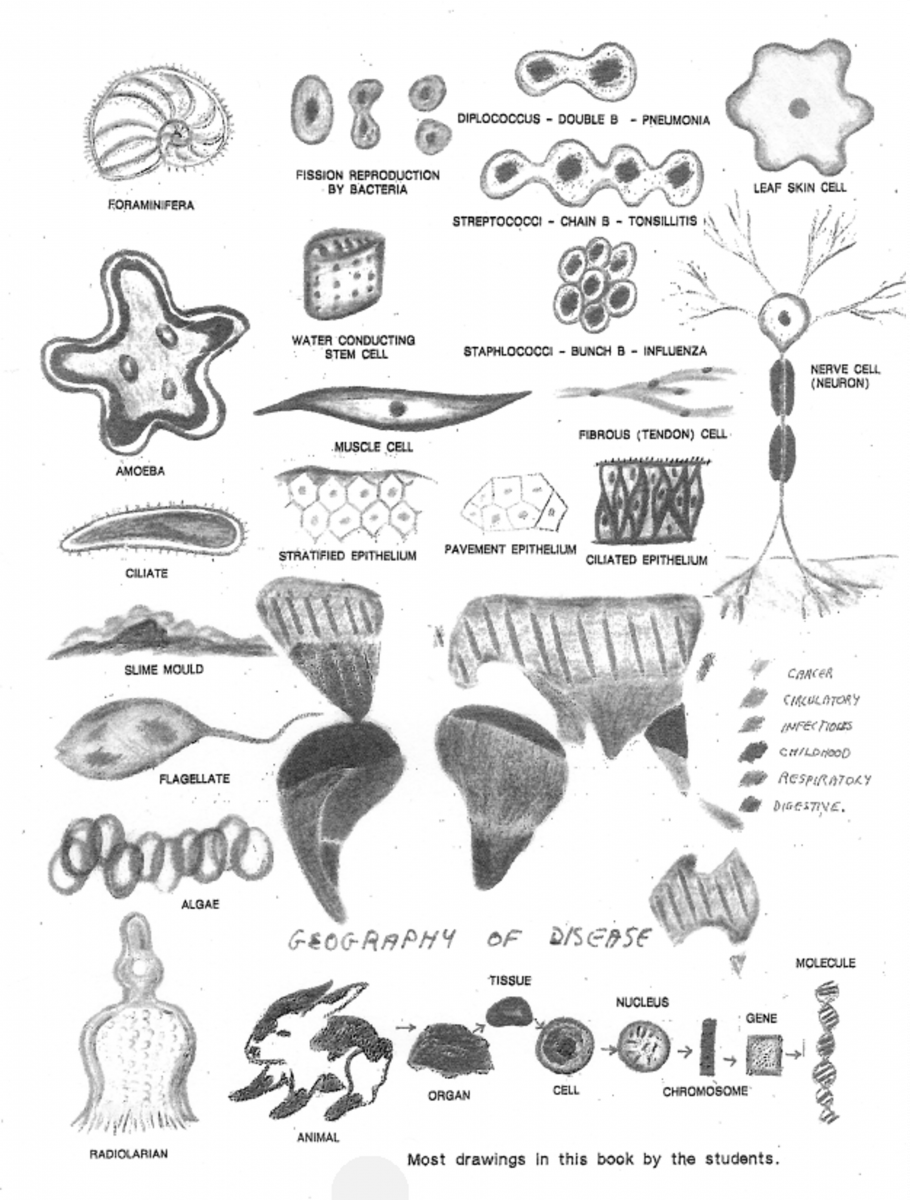
Unlike their larger siblings, viruses cannot be cultured, as they only reproduce inside the cells of their hosts. As this makes their courting impossible to observe, no-one knows how they do It! They are also very selective in their hosts and mode of transport. Viruses are deceptively simple, containing only a protein wall and a nucleic acid inner particle; which is the only part that actually enters the host cell, causing (or being evidence of) infection – virus means ‘venom’! The Protists are probably animals; however many scientists give them the status of a ‘kingdom’ all to themselves – some even include bacteria, algae and fungi – a regular mini-bestiary of form and function. In any case, their name means ‘first’; so the Protists are all unicellular. The Protists were popular with my class because they were such fun to draw, being so fantastic in shape and color as they are (see end of article). Also illustrated was the 9-fold “evolution of complexity”.
This began with the whole animal (say a dog); then one of its organs (liver?); a sample of organ tissue; a cell of the chosen tissue; the nucleus of the cell; a chromosome of the nucleus; a gene of the chromosome; a molecule of the gene; and number nine, an atom of the molecule!
Protists also have their own simple-to-complex hierarchy, which begins with:
- Foraminifera, dear little nautilus-style limestone spirals which have sexual reproduction.
- Sporozoan have both sexual and fission reproduction.
- Radiolarians have a silicon shell, and are mainly responsible for the phosphorescent displays in tropic seas.
- Slime Mold – now there’s a charmer! They are actually Non-cellular, comprised rather of ‘swarm cells’. At one stage of their miserable life, they are called ‘plasmodium’, and are like naked protoplasm (egg white), but with a variety of bright colors, from transparent to yellow, red and violet.
At this time the organism has many nuclei, but these are not divided into separate cells. The Thing creeps along with an amoeboid movement, and when the food gives out it grows sporangia. Inside each globular sporangium are many spores; when this bursts, these single cells (not created by a union of egg and sperm) spill out, Onan-like, as swarm cells to create, when food and environmental circumstances provide, a brand-new creepy-crawly plasmodium! - The good ol’ Amoeba, these are the well-known ‘gingerbread men’ of the Life Sciences.
- The Flagellates (‘whip’), one being called Stentor, named after the soldier at Troy who had a loud voice (akin ‘stentorian’); named thus due to being trumpet-shaped. They cleverly create tiny whirlpools to such in food. Some flagellates even have an eye spot, orientating them to the light source.
- Ciliates aren’t as silly as they sound, being the first creatures to have an anal pore! Actually this list goes on and on, with Monosigna, Globigerina, Coscinodiscus (disc-shaped diatoms), Pleurococcus – but one has to stop somewhere!
An overview of molecularly-induced World Diseases was given (see map at end of article). Surprisingly these are quite regional; for instance respiratory diseases, in the epidemic sense, are mainly confined to south Asia and the west coast of South America; while infectious diseases are most rampant in central and north Africa and South-east Asia.
Although Jenner is rightly credited with introducing immunity-inducing vaccines to the world, the Turks and Africans were doing it, at a grassroots level, 100 years before; as were the Bostonians in the 1790s! Another oddity is that the dreaded leprosy with eliminated in Europe after the 16th Century – after the cultural luminescence of the Renaissance.
The brigands who ‘conquered’ the Wild West will always be reviled for providing smallpox-infected blankets to the shivering Indians. This is akin to the Tartars in the Crimea in 1343, who catapulted plague-ridden corpses over the fortress walls in besiege Genoa.
The unwitting survivors then transported the disease to Europe, where it terminated about 25 million people! The great Plague of London in 1615 reaped a mere 30,000 hapless souls. Here the diseased would be locked in their houses for four weeks, with a warning red cross painted on the door. If they weren’t subsequently killed by Pasteurella Pestis, the bubonic bacterium, they starved to death!
Happily the symbolism of the red cross, that most worthy of global institutions, has improved over the centuries. The plague had completely disappeared by 1720; the flea-infested black rats having been driven out by the disease-free brown rats – you gotta love ‘em! The Yellow Fever epidemic in Philadelphia in 1793 killed 5000. This disease gave its color to the yellow flag, the universal emblem of quarantine. The carrier of this dread virus was a mosquito. An estimated 20,000,000 died in the 1918 world-wide flu pandemic – as if the just ended calamity of the Great War wasn’t enough travail for an exhausted and agonized world!
Archeological records show primitive man – and even relatively recent uncontaminated indigenous societies, like the Australian Aborigines, had quite a long life expectation; approaching our modern age even. The period of a seriously short span is in between during the ‘civilizing’ process; or in today’s equivalent, underdeveloped or 3rd world countries.
In our own culture, the period 7-to-14 is the golden age of resistance; Steiner referred to it as the healthiest period of life. This is because the Life Body is the dominant entity in the human being in this 7-year childhood stage; hence the etheric body is known as the ‘inner doctor’.
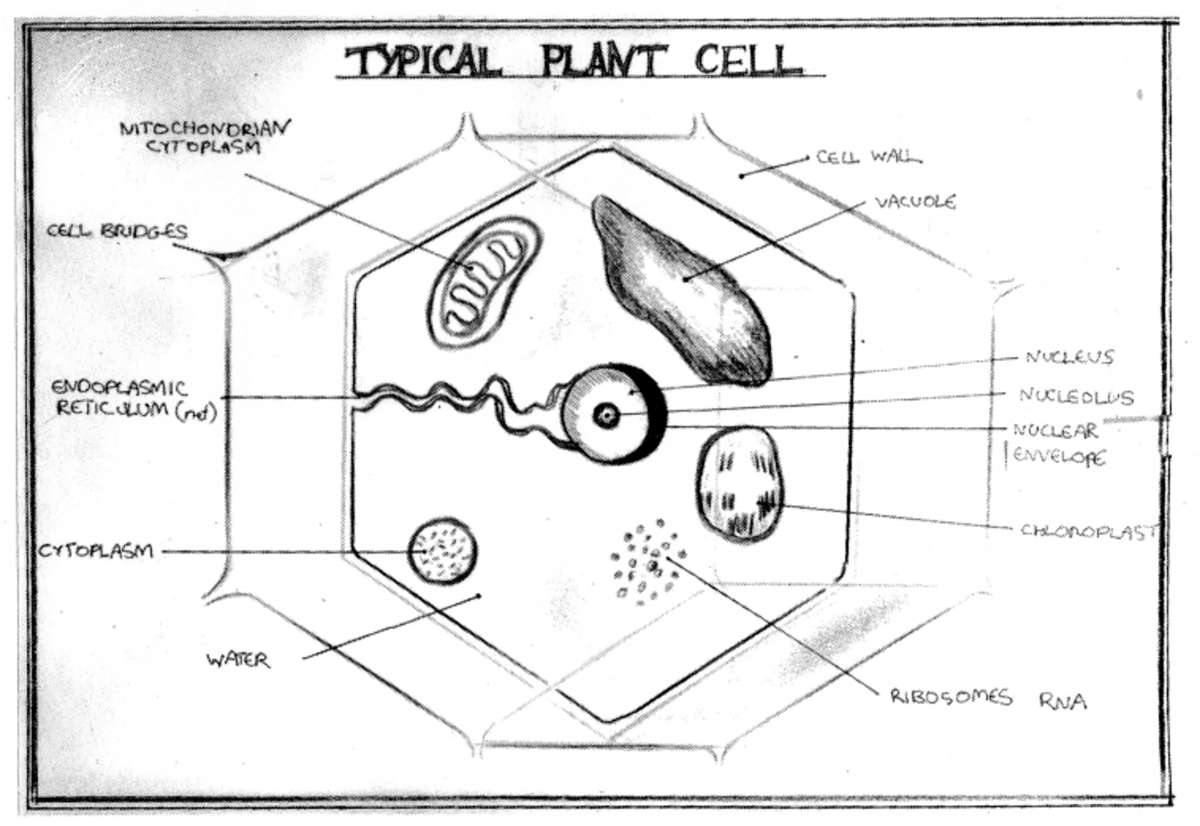
Finally in our study of Microbiology, we examined the cell itself, that mini-universe which repels illness – or succumbs to it. The class did a drawing of a generic cell, in this case that of a plant, to learn its various components, like: mitochondria (‘thread-granule’ – always translate these dreadful Latinisms for the bewildered students where possible!); cytoplasm; endoplasmic reticulum; water (whew!); vacuole (‘cavity’); nucleus (‘nut’); nucleolus (‘source of life’); chloroplast; ribosomes; cell wall; cell membrane…!
Cells of course take infinite forms; we looked at just a few. The first was a muscle cell, the longest of all (the ostrich egg is the largest single cell!), ranging from one 500th of a millimeter to 30 centimeters. A skin cell is only one 10th of a millimeter. Water-conducting stem cells are porous yet relatively simple, while nerve cells are highly complex (see student’s drawing at end).
Cells comprise the material base of all life; in any single entity (above unicellular), there is an apparent infinite variety – yet they all fall into clear divisions. As each cell contains a nucleus, all are capable of reproducing themselves. They are held together in the tissue by a matrix substance, often jell-like, but in bone in the form of crystals of calcium phosphate – in blood it is the plasma.
A community of cells creates tissue’ there are conveniently only five types, with countless sub-types.
- Epithelium is sheet tissue which acts as lining, membrane or covering, such as the dura mata of the brain. Three types of epithelium are pavement, stratified and ciliated.
- Connective tissue binds organs together and packs empty spaces, e.g. blood, white fibrous tendons and yellow elastic fibrous ligaments, as in the backbone. There is also reticular, which surrounds nerve fibers, and adipose, for fat storage.
- Cartilage and bone, of which there are only two kinds; fiber, as in the spinal discs, and elastic – the larynx.
- Muscle tissue is again in just two types, smooth involuntary, like the eye pupil, and striped voluntary, the bicep.
Nerve tissue; one important type being cardiac, that which reliably toils away for 80+ years. In this case it is self-serving, permitting people like me to first teach about it when young – then in the twilight years to write about it! But I’ll let younger hearts, in the form of the following facsimiles of excerpts from a student’s project notes on cells, to conclude this fascinating, often astounding unit.











Leave a Reply
You must be logged in to post a comment.