
Copyright Alan Whitehead & Earthschooling: No Part of this book, post, URL, or book excerpt may be shared with anyone who has not paid for these materials.
Alan speaks in a very symbolic and esoteric manner in some parts of his books. Although they can be read anthroposophically, passages speaking of Atlantis, archangels, gods, etc. do not need to be taken literarily to be meaningful. The more you read, the more you will realize he uses many different religions to express ideas in a symbolic manner and not in a religious manner. His writings are not religious. In some places his writings are meant to refer to religious events in a historical way. In some places he is using religious figures (from Christianity, Judaism, Islam, Buddhism, Hinduism, Paganism, Ancient Roman and Greek Religions, etc.) in a symbolic manner. However, at no point is he promoting a specific religion or speaking from a religious point of view.
I have kept the writing as close to one-hundred percent original so you will also find that he speaks of Australia often and some spelling or manners of speaking may be cultural. Any words I have changed are presented like this: <word>.
Also keep in mind that these books are written by a Waldorf teacher with decades of experience who also studied with a Steiner student himself, so he speaks to an audience that is dedicating their lives to the Waldorf method without exception.
Because of this, all of his views are not reflected in the Earthschooling curriculum and not all of them may be ones you want to embrace or are able to use. In all of Alan Whitehead’s writings the opinions are his own and may not align with Earthschooling or Waldorf Books. In some cases, we will be updating some of these chapters in the future with additional and/or updated information.
Ultimately, however, as I read through these passages I find I can distill wisdom from even those paragraphs that do not resonate with me.
We invite you to read with an open mind and heart and with eagerness to learn and discuss…
FASCINATION, LOVE – OBSESSION EVEN!
Regional Geography – Class 11 – Middle Lesson
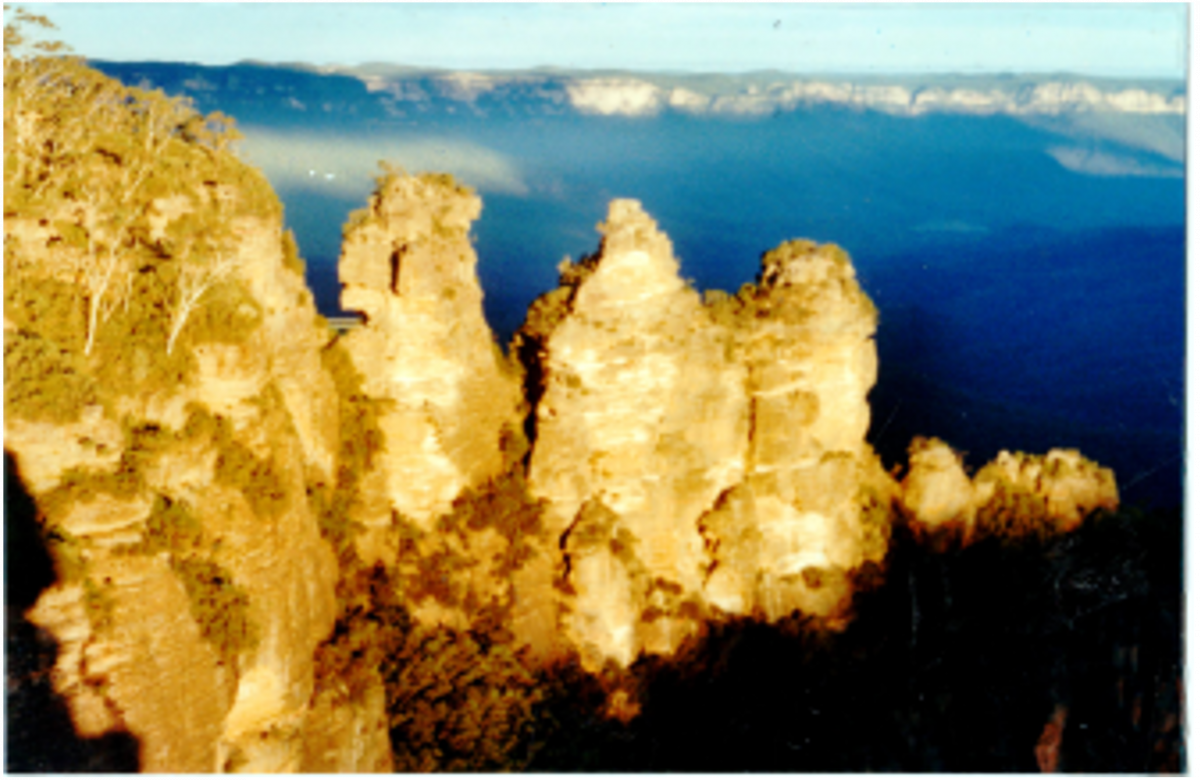
I guess my fascination, love – obsession even! – for the Blue Mountains west of Sydney began when I was about five years young. My parents had taken my beloved grandmother on a train trip to Katoomba for her birthday. I happily shared in this novel and exciting gift. I can still recall the magic of the experience; a door had opened from my rather hum-drum Western Suburbs world onto one of bracing Winter air; of sharp, evocative scents of wet eucalypt forest, of the bell tones and flashes of crimson and cobalt of Mountain Lowrie parrots…and above all, of the sweeping vistas of pink primeval precipices and gorgeous green gorges. From Echo Point, my small family of nature lovers stared in awe at the ochre-blushing Three Sisters, and at silent forests stretching away to the mysterious blue-hazed distance. I imagined this uninhabited vastness to be peopled by all kinds of May Gibbs bush spirits, particularly those in the form of Mountain Devil Men. These flights of (cautionary) fancy were aided by the ubiquitous souvenirs (L. ‘to remember’!), where the hard seedcases or child-high statues of the fire-red Mountain Devil wildflower, had become an emblem of this budding tourist mecca.
When Adam and Eve dwelt happily I the Garden of Eden, there was no need for science – perfection being self-evident. After eating of the Tree of Knowledge of Good and Evil, with the emphasis on ‘knowledge’, the contrite couple were banished form Paradise (Persian ‘walled garden’).
The whole of subsequent evolution has been to ‘become as gods’. This way we might – just might – gain re-entry. A study of science is one of 12 profound pedagogic paths leading to this fulfillment.
The critical issue in relating science to this metaphysical plane, is that the knowledge we acquire of the world must be redeemed – with love. So the cardinal goal of this unit is to encourage the 17-year-olds to love, admire, or at least empathize with the area of study.
One method is to illuminate the concepts – and the secretly yearning heart – with art. Another is to enkindle their souls with practical expression. Thus, we redeem thinking with feeling and will.
The ‘feeling’ at least should come naturally in a middle lesson, as one of the keys to arouse enthusiasm in this part of the day is the Aesthetic. ‘Her’ handmaidens are the many visual arts and crafts with which we can embroider the lesson. There are four middle lesson streams, relating to the four fundamental constitutions of Man of Self, and of Sentient, Life and Physical Bodies. These four streams are Professions; Culture; Social and Industrial. Regional Geography is programmed as a Profession; the expectation being that if a student were to proceed to study this subject at tertiary level, s/he would obtain a university or college degree, and emerge a proud ‘professional’ of one scientific discipline or another.
So what does a pint-sized rambler’s ramblings have to do with a 3-week middle lesson on Regional Geography in Class 11? Fascination, love – obsession even! – with a particular area chosen as a case study for the unit in one good reason. To satisfy this requirement, the region should be reasonably unfamiliar to the students. Familiarity breeds educational contempt, dulling enthusiasm and incentive to learn. It’s also a sure bet that one’s local area has been the subject, in many study areas and lessons, of either central focus or frequent reference.
The Blue Mountains gripped my tender soul not only as a child, but also later on. As a teenager on just one of many bushwalks in the region, a friend and I trudged from Katoomba, along the glorious Cox’s River all the way to Jenolan Caves. As an adult, the cathedral-like glens and gullies of the Blue Mountains were the main destination for my family for soul restoration and recreation – with the emphasis on ‘creation’.
The main reason for these life-long pilgrimages is probably because the region was so different; of course it was also breathtakingly beautiful – a Paradise Regained. This paradise metaphor holds good due to Regional Geography being a Science unit. In Cabbalistic consciousness, Science is the ‘Adam’ (Cancer) subject of the 12-rold Subject Zodiac.
The multiplicity of Regional Geography aspects can be simplified to seven, the ‘perfect number’ in Steiner numerological terms. Even the order of presentation is important, as one phenomenon is logically and naturally built upon those which preceded it. The seven study areas are:
- History
- Topography
- Geology
- Climate
- Flora
- Fauna
- Human
One must be careful that the last, Human, or to give it its full title Human Occupation, Exploitation and Conservation, does not invest itself with a level of importance which would qualify it for the Economic Geography unit, the Professions equivalent middle lesson in Class 12. In any case, Economic Geography is a Social Science.
These are three strands to the Professions stream, calling on will, feeling and thinking (or body, soul, spirit). These are Physical, Living and Human Professions. Regional Geography is the first. This is another reason why will activities, the practical expression of the unit, are so vital.
The previous Physical Professions lessons were: The Petrosphere in Class 8 (see my book La Pleroma); The Hydrosphere 9; The Atmosphere 10 (both in A spiritual Science). Regional Geography largely rests on the foundations of concepts presented in these three units.
Good science, being the Physical Body main lesson as it is Language-Ego; Maths-Astral; Social Science-Etheric), always has a vital hands-on component, as well as being conceptually sound. Some of the practical activities one may include in a Regional Geography unit might be:
- Set up a classroom display in which photographs, maps, nature specimens, fossils, media clippings, relics and other paraphernalia are artistically arranged.
- The taking of said photographs. This can obviously only be done on an excursion to the region – more on this later.
- Map drawing: this is an addition to those published maps displayed in the classroom. The greater variety the better, including satellite photomaps, infra-red, geological maps, hydrographic, flora and weather maps. These can be obtained from books, libraries, historical societies (especially old maps) government offices and so on.
- Film: A good idea in this oh-so visual age is for the class (or an individual student as a personal project) to make a documentary of the region. Again this is in the context of the excursion – or expedition (meaning ‘to go out by foot’, but let’s not take this literally!) as this journey of discovery is more likely to become. Maybe the local television station or cinema could screen it? Or arrange a film night.
- Interview experts of knowledgeable locals on the region. Again, individual assignments could be good here.
- Make a scale model of the subject area – individually or collectively. This combines the conceptual, creative and practical as few other exercises. An enormous amount of information can be embodied in a 3-dimensional presentation, colors, shapes, distance, biology…
The size of the region studied can range from the immense, say the Simpson Desert, to quite a small area, like a caves system. The determining factor is geographical; the desert has clear regional integrity, as do the caves. The skill here is to represent the Being of the region, the Spirit of Place. Most regions studied however tend to be somewhere between these two-dimensional extremes.
Many have conveniently natural boundaries; the Sydney Basin is an example, being circumscribed by the ocean to the east, the Hawkesbury-Nepean River system to the west; Kuringai National Park and Hawkesbury north, and the Royal National Park and Georges River in the south.
Some regions, for example Kakadu in the Northern Territory, do not have such clearly defined perimeters, one zone seeming to blur into its neighbors. When in doubt, consult the Spirit of Place!
Ideally the region studied should be in one’s own country; this is easy to say in Australia – the only country-continent on earth! In Europe for instance, the region could be anywhere on the continent, either in another country, or straddling two or more (say a river system, like the Rhine).
An under-exploited advantage of a study region is if it is in the news for some reason; or if it’s of contemporary interest – or even if it’s controversial. Kakadu is a good example, with its highly contentious uranium mining proposals. The area is also a great destination for the obligatory excursion! Other examples could be logging controversies, a river salination crisis, declaration of a new national park…
An area which receives the spotlight of scientific and public attention due to these kinds of issues can create incentive for study in the first place. Even with 17-year-olds, they need a reason to extend considerable time and energy in casting light on a particular phenomenon, not only in science, but most subjects. “Why do we have to learn this?!” – “Because the information you provide might save the very rainforest (river, beach – whatever) you’re studying, that’s why!”
The practical reasons for a study in Regional Geography are not only to understand its past, but to respect (love!) its present – and in the spirit of prediction, to protect its future even! The greatest incentive for study is the promised excursion. This can be short if the region is relatively close; or it can constitute the annual ‘class trip’, ideally towards the end of the school year. Of course one creates for this a study program, including a range of research and artistic activities. 17-year-olds – inwardly at least – demand a high level of intellectual rigor. One student could create an assignment of the minerals of the region, another on bird life – a third on the pattern of waterways.
There is a wonderful soundless harmonic in the Steiner syllabus; one of revisiting at a much later stage what one has learnt earlier. In this case it works on the relationship between the second and the second-last-year – other lessons resound from the 3rd to the 10th year, and so on. In Class 2 the 8-year-olds enjoyed their Regional Geography/History unit (see The People Pool). This focused on their Local area, one which embraced a reasonable one-day bus trip from the school. In Class 11 however we seek the same kinds of regional blandishments of a more far-flung exotica.
The physical aspect of this Class 2/Class 11 resonance may be reversed, but the spiritual essence remains the same. This is to manifest in the young learner’s hears the Being of the land; the aforementioned Spirit of Place. All-natural phenomena, whether mineral, plant or animal, is imbued with spirit – of different kinds of course.
In recognizing this eternal but enigmatic verity, we subliminally communicate whole hosts of higher truths, first to the children in Class 2 – and later to the Class 11 students. This Being is not merely an abstraction, but veritable flesh and blood. Like our own, a region’s first, most densely incarnated reality is its skeletoncomprised of both its physical topography and geological/mineral constitution.
Just as we have rushing rivers within, so the earth has its own serpentine bloodstream. We also have an aeriform system, and the earth breathes with its wonderful winds. Finally the human being has a warmth body, as of course does the land, whether in the temperature variations of macro- or micro-climates.
There is a difference in the meeting of the Spirit of Place in Classes 2 and 11; with young children it is totally subjective; in large degree borne on the wings of story and fantasy. On the other hand, with 17-year-olds we must be objective in the presentation of information. This does not cancel the ‘love’ factor, but calls on a higher, more detached relationship to the subject region. In little children they become the phenomenon, entering absolutely into it with their whole being. Later we stand outside it, in full appreciation to be sure, but grounded in the power of the newly emerging individual to be objective.
As well as those examples already alluded to – a river valley, caves, a desert, a national park (one Class 11 studied Uluru in the Northern Territory – which included an excursion!), a forest, a basin – other types of regions from which to choose might include: a reef or other marine environment – The Great Barrier Reef in Queensland for example; an alpine region, like the Southern Alps – the boundaries probably determined by altitude, above 4000 meters perhaps? How about a stretch of coastline, from the water to the hinterland, as in the Kimberley of Western Australia? Or a bushwalking track, like that of Cradle Mountain in Tasmania? Then there are islands – Kangaroo Island in South Australia with its stunning geology, flora, and fauna (seals!) being an example.
What about bays? The richly varied Port Phillip in Victoria (you’ve probably guessed I’m trying to include all Australian states in this exposition!) has a wealth of both marine and terrestrial interest. Then so do lakes systems, such as the multitude of biologically rich tidal lakes in south-east New South Wales. The following is a snatch of a song about these lakes that I wrote for my lower primary children. Such things, when appropriate, can be disinterred to provide a splash of reminiscence and fun for the not-so-sophisticated 17-year-olds:
Lake of the sea, gouged out of the land,
Carved and formed by a gigantic hand.
Mirror the sky of blue, pink or grey,
Different colors every hour of the day.
See the swift terns, with their dihedral flight,
Asleep with the moon in the silence of night.
Mullet feed on the high tide – black back, silver side,
Feed on the high tide, high tide.
Soldier crabs love the low tide – mud flats so wide,
Crabs love the low tide, low tide.
The importance of this unit is not the deep, exclusive knowledge of a particular area acquired, while remaining relatively ignorant of all other areas, it is rather an exercise in how to develop disciplines and techniques in studying any area. A good class community exercise is if each student becomes responsible for a single aspect of a comprehensive, ambitious and beautiful treatise on the given region. This many then be presented to the school library. One student might research the animal like; another takes photographs, while a third collects maps.
In senior high school, the world of specialization is fast approaching; tertiary education of course being the appropriate time to narrow one’s horizons in order to master a specific area of knowledge and expertise. This often has its beginnings in class projects such as the above.
One day, while bushwalking with a group of 17-year-olds through the Jamieson Valley in my beloved Blue Mountains, we came upon a veritable mountain of white foam in a narrow creek gully. This provided a jolly diversion from our long, hot trek as we threw the fluffy stuff over each other. A few miles down the creek, we had forgotten about this curiosity as we gratefully slaked out thirst in the clear, bubbling stream.
Alas, on our return, we fell seriously ill. Only then did we realize we had been drinking Katoomba’s sewage water! It sure is hard to retain a fascination, love – obsession even! – for one’s favorite region in these sordid circumstances. It seems that humankind is still a long, long way from Paradise Regained; after all, if you were The Lord God, would you open the gates of Eden and let us back in?!
The following are a couple of Regional Geography-type articles I’ve had published about my own area – examples for students’ efforts perhaps?
Our Most Easterly Hedonists
BY ALAN WHITEHEAD
_________________
HAVE you ever noticed how often the NSW far north-coast town of Byron Bay features in the media? In recent times we’ve heard reports of the bizarre death of the editor of The Echo, the area’s contentious ‘preen’ newspaper; David Bradbury’s anti-development expose, “Battle for Byron’, magnetized national interest for a time, as did an odious string of council scandals; then there is the buying and selling of multi-million dollar properties by such luminaries as Paul Hogan and Olivia Newton-John; and who recalls the infamous New Year’s Eve riots and the “Not Rude to be Nude’ rallies? Bryon Bay has become deservedly famous on the global backpacker circuit as a gilt-edged enviro, New Age and entertainment destination. There is arguably no other town of is miniscule size in Australia that attracts such interest or notoriety. The following is a local’s insight into the heady mix of people and place that continues to draw attention to one of Australia’s most interesting towns.
Thirty years ago, a female Humpback Whale was hauled up on the flensing rack at the Bryon Bay whaling station. Her orphaned calf swam just offshore. Australia’s most easterly lighthouse blinked without pity in the early twilight, as the tourists, who were provided with a special viewing platform, gasped in awe at ‘man’s’ conquest over nature.
WHEN the great whales visit Byron Bay today the scene is somewhat different. The lighthouse still blinks impassively, and observers still gasp in admiration, but the viewing platform is the lofty Cape Bryon itself. The gasps occur when a whale breaches close off-shore – gasps that often erupt into mounds of applause from the many wind-blown whale-watchers.
What a change in just three decades. Things are getting better on the conservation front. It would be hard to imagine some white-shoed ‘greedy’ having success in establishing a new ‘cetacean harvesting co-operative’. The militant Byron ‘greenies’ would flense them.
So the whales now play safely off Bryon Bay while the people play on shore. This coastal town has become a hedonists paradise – a place where fun-lovers come to die. But before they do, middle-aged ‘adolescents’, after having made their fortnightly pilgrimage to the dole office, hop into their beaten up sandmans with their surfboards on the roof, and rip on down to the best waves in Australia. As they float silently on the gentle swell and dolphins play around them, perhaps they puzzle over the stupidity of the less playful members of humanity (those who work), or maybe they wonder why the sea god chose them to live in the best town, in the best country, in the best of all known worlds.
But not all the Byron fun-lovers frolic on government subsidy. Many ‘drop-outs’ have shown imagination and enterprise by establishing small businesses to tap the honey-sweet tourist flow. Okay, a lot of these are art based and fun – but successful nevertheless.
There’s Colin Heaney, a glass-blower whose many-hued marvels are sold internationally; fantasy footwear at Lois Lane shoes; and Ian Walker, one of Australia’s most ambitious mural painters. The local reservoir welcomes the continent’s first rays of sunshine with perhaps the country’s largest mural, depicting the history of Bryon Bay.
Byron Bay must surely be the personal-development capital of Australia. Every week The Echo is weighted with ads for angelic healing, rebirthing, sand play, Eckankar soul travel, tap classes and Chinese massage.
Superficially at least, Bryon Bay comes across as an east-coast paradise, blessed with the only north-facing beach in NSW, a sub-tropical climate and breathtaking scenery. But best of all, the scale of the town has been kept to a minimum – wall-to-wall development has so far been stridently repelled by the local articulate and well-organized greens. When the souls of the surfers have been replenished by some incredible ‘radical re-entries’, or whatever it is they do out there, they might paddle in and visit the Byron Environment Center or attend a strategy meeting of Beacon, a highly credible and long-established nature-protection group. Here they are informed about the latest on the proposed beachfront development or they may get the inside story on the new sand mining leases. Career indolence might be seen as a short-coming in many Byronians, but parochialism is not. There will almost always be a strong Byron contingent at any important eco-demo or blockade from Canberra to Chaelundi.
Two of the country’s more high-profile green activists have made Byron Bay their citadel – Ian Cohen and Fast Bucks. But even in this bastion of militant greens, the spirit is often quirky. When a proposal for a new airport was being debated in Council, the lads rigged up a truck with high amplification sound gear on the street outside and played a tape of screaming jet engines in mega decibels, effectively drowning out proceedings. The airport was never built.
The latest target is the neighboring Ballina Council, whose plan is to greatly enlarge their sewerage ocean outfall to the south of Bryon Bay at Lennox Head – can you believe it?
Byron Bay is a natural playground without peer. Scuba divers become goggled-eyed with astonishment at the waves of fish that surround them when they submerge at the Julian Rocks Marine Reserve. “Suddenly the water all around me went dark,” effused one diver, “then I looked up and a whale as big as a corvette cruised over the top of me!”
A continual replenishment of inner peace seems to be obtained with the ‘Bryon hug’. People meeting in the plethora of coffee shops greet each other with sustained embraces. Everyone is into it – the young, the old, the beautiful, and the…less beautiful.
Fun-loving can also share a bed with its shadowy consort – irresponsibility. Byron Bay has an itinerant ethos. Businesses, eager to exploit the perceived tourist market, pop up like the local gold tops and disappear just as quickly, their debts the only evidence of their former existence. It is a town of big idea but mostly small yet valuable achievements.
James Cook named the area after John Byron, a naval man like himself. He probably hoped to impose a spirit of regimentation on the place, perhaps after experiencing a vision of the town’s wanton future. Alas he failed. Everyone thinks the great navigator referred to John’s grandson, Lord Byron the poet. This idea is so pervasive that even the founding fathers of Byron Bay became accomplices in the deception, naming whole blocks of streets after poets. This enriches the town’s claim to artistic recognition, even though most of the people living on Burns, Gordon, Browning and Paterson Streets would not know a doggerel from a rottweiler. Entertainment is continuous in The Bay. A range of venues present high-quality rock, jazz, theater, and dance, (as well as your typical tourist-leaflet attractions like golf, bowls, and poker machines).
However, the best entertainment of all is just sipping a cappuccino in one of the sunny sidewalk cafes, watching Australia’s most easterly and beautiful people stroll by. The best? Well, maybe not as good as seeing a mother Humpback and calf playing 100 meters offshore!
Wood Art Center of the University
ello readers, I’m Mullumbimby, and I’ve been asked, in a miserly 500 words (delete that – Ed) to tell you a little about myself. Well, I’ve seen many, many summers, having been formed as part of the outer rim of the Mount Warning volcanic caldera (akin to ‘cauldron’ – whew, it was hot in those days!).
By Alan Whitehead
Climatically I’m smack in the middle of a flora/fauna contact zone called the Macleary-McPherson Overlap. This has created a region of spectacular richness in both landscape and life-forms. I reckon it’s the most perfect climate on ear…(No opinions, fact only – Ed).
Anyway, my character took on more definition with the long and sensitive stewardship of the Banjalang Aboriginal people, who gave me my name. then about 120 years ago, the cedar-getters (my Greenie friends call them the “Greedies”, ha, ha) found my pot of gold: timber – timber of unsurpassed quality and quantity. Then came grazing, which decimated what the Greedies left of my low-land forests.
To be fair, the early farming families were in a no-option bind. A strict condition of land grants was to clear the properties – as much and as fast as possible. Most of my irreplaceable timber was burned on huge pyres of profligacy. Only treeless land was considered to have “value” by arbor-phobic bureaucrats.
Around these rural pursuits I was proclaimed a village in 1888. During the 1960s, 70s and 80s I was discovered again, this time by refugees from the suffocation of city-based materialism. These “new settlers” brought a fresh idealism and sense of purpose to my verdant hills and valleys. Many were (are) professional people, artists, philosophers, spiritualists, healers – the one thing most of them had in common was “alternativeness” to seek, in a land as close to Paradise as you can get, a higher value system, or indeed non-system.
They all seem to take vociferous advantage of my very individual voice, the local newspaper, The Echo, a weekly journal of an unexpectedly high literary standard.
The paper’s policy reflects my proudest boast: that I’m a tolerant and accepting community – an MCP (Multi Cultural Polis). This can be seen on any day by the range of hair styles and gear get-ups greeting each other along my sunny boulevards in this valley of contracts (Ugh, don’t overdo it-Ed). Sorry, well I’m a very pretty village anyway (Pop. 2,000+), sited four kilometers west of the Pacific Highway. My streets are palm-fringed, my scale human and my pace – yawn – leisurely. I snuggle in the embrace of the snaking arms of my tidal bloodstream, the Brunswick River, along which reclines the award-winning Heritage Park, a most tranquil and shady lunch-stop (Yawn! -Ed).
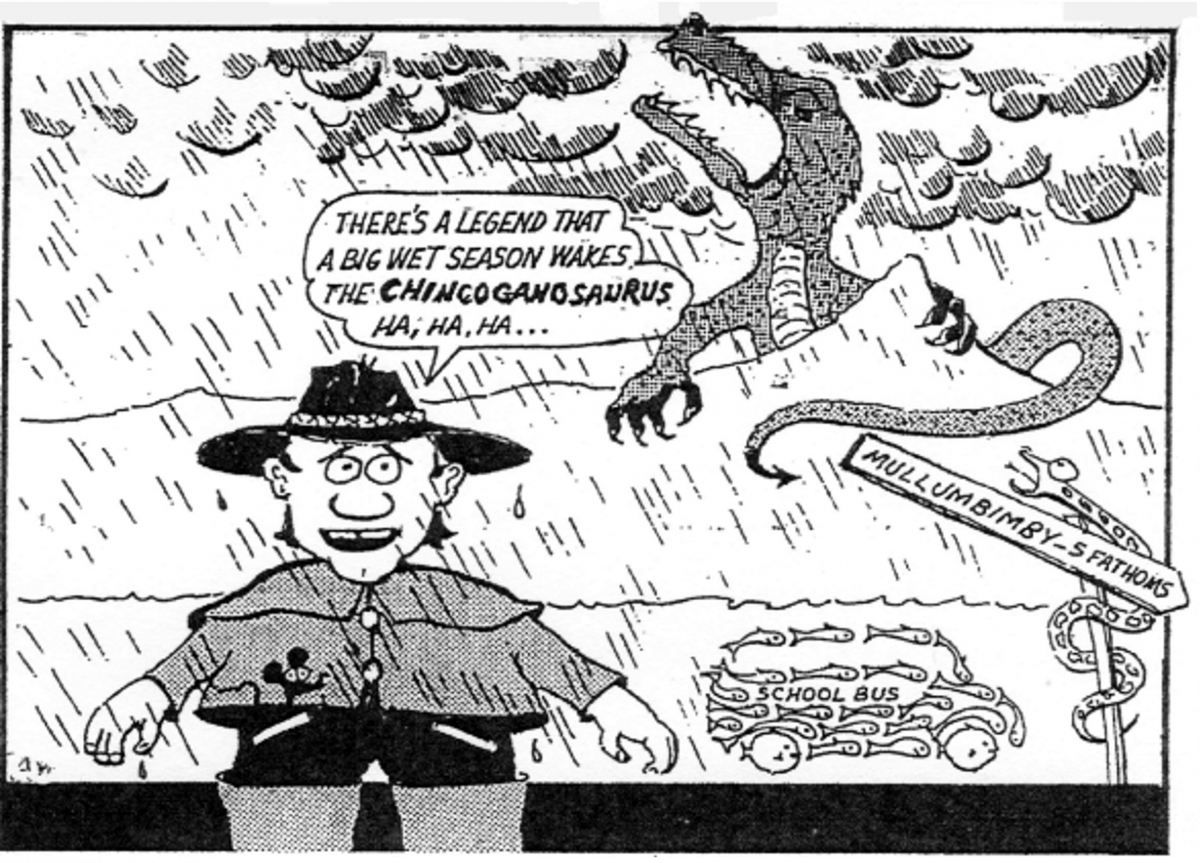
My head, a lofty basalt sentinel, was named by my Aboriginal friends, in their guileless way, Chincogan, meaning “erect penis”. This was no doubt (I think) meant to express the reality that I am an extremely productive and fruitful area. Wildlife abounds wherever people have regenerated my tree cover – koalas breed happily among my foothills, right on the edge of town! Perch, tortoises, and eels sport in my many scintillating freshwater creeks; and a wealth of birdlife finds sustenance and shelter in my now-increasing rainforest canopy (fish up now, please – Ed)
Um, how do you find me? About halfway between Bryon Bay and Brunswick Heads on the Highway, you’ll see a large pelican and a motley of other animals clinging to three tall poles standing in a small park. Well, that’s my turn-off. Do stop and admire the wonderful sculpture of the Pelican Poles and Dragon Seat. Actually this “Gateway” symbolizes my unique status as the Wood Art Center of Australia (No-one told me!- Ed).
Timber craftsmen, from shingle splitters to sculptors to fine-art cabinetmakers, have over the years been attracted by the rare and beautiful products of my generous forests. After all, I am best characterized as a “tree” area. In fact I rather like to think of myself as the Wood Art Center of the Worl… (Sorry, that’s your 500 words! – Ed.)










Leave a Reply