
Copyright Alan Whitehead & Earthschooling: No Part of this book, post, URL, or book excerpt may be shared with anyone who has not paid for these materials.
Alan speaks in a very symbolic and esoteric manner in some parts of his books. Although they can be read anthroposophically, passages speaking of Atlantis, archangels, gods, etc. do not need to be taken literarily to be meaningful. The more you read, the more you will realize he uses many different religions to express ideas in a symbolic manner and not in a religious manner. His writings are not religious. In some places his writings are meant to refer to religious events in a historical way. In some places he is using religious figures (from Christianity, Judaism, Islam, Buddhism, Hinduism, Paganism, Ancient Roman and Greek Religions, etc.) in a symbolic manner. However, at no point is he promoting a specific religion or speaking from a religious point of view.
I have kept the writing as close to one-hundred percent original so you will also find that he speaks of Australia often and some spelling or manners of speaking may be cultural. Any words I have changed are presented like this: <word>.
Also keep in mind that these books are written by a Waldorf teacher with decades of experience who also studied with a Steiner student himself, so he speaks to an audience that is dedicating their lives to the Waldorf method without exception.
Because of this, all of his views are not reflected in the Earthschooling curriculum and not all of them may be ones you want to embrace or are able to use. In all of Alan Whitehead’s writings the opinions are his own and may not align with Earthschooling or Waldorf Books. In some cases, we will be updating some of these chapters in the future with additional and/or updated information.
Ultimately, however, as I read through these passages I find I can distill wisdom from even those paragraphs that do not resonate with me.
We invite you to read with an open mind and heart and with eagerness to learn and discuss…
“…and the shepherd carried a small rod on which were tied knotted strings; each knot represented a sheep. If, as the sheep passed through the gate, there were as many sheep as knots, the shepherd hadn’t lost any – sheep that is – ha, ha! Of course if after the knots were all counted, another 3 sheep passed through, then s/he’s blame the knots, and leave things as they were!”
The visiting lecturer was well in his stride on the subject – A Main Lesson on the History of Number for Class 4. Outside the beautiful, curve-roofed hall, the rain pelted against the glass walls. The small but earnest company of teachers felt cozy however; one lady, with ingenuous blue eyes, took advantage of Lecturer’s pause to add her own snippet.
“I understand that prior to knotted ropes and notched sticks for counting, number was experienced in the human boy itself. This is why many number systems were based on 10 – ten fingers. In fact some primitive peoples had only numbers up to 5; and then ‘many’. They not only counted with the body, they mostly only counted bodies – their family, other tribe members and so on.”
“Yeeess;” said Lecturer unsurely, he was suspicious of his lectures taking his floor “all human communities have used number, albeit simple. Numeracy is more natural to man than writing. In fact most early peoples existed quite well without writing. As man detached his body – the soul – from nature, living in cities and the like, he felt the need to develop the somewhat unnatural skill of writing. Among the earliest being the old cuneiform of the ancient Akkads. But the first formal system of number was created by the Sumerians, they who proceeded them. Man counted before he wrote or read, as indeed do infants today. And in our schools, number skills, at least in the first 3 years, are ahead of literary ones.”
“Excuse me,” it was a slightly-built girl who assumed the title of architect in the school; it was she who had created the lovely edifice they were in. As such, she was no mean hand at maths – Lecturer had better exercise caution here!
“I’ve noticed that the level of maths in the various classes is often – at least at an ‘epoch’ level – ahead of the children’s actual development stage. For instance, when they’re passing through the ‘Persian’ period in Class 3, they are wrestling with the Linear concepts of the Egyptians.”
“Correct; however there are appropriate development stages where particular number content is especially beneficial. In the course of this main lesson, we learn the ‘shapes’ of numbers – right up to square numbers, as this incarnation of number into solids hardens the soul if taught too early. IF we want extension work for the brighter child, we present more complex problems still based on the ‘shapes’ theme – a specifically astral number phenomenon. We remain in the same content area, but increase the difficulty level.”
“I see,” said Architect “The physical body expresses as ‘structure’; the etheric as ‘form’; and the astral as ‘shape’. It’s the ego which finds reflection in the ‘solid’. But I suppose in the History of Number, you touch on the development, in Ancient India, of the number symbols themselves – the numerals, the same, in essence at least, we use today? These often-meaningful symbols were brought westward by the Arabs, and taken into a Roman Numeral Europe by Fibonacci, the Italian…”
“I’ll be getting to that a little later!” Lecturer glared at the lady, then stared at the rain-swept windows waiting for the next gust of inspiration. The small audience stared at him!
“An excellent method of ‘visiting’ these ancient times and places with the children is through the vehicle of a story. Say a pair of twins, could do a stint of time-traveling…”
“Ahem – ‘a pair of twins’ is tautology.” Said a tall, dark-eyed teacher “I think language standards should be maintained in every subject, even maths. In fact a ‘word’ element can help in understanding the number mysteries. I would present lists of number words, not only as spelling and vocabulary extension, but as primers for class discussion. Words like single; lone; pair; triplets; couple – get the children to find them – one; brace; series; digit; figure; value; addenda; factor; multiplicity; pluralism…”
“Thank you.”
“…total; duality; manifold; aggregate…”
“I said thank you!!”
“That’s not a very rational response – ‘rational’ is another.”
“What?! Oh yes, so it is; but we don’t deal with rational numbers until we teach fractions later in the year. Unlike the rationals, the early number systems were all based on Natural numbers, but with the advent of zero by the Arabs, the system of integers was bestowed upon mankind – the positive and negative numbers. We must not give the children the idea that the ancients were number nongs; certainly shepherds and the like were simple-minded souls, but in the temples, disciplined visionaries perceived the Number Mysteries on another level – mysteries which were made manifest in the computations used to create the great structures like the pyramids. Number which was purviewed directly in its starry astral home…”
“I’m sorry, that’s tautology too – astral means star.” Again Lecturer stared – glared! – out of the window, but continued.
“One might introduce the concept of the 4 classic Number Shapes – Pries, Triangles, Rectangles and Squares – with a story about 4 ‘houses’ which the twins, in turn, visit, learning different number knowledge in each. The prime numbers, representing the physical body as they do, have a round house. The word prime of course means ‘first’, the physical body was the First Creation. The circle is the symbol of the physical body.
Teach them about the factor less prime number family; and how to find the primes with the famous Sieve of Eratosthenes. This naturally brings in the history element again. They learn the unlimited nature of the primes, adding to their rudimentary ideas of Infinity, its symbol being the lemniscate of the astral body, the curve of multiplication.
The Triangle Number house is obviously an A-frame – ha, ha – when teaching these, it’s best to start with counters, or coins even. Below the first coin, place 2 others; under these, 3 more. So the first 3 triangle numbers are 1, 3, 6. To maintain balance – these are spiritual principles here – both ascending and descending triangles should be constructed. This, in the spirit of the Star of David, represents the harmony between heaven and earth. Not all children will grasp it, but the equation for finding any triangle number – form of the ether body – is No. x No. plus 1 over 2.
Say you want to find the 7th triangle number, without coins all over the desk, merely multiply 7 x 7-plus-1 (56) and divide by 2. 28 is the 7th triangle number – obviously self-evident.”
“That’s another tautology. In the archangelic dispensation of the 4 Season, maths (and music) is served by Uriel, the Summer Regent. These are part of the St. John Mysteries – Patron Saint of Writers. Uriel is a grammarian as well as a mathematician.”
In a supreme effort to restraint, Lecturer turned to his tormentor, smiled sweetly in thanks, and went on. “The ‘magic’ of this triangle equation is based on the fact that 2 triangle numbers always make a rectangle number.
Speaking of Rectangles, my ‘house’ here could be metamorphic, transforming into parallelograms or curved rectangles even – metamorphosis is of the astral plane, and rectangle numbers are the same. In that house the twins would find these to be always the product of smaller numbers.
However it is in the Square or ego house where we really get going. Any number multiplied by itself always gives a square number; so do odd numbers added from 1 up: 1 + 3 + 5 = 9, 32. Add 2 adjacent triangle numbers and you always get a square number: 6 + 10 = 16 or 42. On a multiplication chart (to 144), the square umbers form a diagonal line. When the children experience the visual, square numbers are elevated from the abstract.”
A wild gust of wind bent the slim Casuarina trees and whipped tongues of rain against the glass. Lecturer found this nature-violence inspirational, and continued to assail his small audience.
“The children should draw up a Number Shapes list, with Primes, Triangles, Rectangles and Square numbers shaded in different colors, again exploiting the ‘visual’. This identifies and differentiates the 4. The numbers might only go to, say, 60 this time: 1 is empty; 2 a prime only; 3 a prime and triangle; 4 a square umber only; 5 a prime; 6 a triangle and a rectangle – and so on. A lot can be learnt about the profile of each numbers in this way. For instance knowing that 3 is both a triangle (etheric), and a prime (physical) tells us something about ‘trinity’ in the world.
Even the 4 elements are part of the tapestry. Number 1 of course remains the imponderable Unity, not conforming to any of the 4. Number 2 is a prime only – the fire element! 3, prime and triangle, is fire and air; Lemuria, the 3rd earth evolution, was consumed by fire-air storms. 4, a square number only, is of the 4thincarnation of our planet, our very own earth – 4, in esoteric numerology, is the number of the earth. 5, 7, 11 are all prime of ‘fire’ numbers only, as such they incarnate only lightly.
5 is a number employed in a wide range of mystical practices in the form of a pentagram. If these descent into evil, then the star, or ‘wizard’s foot’ is inverted. & is the number of the soul – of perfection as Rudolf Steiner tells us. There are 7 planets (astrological); colors; tones; continents; oceans – you name it!
The ‘prime’ influences barely touch down with 7. 11 is the most enigmatic of all – the ‘Judas’ number, he who obstructed the incarnation of the Logos through the 12-fold paths of the Zodiac. Judas condemned the ‘fire’ of the Spirit to the tomb of the body.
6 and 10 are Triangle/Rectangle numbers; air and water, or as the Chinese have it, Feng Shui – ‘wind-water’. (Refer to the companion volume to this, Journey to Numeria, for further insights on 6 and 10 in the Times Tables chapter.) 6 expresses in the hexagram; and 10 in the metric number system. These are numbers of conservatism, held sacred by both the Chinese and the Jews, the most spiritually conservative people on earth – again as stated by The Doctor.
8 and 12 are Rectangle/water numbers only; 8 is the sacred number of Buddhism, an astral force in world evolution (the Buddhist or ‘astral’ gospel is that of St. Luke.). 12 is the number of the Zodiac, the fixed stars – astral is from ‘aster’, star.”
“You’ve already mentioned that.” Cut in Dark Eyes “But I can’t see what all this has to do with teaching children?”
“The exoteric content is often carried into the deeper realms of the child’s soul by what lives in the teacher as spiritual knowledge. They know when they’re in a content-less desert!” replied Lecturer meaningfully. “you don’t actually teach these things (although you can infer them), rather are they the rich soil from which the flowers of learning grow. And speaking of flowers; our old friend Fibonacci was taught these things by his Arab mentors, the series so often seen in nature is even named after him. We too can demonstrate the creative basis of these divine ratios.
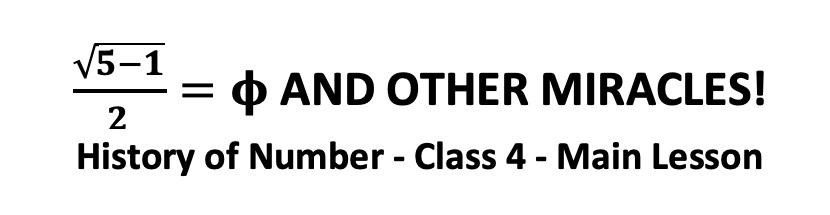
The Greeks of course knew this, and provided a beautiful symbol for the Golden Mean, the letter phi – f . In a deeper sense, this is the Self in the Circle of the Spirit. The children can accept at this age the phenomenon of ratio, especially if described with things in their world – like the ratio of boys to girls in the class. With 5 boys and 8 girls it would be a special class indeed – the Golden Section! This cosmic ration is naturally found in Man as well, in body, soul and spirit. The formula is .
As a plant grows, a strict ratio of leaf to turn is created; at first 1 to 1, then 1 :2, 2: 3 (you will notice that the next number is obtained by adding the previous 2) – 3 + 5 = 8, 5 : 8, and so one. The accuracy of the ratio increases as the numbers do; there is no perfect ratio for the Golden Mean – for instance, 5 : 8 is 1 : 1.616, while further up the line, 89 : 144 is 1 : 1.617! this apparent imperfection is where the Spirit enters.”
Bright Eyes raised a tentative hand “I know some interesting properties of the Golden Section; if you pick any 3 sequential numbers from the series, say 3, 5, 8, square the middle number – 25, multiply the 1st by the 3rd 3 x 8 = 24 – the result always differs by 1; 25 and 25 in this case. Why is that?”
“Er, I don’t …it’s too complicated to discuss here!”
“And if you take any number, square the digits, and add them, you always end up with 1 or 58 – weird! Take 32; 32 = 22 = 9 + 4 = 13. Square these two, 12 + 32 = 1 + 9 = 10, 12 + 02 = 1!!
“Gosh!” exclaimed Dark Eyes, ignoring the lecturer “What about 51? No, let me do it – 52 + 12 = 25 + 1 – 26, 4 + 36 = 40, 16 + 0 = 1 + 36 = 37, 9 + 49 = 58!! Loud applause greeted this triumph, but Dark Eyes’ gratuitous acknowledgement was cut short.
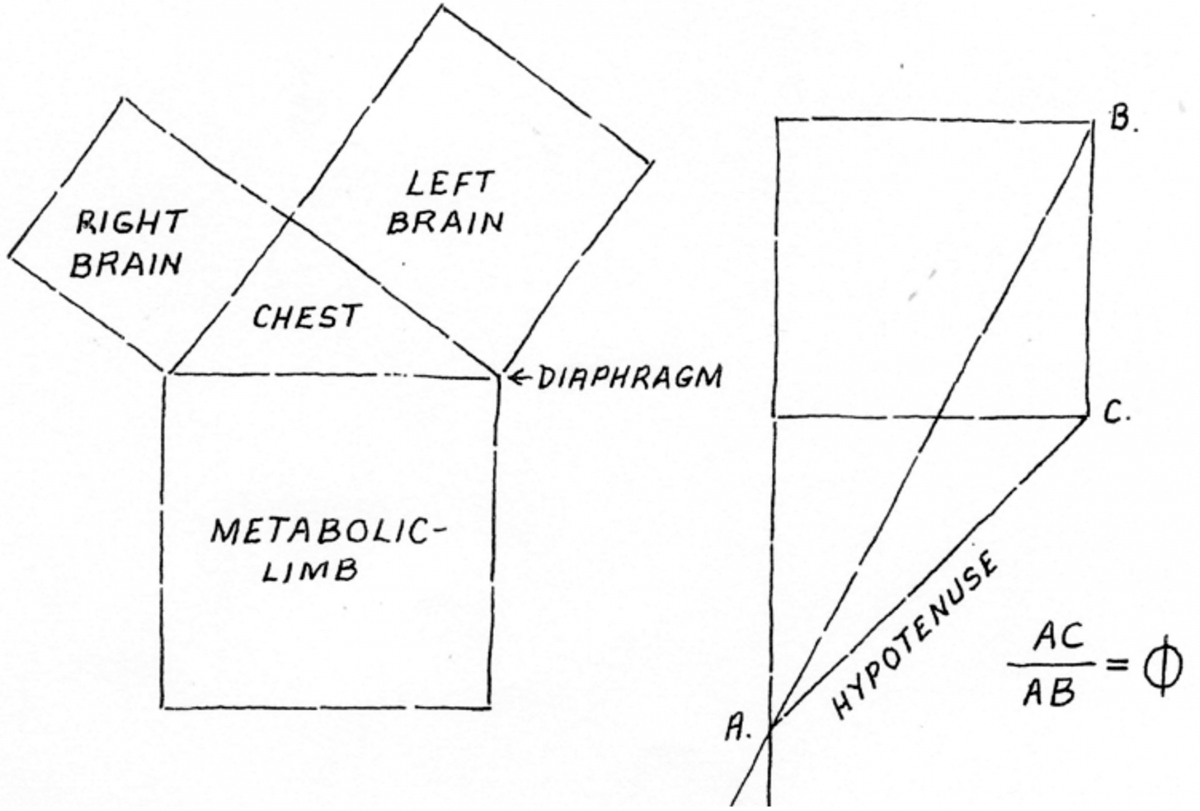
“That’s all very interesting, but we must move on to more important matters. The Golden Section is a vital element in the Theorem of Pythagoras, with the well-known formula of AC over AB = 1.6, or thereabouts. As the egos of the children in Class 4 gradually emancipate from those of their teachers and parents, it is a good time to introduce them to this wonderful symbol of man. Invariably modern textbooks place the theorem drawing upside down. The hypotenuse must be on the bottom (the word means ‘stretch below’), the Greeks recognize these important principles in their nomenclature. It is almost as serious a crime in the realm of cosmic semiotics to invert the Pythagoras drawing as it is to invert the pentagram! It is standing Man on his/her head.
The hypotenuse is our diaphragm, that elastic organ (‘stretching below’) which separates the upper from the lower man. This lower, or metabolic/limb system, is represented by the large square below the hypotenuse, usually referred to as C. The right triangle itself is, appropriately, the triangular rhythmic system – the chest. The top-facing right angle is the symbol of the ego. On both sides of this are squares A and B, which are squared to provide the equation A2 + B2 = C2 – the ‘head’.
This left-right dichotomy represents the two sides of man – minor-major; left-right brain, relating, as do the squares, to the whole body through the arterial and venous bloodstreams. In the correctly-drawn diagram of the Theorem of Pythagoras, we have, like the remarkable mathematician himself, a universal image of 3-fold man – head, chest, and abdomen. This is the triumph of the ego wrought in divine numerology – it is indeed the Number of Man – end of lecture!
The only sound in the arm room was the swishing of the Feng Shui broom as it scrubbed the windows and paths outside. Architect looked up curiously “If Pythagoras is the ‘ego’ Archai Master of Ancient Greece, what are the other 3 giants, Eratosthenes, Euclid and Archimedes? What aspects of the human being did those there express in their respective number breakthroughs?”
The smell of freshly brewed coffee wafted across the earnest assembly, creating a restiveness that eclipsed even their desire to learn abut Archimedes, Master of Matter; Euclid of Life; and Eratosthenes of Space.









Leave a Reply
You must be logged in to post a comment.