
Copyright Alan Whitehead & Earthschooling: No Part of this book, post, URL, or book excerpt may be shared with anyone who has not paid for these materials.
Alan speaks in a very symbolic and esoteric manner in some parts of his books. Although they can be read anthroposophically, passages speaking of Atlantis, archangels, gods, etc. do not need to be taken literarily to be meaningful. The more you read, the more you will realize he uses many different religions to express ideas in a symbolic manner and not in a religious manner. His writings are not religious. In some places his writings are meant to refer to religious events in a historical way. In some places he is using religious figures (from Christianity, Judaism, Islam, Buddhism, Hinduism, Paganism, Ancient Roman and Greek Religions, etc.) in a symbolic manner. However, at no point is he promoting a specific religion or speaking from a religious point of view.
I have kept the writing as close to one-hundred percent original so you will also find that he speaks of Australia often and some spelling or manners of speaking may be cultural. Any words I have changed are presented like this: <word>.
Also keep in mind that these books are written by a Waldorf teacher with decades of experience who also studied with a Steiner student himself, so he speaks to an audience that is dedicating their lives to the Waldorf method without exception.
Because of this, all of his views are not reflected in the Earthschooling curriculum and not all of them may be ones you want to embrace or are able to use. In all of Alan Whitehead’s writings the opinions are his own and may not align with Earthschooling or Waldorf Books. In some cases, we will be updating some of these chapters in the future with additional and/or updated information.
Ultimately, however, as I read through these passages I find I can distill wisdom from even those paragraphs that do not resonate with me.
We invite you to read with an open mind and heart and with eagerness to learn and discuss…
MEASURE THE EGO – SQUARED!
Area Measure – Class 4 – Main Lesson
The afternoon light was warm and golden as the school community of teachers, parents, friends, and children lolled around on the grassy slope. The social occasion was the annual School Picnic, where everyone could get together on an informal level, strengthening those bonds between the child’s two most important worlds, home and school.
“By the way, thanks again for coming into our Linear Measure lesson last year.” said Nyyl the teacher, idly chewing on a stem.
“No problem, I really enjoyed it. The children are so responsive; it’s really good to actually see the kids in the school environment. Sometimes we parents think they do ‘nuthin’ all day – ha, ha.”
Not sure whether the twins father was joking or not, Nyyl went on “Hmmm, yes – as a surveyor, the class admires your worldly expertise; it helps to teach a subject when they know that people out there actually earn a living with it. Um…I was wondering…actually we’re in the middle of our Class 4 Mensuration main lesson right now – it’s Area Measurement this year…I thought…?”
Dad looked around wryly “No, I don’t mind at all; you can grow rather fond of those little scamps can’t you?!”
“Indeed – we teachers can be insular souls, and it’s so refreshing to bring in someone from the outside world to elaborate the lesson content – the stamp of confirmation if you like.”
Tan and Lily, Dad’s twins, came running up the hill together, panting but full of pink-cheeked energy. “We just paced right around the school fence!” gasped Tan. “Yes, and we both began in the same place.” Added Lily. “But we paced off in opposite directions.” – “And guess what?!” – “When we met back again…” “…at the exact same spot…” – “…we had exactly the same number of paces!” – “Well, almost exactly.”
“That’s incredible!” exclaimed Dad, Nyyl just nodded. “That means you have exactly the same pace length. As twins I suppose that’s not surprising – but exactly?! How many were there?”
“1562!”
“We should be able to work out the area of the school property from that.” Chimed in Nyyl, after all, it was hislesson “Now we measured your pace-length the other day – and I do recall they were both about the same. What were they?”
“75 centimeters.” The children said, their tone proprietal. After all, they were their paces.
“Let’s see,” muttered Dad calculating quickly; after all, he did this kind of thing every day! “.75 x 1562 equals 1171.5 meters perimeter – divide by 4 to get length and breadth – 293 approx. – that figure squared is, er, 85,850, or thereabouts. This rather irregularly-shaped school is about 85,850 square meters – or somewhere around eight and a half hectares.”
“Wow! Chorused the children; then they saw their friends on the trampoline and ran off.
“But Nyyl, I’d like to know a little more about the philosophy of this Area Measurement strand in your learning program; where does it start? What are the goals?”
“Well,” said the teacher sitting up and discarding his grass “Knowing you to be a well-informed man on matters esoteric, I can call a spade an astral body – ha, ha – which is the member of the 4-fold human organization expressed mainly through mathematics. The other 3 main lesson streams of language, asocial science and science are represented by the ego, etheric and physical bodies respectively. But back to maths; we have 3 math/astral main lessons a year, one each appealing to Will, Feeling and Thinking – usually taught in that order. These 3 are Mensuration, Numeration and Calculation. Measuring, the ‘will’ lesson, is obviously mensuration; that, as you know, is what the word means.
Area Measurement, based as it is on surfaces, or the 2-dimensinal, is very specifically one of the properties of the astral world. Last year, in Class 3, we studied Linear Measurement, obviously related to the etheric world; it is the ‘timeline’ of existence if you like, the 1-dimensional. The non-dimensional mysteries of the physical body (in its purest, or ‘heat-energy’ sense) is the point – unmeasurable! It existed on that creation center of the physical body, Ancient Saturn, as a condition of duration. The equivalent lesson in Class 1 is Counting. But even in the so-called ‘will’ world of mensuration (one must employ one’s limbs to measure) – or even square area, this division of The Big Four is again seen, and in a subliminal way, can be taught.
These 4, ego, astral, etheric and physical bodies, appear in the manifest world through the Square, Free Curve, Triangle and Circle respectively. Expressed in shapes, the 4 create a foundation for the whole lesson. Square area in its simplest form is the Square itself; so that’s where we start, working our way right through to the complexity of the circle with its Pi equations and so on. Someone’s actually worked out Pi to 2,000,000 decimal places – I won’t go that far with my 10-year-olds!
Initially we only teach the square, triangle and parallelogram, with their obvious length x breadth equation. But in so doing, we color the lesson with the ego-type concepts of contraction and mineralization which these ‘square’-type shapes express. The children then associate the idea of the square with the shape – they are dealing in reality rather than trying to understand maths phenomena in isolation.” Nyyl paused – Dad seized the moment.
“I can guess how you’d proceed to the astral or ‘free curve’; the old wet cotton, string or rope around the perimeter. Just measure, divide by 4 and square the number. The children might have remembered the wet string from their linear lesson last year when they measured curved lines that way. It’s remarkably accurate.
A close approximation can e taken of an irregular shape by laying, or drawing, a squared grid over the ear. You then count all the squares, estimating the parts of squares (half in the shape, half out, etc.). All you do then is apply L x V to the total squares. A similar thing can be done with thin rectangles, like strips of tape. Actually Archimedes thought of that one – an early form of calculus really. I s’pose they get onto that in high school?”
“I s’pose – yes, the free-form defies the mathematician’s obsession with exactness (as does Pi!). The ever-metamorphosing nature of number in the astral world – its true home, or the ‘Number ether’ as Steiner calls it – ignores absolutes. Number nature is rather…cryptically descriptive, or pictorial.”
The sun slanted laser-like beams through the tall gums at the bottom of the playground. Nyyl took inspiration from this and continued, more slowly than before. “Those rays are creating ‘angles of incidence’; the Triangle lives in the realm of this etheric sun power. These etheric or ‘life body’ children really love to explore the utility and sheer beauty of the triangle. I teach it with the Greek understanding of the 4 triangle types, relating as they do to the 4 Elements (according to the Greeks anyway).
Firstly I show the children the relatively simple equation to determine the area of any triangle – L x B x ½; only then do I characterize, in story and description, the 4-elements triangles.
I begin with the purest, the Equilateral, with all sides and angles equal. This form fits perfectly into the circle, timeless symbol of the fire element. Great balls of fire, an equilateral triangle rolls easier than any other! With its triangular limitations, this form is an expression of equal expansion, the essence of the heat element.
When the sun’s rays strike a horizontal earth, they mostly create Isosceles triangles – 2 sides equal, 2 angles equal. We can see these isosceles (‘equal legs’) rays right now, through the medium of the airelement – or air-and-light as the Greeks might have said.
A good exercise for the class is to draw a triangle, any triangle, cut off each of the 3 apexes, and stick them together. This proves of course that the sum of the angles of a triangle make a straight line – or 180 degrees.
That frustratingly mobile element, water, is represented by the equally bewildering Scalene triangle (‘unequal’); it has of course no sides or angles equal. The scalene’s capacity for variation is consistent with the liquid element’s metamorphism. An imminently-breaking wave is more often than not a kind of curved scalene.”
Nyyl made the mistake of pausing to find another grass stem, giving Dad the chance to complete the 4-fold triangle/element exposition. He picked u a chunky lump of sandstone.
“The Right-angled triangle is obviously an expression of the mineral element – of this lovely creation. In my job, the building industry in general, and surveying in particular, we employ the right-angle triangle more than any other.
This is consistent with the current mineralization – or materialization – of human evolution; the shelter we provide for ourselves always reflects our soul in some way. By the way, a right angle is easy to create without a set square. Take any old scrap of paper, fold it, fold it again along the line, open it up and – presto, 4 right angles!
Brickies of course get the right angle with a spirit level bisected with a plumb line. When I was learning the game, I had to make continuous calculations based on seemingly limitless combinations of areas. So I invented an Angle Nail-board; a 50-centimeter square board, painted a light color, with small nails (numbered) around the perimeter at 1 centimeter spacing. Large colored elastic bands could be stretched between the nails, creating squares…”
“…triangles; parallelograms; trapezoids – and with more bands, combinations of all of these!” Nyyl had seen the potential of the nail-boards for his area measurement unit, and eagerly continued.
“I teach the children how to determine the area, not just of the regular geometric figures, but of many others as well, like combinations of rectangles and triangles. First we work out the square form, then the triangle attached to it – then add the two figures – L x B plus L x B x ½. Similarly you can even work out the area of a pentagon, if the right dimensions are given.
Gosh, the nail-board could save a lot of drawing. Another board, perhaps this time a big one for the whole class, could be based on the circle, for computations on chords, radii, tangents and so on. The visual and tactile perceptions would make the shapes, whether on the circle or square board, real; locking them more firmly into the ‘muscular memory’ of the child.”
“Great – would you like me to make a couple for the class?”
“Awfully kind of you, but you can help when we make them with the children perhaps? Oh, we still use all the measuring equipment you made for us last year, tor our ‘linear’ main lesson. The meter sticks are very popular. Would you be able to make a Square Meter Board – in 3-ply?”
“You’ll have it by Monday – divided into square decimeters?”
“Um, how about squaring the decimeters into centimeters as well? Having a physical example of a square meter really helps the children comprehend how big this standard measurement really is.
And speaking of the physical, we inevitably return to the circle; if this area form is not approached with care in teaching, it can scare the wits out of the less numerically-inclined pupils. This bewilderment is more often a terminology problem, so I drum in the language of maths till they cry out for mercy – especially as so many terms are so conceptual, and hence intimidating, for the young child. It does help if we can attach a picture to the word, like ‘tangent’, a Latin word, ‘to touch’.
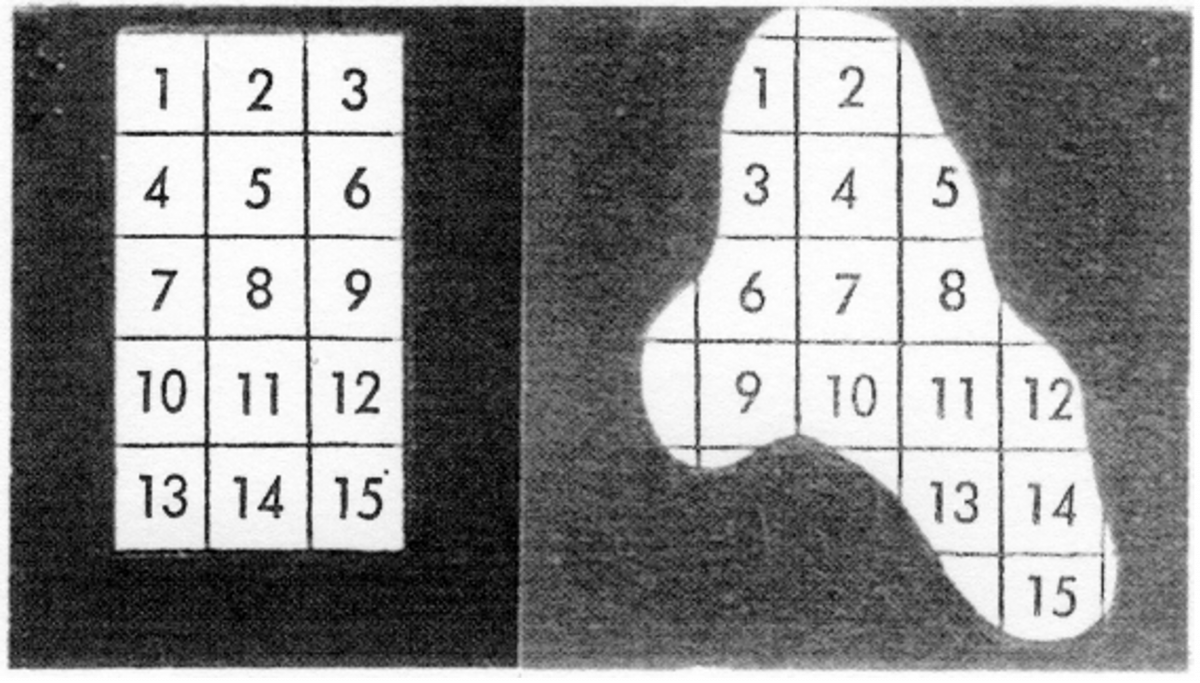
It would really mean something for children to stretch a piece of string around a circle and find that it really is 3.14 approx. – every time. So when we introduce C = Pi (or 2 Pi R), we’re not speaking Urdu! The nail-board would also be great for demonstrating and exercising the division of the circle in that factor-rich number, 360 degrees; so the circle board should really have 360 nails, instead of the 100 centimeter of the square.”
The two men watched a small group of children run around the school oval – or circle more like it. This made Nyyl think of measuring equipment. “A tangible – to ‘touch’ remember – expression of a new learning plateau is the issuing to each child of a good-quality protractor and set squares. The former should be full-circle if possible, a practical symbol of the divine unity of the circle, with its ubiquitous sexagesimal system – the 60.”
“So that’s what it was all about?!” muttered Dad, a glaze of recognition in his eye. “A couple of nights back, Tan and Lily were behaving quite strangely; measuring things from the table top, right up to the whole house – in the old ‘squares’ system, 10 foot by 10 foot – as well as in square meters.”
“That’s good, they’ve had lots of practical activities in this unit; we measured chess boards, skateboards, floorboards – un, dartboards, mortar boards – no we didn’t, just kidding.”
“How about breadboards?! Ha, ha – school boards!!?”
“Surfboards, and, um sideboards – ha, ha…and nail-boards!!! Haw, haw, haw…” the two adults rolled around in mirth, until Nyyl collected himself again “Anyway – cough – the children measured their ‘area world’. When you come in, I’d like you to describe the skill required of a Quantity Surveyor; one who has to, say, work out the square area of the internal walls of a house to order the plaster sheeting with as little waste as possible. Oh, and tell them how you cost materials and labor.
All this demonstrates the practicality of square area knowledge. If you were a farmer, the equivalent exercise would be on crop growing; a dressmaker has similar area calculations, but on a smaller scale. Then there’s paint, and paving and…”
Tan and a friend ran up “Hey Dad, David asked me to go and stay wat his house tonight – okay?” a bemused shrug was taken as approval ‘Bewddy!!’ they yelled as they tore off down the hill.
“And that’s another, yet deeper, reason to each square area to 10-year-olds – separation. The 10th year is the age when they are expressing the Conceptual (ego) Aspect of the Etheric Body. This manifests as the ‘9 ½ year split’. A realignment of relationships is observed; the children are less ‘clingy’, more objective even. You, as their dad, are not necessarily perfect anymore.”
“That’s right, these incipient ‘ego’ children relate in a curious way to the 2 eternal symbols of the Self; the circle in the square represents the incarceration of the Fire of the Spirit, the ego, in the corporeal or mineral body. This is called The Tomb of Adam, that relating to the Sons of Dust, the Adam creation in Genesis.
The second, the square in the circle, is incarnate man embraced by the Fire Circle of the Divine Ego – Elohim Man, the Sons of Fire of the ‘Let us make man n our image’ Genesis creation. In China this great spiritual truth is known as The Tao; a remnant of the knowledge being seen in the coins with the square cut out of the center. This Phoenix – or Fire Bird – creation is the more highly regarded in the East.” Nyyl sat up very straight now.
“The measurement path seems to relate to the 3 Dimensions; Measurement of the line in Class 3 is of curse 1-demensional; area, that studied this year in Class 4, with its length and breadth, is 2-dimensional; and volume, the 3rd dimension, will come in Class 5. The ego, in relation to the ‘body of formative forces’, must have well and truly arrived before entering this world of weight.
These relate to the creations of the 4 planetary incarnations of our earth: Duration is of Ancient Saturn; Time, and its sister concept, line, came on Old Sun; Space was of Ancient Moon; and the ‘globe’ of the ego, the Earth, gave us the reality of Weight.
It’s funny isn’t it, how these 10-year-olds work with 10 formal shapes – not 9 or 11 – in their square area calculations: the circle; the 4 triangles; and the five 4-sided figures (square, rectangle, trapezoid, rhomboid, parallelogram). That’s just coincidence surely? The Ten Number Commandments perhaps? Ha, ha…it’s funny with the twins, Tan takes after me with his easy grasp of number, but poor little Lily…”
Just then his daughter approached, her gait purposeful, her expression resolute “Dad, you go that sum wrong, the schoolyard has an area of 85775 square meters – I just worked it out!










Leave a Reply
You must be logged in to post a comment.