
Copyright Alan Whitehead & Earthschooling: No Part of this book, post, URL, or book excerpt may be shared with anyone who has not paid for these materials.
Alan speaks in a very symbolic and esoteric manner in some parts of his books. Although they can be read anthroposophically, passages speaking of Atlantis, archangels, gods, etc. do not need to be taken literarily to be meaningful. The more you read, the more you will realize he uses many different religions to express ideas in a symbolic manner and not in a religious manner. His writings are not religious. In some places his writings are meant to refer to religious events in a historical way. In some places he is using religious figures (from Christianity, Judaism, Islam, Buddhism, Hinduism, Paganism, Ancient Roman and Greek Religions, etc.) in a symbolic manner. However, at no point is he promoting a specific religion or speaking from a religious point of view.
I have kept the writing as close to one-hundred percent original so you will also find that he speaks of Australia often and some spelling or manners of speaking may be cultural. Any words I have changed are presented like this: <word>.
Also keep in mind that these books are written by a Waldorf teacher with decades of experience who also studied with a Steiner student himself, so he speaks to an audience that is dedicating their lives to the Waldorf method without exception.
Because of this, all of his views are not reflected in the Earthschooling curriculum and not all of them may be ones you want to embrace or are able to use. In all of Alan Whitehead’s writings the opinions are his own and may not align with Earthschooling or Waldorf Books. In some cases, we will be updating some of these chapters in the future with additional and/or updated information.
Ultimately, however, as I read through these passages I find I can distill wisdom from even those paragraphs that do not resonate with me.
We invite you to read with an open mind and heart and with eagerness to learn and discuss…
DUSK OF THE SPIRIT
DAWN OF THE SOUL
***
Art History – Class 10
Baroque to Impressionism
An education in Art History is an ‘Aesthetics Education’ – in the best Schiller tradition. Or the ‘picture’ aspect of aesthetics at least. This is particularly so with 16-year-olds, who are in this year of seven, from 14 to 21, exploring the prismatic plane of the ‘Pictorial Aspect of the Astral Body’; itself an astral phenomenon – astral-astral!
So one sacred chamber of the soul of every Class 10 student, subject always to karma, environment and native talent, will be responsive to ‘pictures’; as probably in no other year of their lives. Another appellation of this year is the ‘picture aspect of the picture body’!
This wonderful synchronicity is further compounded in the period of Art History study for Class 10, known generically as the ‘painterly’, the 17th, 18th, and 19th Centuries – Baroque to Impressionism.
Of the three visual arts explored, painting far outshines either drawing or sculpture. Mind you, by this time every artist was a master draftsperson, building on the solid foundation of the ubiquitous Renaissance genii. So, there is plenty of drawings to admire, but much of it is as a preparation for, or subordinate to, painting.
Sculpture, alas, continues to diminish as a major – European – art form in the three centuries of this Age of Enlightenment – Age of Reason – Romantic Age – Industrial Age – Age of Materialism – Intellectual age – Baroque Age – The Rococco … or whatever one chooses to call this amazing culturally progressive period. (I like the title Baroque, meaning ‘misshapen pearl’ as it does!) Bernini represents one of the final -oh-so majestic – outpouring of the formative sculptural forces, with his soul-turbulent masterpieces at St. Peters, Rome.
I guess from the painterly point of view, the Age of Enlightenment is the best name (even though Baroque is the official ‘art’ title); as one sees an increasing awareness of outer light, right through the 300 years from the gloomy 17th Century Dutch and Siennese (burnt sienna – brown!) schools, to the luminous treasures of Impressionism.
It must be stressed that this is the light – and color – of the outer world only; a Rembrandt portrait has greater inner luminosity than, say, a Van Gogh – to use two Dutch painters for comparison. As humanity’s inner lantern of spirit dimmed, it awakened to the soul wonders of the outer light – enter Vincent!
In the great 12-fold Subject Zodiac, taught consciously or not, in all schools in all places at all times, the Visual Arts abide in the House of Capricorn, with its sense of sight. In the zodiacal spectrum, white is the color ascribed to the Sea Goat. White is light; that which contain all other colors in its invisible spirit spectrum.
When a Capricorn Master, a painter, contemplates the white canvas, s/he enters a realm of artistic freedom, where – potentially at last – any image can manifest. The heights to which this image is realized is of course dependent on training, talent and, most important of all, divine inspiration; especially that of Gabriel.
This limitless lode of images, or imaginations, is symbolized by that ancient Capricorn symbol, the Cornucopia – overflowing with fruit, flowers, and grains. It was the Sea Goat’s horn. (Amalthea, who bequeathed the “Horn of Plenty’ to Zeus, was a Sea Goat, a nymph.)
The images are the multi-colored fruits et al spilling forth from the bounteous Horn; and soul-nourishing fruits they are the Horn can be filled with whatever the owner wishes. So, the painter – or visual artist generally – can fill his/her own Horn of Plenty, the white canvas, with whatever pictures or imaginations s/he wishes – such freedom!
A training in Art Appreciation, as we provide for our high school students, is an in-depth training of the Capricorn sense, that of sight. For students to be encouraged to look at – not just look at but see – is to heighten their visual discrimination. Their seeing becomes more and more conscious as their gaze is directed to the subtle distinctions of color, tone, form, style, and texture.
This visual discrimination is legacy they will carry with them throughout life. A person who has been denied an Aesthetics Education cannot truly be considered learned.
Another Capricorn interpretation, this time Hebrew, is Joseph. His ‘coast of many colors’ – or as inferred allcolors – is a symbol of this heavenly thesaurus of imaginations After all, Joseph became a ‘dream speaker’, one who could clairvoyantly see the reality of the astral of picture world for the pharaoh.
Not insignificantly, his mendacious brothers spattered his beautiful coast with goat’s blood – not, alas, that of the Sea goat. This is a descent into the ‘pit’ of materialism, with its attendant dimming of astral sight.
A lack of exposure to Art History in general, and this marvelous painterly/cornucopia/coat-of-many-colors period for Class 10 would be to leave them in the dark hole of artistic ignorance – maybe for life.
If there is a distinct north-south European dichotomy in Renaissance art, which there is; then the spiritual compass needle shifts, in the Age of Enlightenment, to pint west. Although the Baroque was born in Rome, it matured in Holland, England, and France – in that order.
Even today we live with this legacy of France being the Visual Arts center of Western Civilization. This shift from Italy-Germany followed an Ego path; the West, according to occult wisdom, being the direction from which world ego forces stream.
As such, the portrait, a fundamental ego expression, became increasingly important. There were also many ego-based technical advances in art, like the perfection of sun-filled oil paints. Their inherent light redeemed much of the darkness of the Age of Reason.
North and south are physical and etheric world body streams respectively. These are expressed in art through the obsessive physical naturalism of the northern artists, and the sculptural power of the south (sculpture is the ‘art of the ether body’, as Rudolf Steiner assures us).
As Self, or Ego, Consciousness awakened in Europe in the 17th Century, it sought its own – in the wet. However, there was a new dualism born at the same time, not of north-south, but of Left-Right!
A political element, rather than religious as in previous years, pervaded the gloomy halls of the Art Establishment, particularly that of The Academy in Paris – the new art authority. Here two virulent protagonists, Poussin and Rubens, established a set of twins, if opposite, canons we still live with – or in their extremes ‘endure’ – today.
Poussin of the Right, espoused drawing, or ‘art of the mid’ (drawing is the ‘thinking’ of the 3 visual arts in our block lesson stream), with its focus on form. Rubens preferred to delight rather the senses (you can tell which one I prefer!) with rich and colorful image. He also enjoyed the flamboyant, as opposed to staid classical themes.
We perennially live with drawing-traditionalist-form artists contending with – complementing – expressive-reformist-image exponents. It is valuable for the students to track these parallel paths right through the three centuries. 18th Century French Mannerism actually managed to wed the two for a time, being a striving for harmony between mysticism and intellectualism. Some art critics may not warmly embrace the oft-pretentions Mannerist style. Considering it ranging from the simpering to the superficial; but for the students we must present it, and every other period, as great art.
Every art teacher has likes and dislikes; we have no right to burden our young charges – in some cases for life – with the ballast of our own aesthetic prejudices. If the global art community has, over time, accepted a period or a painter into the Gallery of the Greats, then what right have we, from our earth-worm perspective, to condemn? – with our captive students at least!
Tiepolo’s soapy and saccharine ceilings may make us personally nauseous, but we can’t let this become a contagious disease for our class by vilifying what the world has accepted as great art. This is a violation of the freedom to make their own like-dislike choices – which they eagerly do without hour help! Art History is about promulgation and presentation, not propaganda. This is a most vital point, as the goal of an Art History course is intellectual liberty, not cultural incarceration.
The invisible hands of higher beings can be seen on the fast-forward move into this prismatic Period of Paint. The golden urn of Time Spirit regency was handed on, in 1510, from the Archangel Samael to Gabriel. This pulchritudinous spirit, with this promotion to Archai status, poured his good graces into the cultural life of humankind in the form of, in a general sense a love of beauty, and in particular, Color and Tone. These are the two major aesthetic aspects of the Gabrielic ministrations. Gabriel, or his Esoteric Christian equivalent, St. Luke, is traditionally the Patron Spirit of Painters.
This ‘painterly’ power gathered momentum with a continuing mastery of the color media through the 17th, 18th, and 19th Centuries – right up to 1879. In this threshold year (when Rudolf Steiner, incidentally, reached his 18th year, or completion of his secondary learning period – nominal adulthood!), the Archangel Michael became the ruling Zeitgeist.
Almost to the year this heralded a dramatic change in painting expression – from the beautiful, to the powerful! Michael is after all a warrior deity. Even the content shifted form the classic, or idealized vernacular, to the social or political statement – more a Michaelian than Gabrielic expression.
Naturally there were a few lonely forerunners of the new dispensation. Like Goya and David, but both expressed through their content a kind of romanticism over social realism in their depictions of liberty, love, and violence even. In Class 10 we should only introduce this michaelic factor, as it forms the basis of the next study period, Post-Impressionism to Modern; the period Rudolf Steiner painted in!
The early Impressionists provided the last, fabulous, color-aware outpourings of the beauty-bound Gabrielic Inspiration – concluding the 300 years with flash and not a fade!
Painters like Manet and Monet had higher regard for the painting than the actual picture – if you see the difference – of the paint over the subject. “Hmm, it doesn’t look much like it” a pipe puffing sailor might have commented over Pointillist Signac’s shoulder.
“Why should it?” the artist acidly retorts “this is a painting, that’s a harbor!” Essentially the great Impressionists, pointillists and otherwise, were using light and color, and only incidentally subject, as vehicles to see what innovations and visual effects – what beauty – they could create with paint. A truly gabrielic approach.
Of course, the Romantic School, with artists like Dante Gabriel Rossetti of the Pre-Raphaelits, earlier in the 19th Century was an unapologetic Gabriel manifestation, with its sentimental themes, sanitized colors, stilted forms and soporific subject matter … whoops!
There I go again, showing my aesthetic, if alliterative, prejudices. Yes, even the Romantics deserve to be treated as great art; it is likely that some students’ ‘picture-picture’ souls will find an affirming resonance here; as mine does in the lambency of the mighty Impressionists. It is our holy task, through a comprehensive Art History program, to help them discover and then experience this resonance – in freedom.
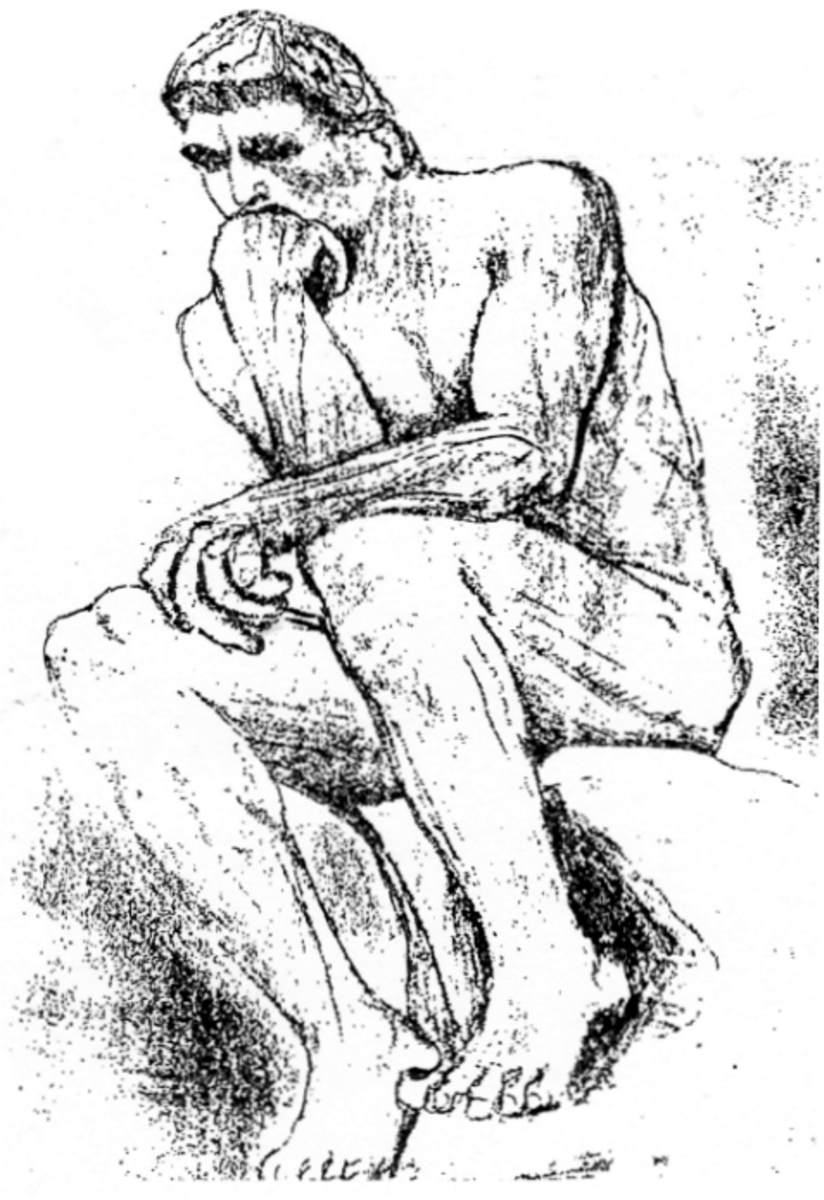
A student’s pencil rendition of Rodin’s The Thinker from the 3-week Class 10 Impressionism Art History unit.










Leave a Reply
You must be logged in to post a comment.