
Copyright Alan Whitehead & Earthschooling: No Part of this book, post, URL, or book excerpt may be shared with anyone who has not paid for these materials.
Alan speaks in a very symbolic and esoteric manner in some parts of his books. Although they can be read anthroposophically, passages speaking of Atlantis, archangels, gods, etc. do not need to be taken literarily to be meaningful. The more you read, the more you will realize he uses many different religions to express ideas in a symbolic manner and not in a religious manner. His writings are not religious. In some places his writings are meant to refer to religious events in a historical way. In some places he is using religious figures (from Christianity, Judaism, Islam, Buddhism, Hinduism, Paganism, Ancient Roman and Greek Religions, etc.) in a symbolic manner. However, at no point is he promoting a specific religion or speaking from a religious point of view.
I have kept the writing as close to one-hundred percent original so you will also find that he speaks of Australia often and some spelling or manners of speaking may be cultural. Any words I have changed are presented like this: <word>.
Also keep in mind that these books are written by a Waldorf teacher with decades of experience who also studied with a Steiner student himself, so he speaks to an audience that is dedicating their lives to the Waldorf method without exception.
Because of this, all of his views are not reflected in the Earthschooling curriculum and not all of them may be ones you want to embrace or are able to use. In all of Alan Whitehead’s writings the opinions are his own and may not align with Earthschooling or Waldorf Books. In some cases, we will be updating some of these chapters in the future with additional and/or updated information.
Ultimately, however, as I read through these passages I find I can distill wisdom from even those paragraphs that do not resonate with me.
We invite you to read with an open mind and heart and with eagerness to learn and discuss…
Is it an Actress – is it an Aviatrix!?
Portrait Drawing – Class 11
Anna’s loud voice broke the calm, industrious mood of the classroom.
“Your eyes are too close together!”
“They are not!” protested Rod from the other side of the two desks that had been moved together for this Portrait Drawing block lesson.
“No, I mean in my drawing. I forgot what Art Teacher said about eyes being about one eye-width apart.
“I hope that’s all you’ve forgotten; you’ll have me looking like the Elephant Man next! Here, let me have a look …… hmm, not bad; the proportion of head length-to-width is out a bit. I don’t have a long face like that. Look, you get the proportions by holding a pencil against the feature – remember? But what do you think of my drawing of you?”
This was typical of the banter in Class 11 in yet another afternoon of their 3-week block lesson on the rendition of the human head. Of the 3 Visual Arts strands, this was the final one, that of Thinking. It was, not surprisingly, the students who pondered their drawings – those who thought about them – who tended more easily to solve the problems of proportion, position, scale, ratio – and all those specific factors which actually make the drawing look like, or truly represent, the subject.
Drawing is above all conceptual; just as sculpture relies more on a highly refined feeling life – and painting is one of the most powerful forms of will expression (‘painting cultivates the will’ – saith Rudolf Steiner). Rendering the human head brings this conceptual element right down to earth; the head is, after all, a kind of microcosm of our globular planetary home.
The inspiring zodiacal center for the Visual Arts is Capricorn, or as the Ancient Greeks conceived it, Pan. His name is often used in association with visual perception or acuity, as in panorama! He is the Being who manifests visually mainly to rustics and bucolics (he is a nature or wilderness spirit) in myth and legend. A modern example however is his sublime, deeply-moving – and wholly unexpected! – manifestation to the simple woods-folk in the children’s story, Wind in the Willow. Pan is the god you see; but you only see him in an earthly context, his goat feet are a potent symbol of his incarnational or earth-bound principle (white is the color ascribed to Capricorn). But he is usually only seen in shady groves and the like.
Pan’s appearance to a single viewer, or small group, is unforgettable and spiritually transporting; but to a crowd it created – Panic! Art Teacher was idly thinking about her – the Visual Arts teacher’s – supersensible benefactor, as she was pinning a set of large ‘head’ drawings on the display board; drawings which both she and the class had collected for this unit. There were so many styles, techniques, and materials; but she was careful to avoid head paintings; these dwell in a different golden chamber of aesthetics in the souls of the students.
She had examples of stylized line drawings, satirical works, some of Leonardo’s ‘character’ masterpieces (and other classical artists’), and newspaper cartoonists. One good one was where both the (irreverent!) drawing of the politician was displayed next to the actual photo form which the artist worked.
Here the students could see exactly which elements were chosen to be exaggerated; they could see the ‘thought path’ of the cartoonist behind the work. There were also drawings displayed from previous Class 11s; this gave a kind of rough benchmark of what was expected; even if at the start of the unit the artistic heights attained by their same-age predecessors seemed impossible to scale!
As well there were art materials richly supplied (the classroom had become a veritable professional studio!). Students were also asked to bring in any materials they had at home, some were of an arcane nature indeed, inherited from old aunts and the like! These included papers and card; inks; silverpoints; pastels; grades of colored pencils …!
This wide variety was to enhance the individualistic aspect of this lesson. The drawing of faces is really drawing of individuality; and is not easily managed by adolescents until about the 17th year, when their own – at this stage, ghostlike – Self-hood is gradually emerging. AS well, 17-year-olds are passing through their 19th Century development phase; a time when the empowerment of the individual was a most evident social force. This resulted in new forms of personal emancipation, like voting, women’s, workers’ – and other’s – rights.
The 19th Century, on a social level at least, was the New Day of Individualism. 1879 was the beginning of this long-awaited – in the spiritual world – epoch; that under the regency of a new Time Spirit, the Archangel Michael. His mission is, over the next 200 years or so, to liberations of the Individual! Little wonder then that Class 11, in particular, so enjoyed expressing this unspoken Self soul-surge.
“I’ve drawn that marble bust of the 4-year-old child form several perspectives now. How many should I do?” said Yvette.
Yvette was a diminutive girl, with masses of wavy, brown hair; she was so small hiding behind her drawing board that Art Teacher at first didn’t know where the query was coming from “Uhh … what? Oh, there you are – right, yes those are quite good, but you still tend to go into too much fine detail Yvette. This part of the ‘Antique Drawing’ lesson (the formal term for classical statue rendering) is quick sketching. Just use simple line and rough block-in to capture the essentials of the face. In this case it’s a virtue to leave things out! Time yourself, 5 minutes a sketch.” Yvette laboriously lugged her large board to a different position, got another sheet of cheap paper, and resumed her charcoal sketching.
Rod was also now working on an antique, but his was a highly detailed finished drawing (one allows a lot of individual enterprise by Class 11!). This was a sepia, fine-nib pen on ivory card – beautiful! He was warned from proceeding to the rendering stage until the light pencil construction had been approved. “After all,” smiled Art Teacher “you might have the eyes too close together, and not find out – to your disappointment – till after you’ve finished the ink work!”
No-one would admit where the human skull – whose name was Yorick! – come from; or knew whose ‘individuality’ it one supported! But here it was in the classroom, all polished up and ready to be drawn. “you can’t be convincing in the surface contours of portraiture unless you know the architecture beneath the skin and muscles – the skeletal structure itself. So we’re going to do quite a few skull drawings (most classes have to work from photos!), from different angles of course.
You have to be conscious, say, of the connecting mechanism of the jaw, and the ‘squared-globe’ design of the cranium, to bring integrity to the work. That’s why Anatomical Drawing is vital; later we’ll do a couple of drawings of the head and face muscles as well – what are the muscular dynamics of a smile? Of a frown? If the skeleton gives the ring of truth to structure, the muscles do the same for expression.
These also help in understanding the construction of the head from a sphere – with specific eye-line, ear-lines, longitudinal nose-line, etc. Later I’ll get you to invent a simple character; someone you might create for a comic. You will do, um, about half a dozen drawings with different expressions and viewpoints. One might be angry, from the side; a second, wear a seraphic smile, with a from-below-up perspective – another could express fear, face on! You never know, you might work this up and submit it to a newspaper or magazine – if your character is original, and apt to their needs, it could be accepted. After all, that’s how every comic strip character got his/her start in life! Your character could be simple, like Charlie Brown, or complex – Prince Valiant!”
“As well, I want you,” said Art Teacher to her ardent class “to keep an eye out for ‘character’ pictures to draw from. Within the course of the 3 weeks, you should experience the difference between illustrating a baby (the easiest head to draw, due to is relative lack of individuality); a child; a teenager … yes, you’re covering that by drawing each other … an adult; and an aged person. Head forms change dramatically through-out life, with the babe’s being based on the (physical body) sphere; the primary child’s on angular (etheric) forms; your own on the gentle (astral) curve; and as the human being ages, the blocky (ego) aspect dominates.
Also, I would like you to experience caricature; here’s an example of my work as a student, where I was given an assignment to draw a will-dominant face. See the large jaw, pinched features, and egg-cup skull – ha, ha. This one rather has a receding chin, large, cow-like face, and a flat head; my satirical idea of the ‘feeling’ face. The third you will recognize easily, the so-called ‘professor’ head, with large dome, tiny facial features, and a little pointed chin.”
The students seemed amused at these will-feeling-thinking drawings (little realizing they were taking in the seeds of a study of physiognomy for later life) and were anxious to try their own. Indeed, the enthusiasm for this lesson gripped the souls of some of them so strongly, that they even took their drawings home to finish them. Perhaps the incentive of a small Art Show at the end of the unit had something to do with it. This was also going to be shown at a local shopping center, on display boards made by Technics Teacher.
There were many advantages to moving out into the world, especially for 17-year-olds, whose soul-gaze was continually turning outwards, wondering how their learnt skills would be received by the wider community. With these convenient boards, a display could be mounted at school, and transported in a van to the shopping center, bank, college – whatever – that was obliging enough to show them. This was excellent P.R., based on the (Capricorn) principle that ‘a picture is worth a thousand words. Some drawings were later even sold off the board – great for the student’s sense of self-worth! In any case, a sacred law of the Visual Arts is that they must be shown, the more public exposure the better. An unseen picture or sculpture is a statement of egotism, done in the spirit of self-indulgence for the artist alone. The Visual Arts must be viewed to justify their existence – must be shared.
“I want you to think about developing a few stereotypical characters. You see these all the time in cartooning and commercial illustration, where the rich man is often bald, with a big cigar.”
Rod looked up in surprise “I’ve got an uncle like that; but I’ve also got one who’s French, and he doesn’t look like the typical Gallic artistic type, with beret and pencil-thin moustache?”
“I know that most of these people don’t actually look like that; it’s a kind of shorthand that’s all, used by illustrators to portray different types for easy recognition. What does the archetypal Aussie look like? Or the exhausted housewife? Think of some of your own. The acid test will be, if when we look at them, we immediately know who, in terms of human type, they represent.
One thing to be careful of if characterizing an actual person, especially someone close to you, is to be generous and don’t highlight their warts, big noses, and such – you can lose friends that way. I know I did; when I was at art school, I drew one of my -sadly unattractive – fellow students in a very uncomplimentary way. To this day I’ve never forgiven myself, in spite of it being a very good drawing! – for causing the poor girl such hurt and humiliation.”
It was a few days later that Anna held up a drawing with “This is one of those stereotype faces – so who is it? … Come on, it starts with an ‘A’! The well-drawn picture in dark blue pastel on light blue paper was of a somewhat dreamy aesthete, with delicately chiseled features, large, pale eyes, and an unruly shock of blonde hair. Art Teacher looked at it first this way and that “I … er, I’m not sure – starts with A eh? An actress? O? An aviatrix perhaps?”
“Wrong!!” yelled Anna in delight “That’s an art teacher!!” The calm, monastic mood of the classroom dissolved in gales of mirth!
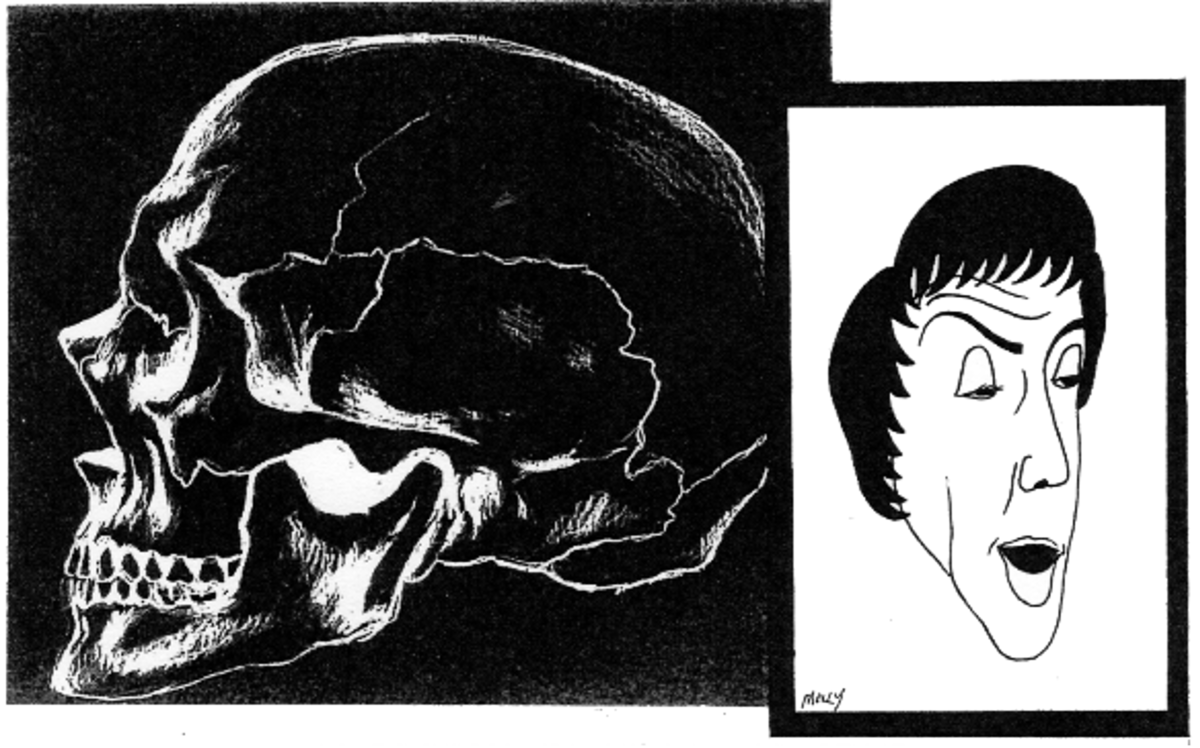
“You can work miracles with drawings; when a line has a particular lawfulness, it works so as to lead a person directly to great cosmic mysteries” Rudolf Steiner, Berlin.
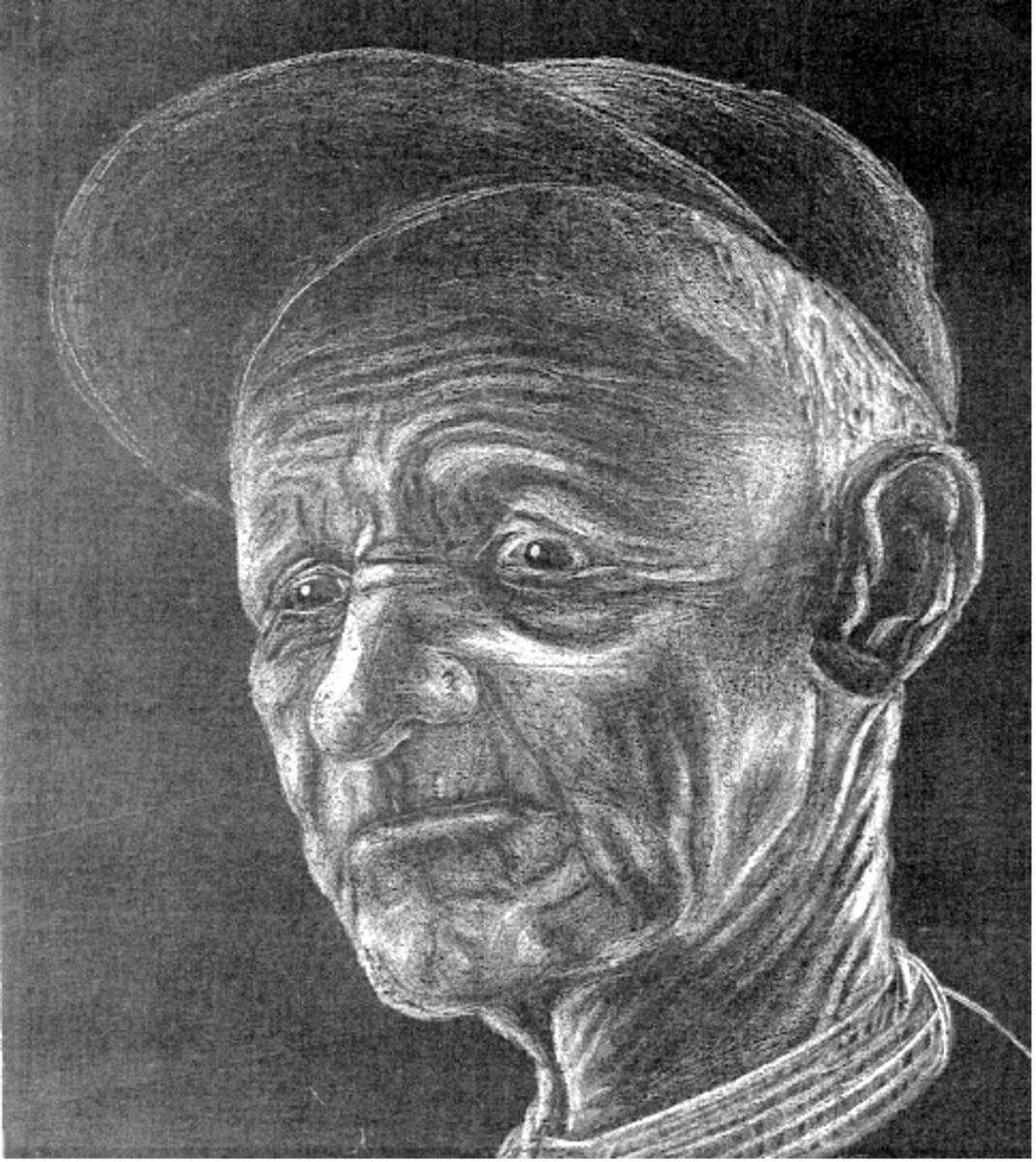
White pencil on black card portrait by author as a 17-year-old student. See Class 11 ‘Portrait Drawing”.










Leave a Reply
You must be logged in to post a comment.