
Copyright Alan Whitehead & Earthschooling: No Part of this book, post, URL, or book excerpt may be shared with anyone who has not paid for these materials.
Alan speaks in a very symbolic and esoteric manner in some parts of his books. Although they can be read anthroposophically, passages speaking of Atlantis, archangels, gods, etc. do not need to be taken literarily to be meaningful. The more you read, the more you will realize he uses many different religions to express ideas in a symbolic manner and not in a religious manner. His writings are not religious. In some places his writings are meant to refer to religious events in a historical way. In some places he is using religious figures (from Christianity, Judaism, Islam, Buddhism, Hinduism, Paganism, Ancient Roman and Greek Religions, etc.) in a symbolic manner. However, at no point is he promoting a specific religion or speaking from a religious point of view.
I have kept the writing as close to one-hundred percent original so you will also find that he speaks of Australia often and some spelling or manners of speaking may be cultural. Any words I have changed are presented like this: <word>.
Also keep in mind that these books are written by a Waldorf teacher with decades of experience who also studied with a Steiner student himself, so he speaks to an audience that is dedicating their lives to the Waldorf method without exception.
Because of this, all of his views are not reflected in the Earthschooling curriculum and not all of them may be ones you want to embrace or are able to use. In all of Alan Whitehead’s writings the opinions are his own and may not align with Earthschooling or Waldorf Books. In some cases, we will be updating some of these chapters in the future with additional and/or updated information.
Ultimately, however, as I read through these passages I find I can distill wisdom from even those paragraphs that do not resonate with me.
We invite you to read with an open mind and heart and with eagerness to learn and discuss…
Beyond the Image
Abstract Painting – Class 12
“And why do you teach Abstract Painting to your Class 12 students? Asked the school inspector, his face grave. “I’m rather of the old school myself; I need to be able to recognize what I’m looking at. There’s too much of this new-fangled…”
Art Teacher stood a large work of Andy’s up against the wall; it was rendered in a set of pleasing autumn harmonies, and vigorous, sweeping forms. “Well, it should be easy to guess what his painting’s about, it has a title you see – Willows in the Wind …”
“Or is that Wind in the Willows! Ha, ha, ha!” it seems that this stern man had a sense of humor hidden under his grey suit.
“How droll – many abstract pictures are titled; the artist giving us the key to the picture content. Others insist on letting the painting speak for itself, being a kind of color cryptogram. This Mondrian-like geometric work by Steen is one of these – ‘Composition 3’! Art Teacher folded her tanned arms and smiled at her interrogator.
“Well, I suppose it does help to have a title.” School Inspector was slowly mollifying, but still far from convinced “I mean these days anyone can be an abstract painter and not even be able to draw; bring back the old disciplines I say – like antique and still-life…”
“It’s true, one can’t paint abstract with integrity without the foundation of good draftsmanship. Picasso, the father of abstract art, was a superlative traditional artist as well. These high skills have already been developed in y students – first in their 7 years of primary, but in an even more conscious way in the 5 years of high school.
Abstract Painting is the very last of the 12, 3-week afternoon block lessons on painting; one each year right through school. As the culminating painterly experience, I allow them to choose their own medium for this, experienced as they are in all kinds by now. I even encourage mixed-media pictures, with gouche-and-oils, or pastel-and-watercolor – even collage. Look, Jasmin created this beautiful work, exclusively out of different colored foil papers – silver, gold, emerald, violet – lovely!”
“Hmmm – that is very decorative; and I agree that quite a lot of abstract art is beautiful; but is doesn’t meananything! Not like, say a Madonna and Child.”
Art teacher smoothed her frock in admirable restraint “Actually some abstract works contain as much, if not more, meaning as many old masters. The mission of non-representational art was to wrest painting from the tyranny of the fixed image. Before the 20th Century, a picture had to contain the recognizable, but with abstraction – as the word implies – only the spiritual essence need be depicted.”
“The what!? You’re not propagandizing these vulnerable young people with religion I hope?!” retorted an unsmiling Inspector.
“Good heavens no – we use the word spiritual in the most liberal sense only. With painting, you don’t have to believe in its metaphysical reality – you can see it! Anyway, there are 3 basic subjects in abstract art. The first is found in pictures which contain mostly an idea, say the abstract noun ‘growth’ – or ‘creation’. The second are pictures of emotion – anger, love, serenity – and the third are pictures of things – ‘city silhouette’ would be one such subject, or ‘palm grove’.
There is however a primary restriction in all three, namely that there should be no recognizable image, or if there is, it is in such an unlikely context, as in Cubism, that it is still regarded as abstract.
Every idea/emotion/thing is to be portrayed through one of the 4 Fundamental Elements of painting – tone, color, form, and texture. These express the ‘Four Bodies’ of the picture, and indirectly at least, those of the artist. You are familiar with the, um, ‘spiritual’ foundations of our education I presume?”
“What? Oh yes, I – er, did a bit of reading before I came. These four are – let me see – the ego, astral, etheric and … er, psychic?”
“Close, the 4th is the physical body itself. The first element, tone, the light/dark nature of a work – the chiaroscuro – is an expression of the Light of Self (or its dark adversary) – of the Ego. A gloom-filled picture has a melancholy brooding tone – evil perhaps; whereas one filled with light, like Lloyd Rees’ final works, bespeak a spirit-seeking self-consciousness which is almost palpable. Most pictures dwell somewhere in between, the ego performing its usual high-wire act between the light above, and the dark below.
The actual colors of the picture reflect the astral aspirations of the artist. These range from gaudy, through pastel, to somber tertiary hues – to black and white even. What kind of astrality does the foil picture express do you think?”
School Inspector shifted uneasily on his easel stool, his countenance dark, his eyes wary. “How would I now, I’ve only met these terms today! How about – how about the astral body. It seems to be fashioned by the slickness of modern life, with its chrome-plated technology.
“Well, well – verrrry good. See, these pictures do have meaning, even without the reassuring image element. The ether body finds expression in the form and dynamics of the painting; whether geometrical, free-form, amorphous or whatever. Willows in the Wind, depicts a satisfying freedom of etheric expression.”
I’ll say, more than, say, some of Ferdinand Leger’s mechanistic works.” School Inspectors’ face was brighter now that he was able to make an intelligent contribution, but the question ‘Who was inspecting whom?’ did occur. “What ‘astral’ reality do you think Leger saw beyond the image?” he said, “you do know Leger’s work I trust?”
Art Teacher had large, quality reproductions of the great Abstractionists (ancient and modern) displayed around the walls of her art room; a fact that would be favorably reported by School Inspector.
“But let me guess the 4th and last ‘Element’ – that of Texture.” Said the visitor warmly. This is so obviously a physical body expression. Some pictures don’t emphasize texture/physical properties at all – others trowel on the paint, creating a 3-dimensional effect even. A glossy varnished surface heightens the sense of physical perfection; a hessian or raised natural finish, creates rather a rustic impression.
It seems that nay painting can be assessed on this 4-body principle, in order to gain greater insight into its nature. That Picasso for instance – hmmm, tonally dark, suggesting an ominous ‘ego’ quality. The picture’s colors are in the tertiary range, a weighted astrality one might say – earth-bonded even! The strong geometric forms are those of a disciplined – mechanical even – ether body (of both art and artist perhaps?). Ah, and the rippling texture is suggestive of a fairly gross, physicality. But I notice that in your lesson program – and very informative it is too, not like some disorganized teachers, where their paperwork reflects their general incompetence! – you don’t tach abstract painting till Class 12, what is that?”
“Thank you,” demurred Art Teacher, wondering if a compliment from a school inspector a compliment at all is really “it’s not that high school students couldn’t actually paint in non-representational method before the 18thyear, it just wouldn’t be as soul-bonding an experience that’s all. you see, in the unfolding of the Individual, we observe a recapitulation of the whole of human evolution. The body in its first year is reliving a kind of Ancient Saturn consciousness, you know?”
“Um, yes, I think so … and Ancient Sun is the 2nd year of life – Atlantis with 7-year-olds (sorry to skip a few, I’ll look them up when I get home) – Ancient Greece in Class 5 – the Renaissance with 15-year-olds – I forget the rest!!”
“Nice going,” said Art Teacher encouragingly “so then we have the Age of Enlightenment in Class 10: the 19th Century in 11; and with Class 12 we arrive at our very own era – the 20th-21st Centuries! An 18-year-old is truly a thoroughly modern person.”
“Of course – it all makes sense doesn’t it?” beamed School Inspector, his hands sweeping the pictorial display and hung student’s works for emphasis “Abstract painting actually only came into the world at the beginning of the 20th Century! Now I see why it’s inappropriate to introduce it earlier. The delicate lotus of the non-concrete soul really only open in the 18th year. But tell me, what are those sketches on the wall, they seem like a series of drafts for a triptych to me.”
“This is an exercise to lead the students through the 3 Stages of Expression – naturalism, stylization, and abstraction. ‘Draw a subject, any subject, in a figurative style, that which is truly the ‘body’ of art – the more naturalistic the better.’ I ask the class ‘Now render the same subject again in charcoal or pencil, as a stylizedversion. Stylization is a specific ‘soul’ expression, rather than body. This includes both symbolic and surreal art. Here the soul distorts, in either an exaggerated or diminishing way, the physical reality to suit itself. At the same time, it retains the recognizable characteristics of the subject.
Finally, the 3rd draft, that of ‘spirit’, the totally abstract version. Here the essence only of the subject is retained; we are not burdened with the image. Ostensibly the viewers – initially at least – do not know what they’re looking at. But with psychic effort, that in which the soul moves through and beyond the painting, the sensitive learns to ‘see; the reality expressed – to partake in its spiritual activity. Psychedelic Art of the 1960s and ‘70s was a kind of catapulting – in some cases a premature one, drug-induced as it so often was – into this ‘psychic’ realm. Even this was part of a higher mission.
You see, abstract art, in its highest manifestation, is a pictorial vestibule to the Spirit. When the human soul crosses over The Threshold, whether through meditation, revelation – or termination! – the world encountered there has no recognizable forms. In fact it looks just like an abstract painting, or endlessly metamorphosing painting! These contain the spiritual essence of the created world. The so-called human aura is an example of this.
So to prepare humankind, especially Western Man, for its slow but inevitable epiphany, abstract art had to come into the world, being really a gift of the gods. Mind you, only the very best of this remarkable aesthetic phenomenon depicts spiritual truth. Much that goes under the guise of modern art is little more than artistic fraud.”
School Inspector looked ill-at-ease at these fiery condemnations but held his piece in case some picture hewas fond of was cited as being a ‘fraud’. She went on unfazed “And to hearken back to our earlier concerns, these are foisted on a gullible public not only by ‘artists’ who can’t draw – but who can’t even see!” He decided to change the subject before she began foaming at the mouth!
“Er, very interesting – but I was thinking; there have been many precursors to abstract art through the ages, especially in the Middle East cultures. A Persian carpet is even non-representational art of a kind.”
“It is – and brought about by a proscription on image if you recall – ‘Thou shalt worship no graven image’. Both Jews and Moslems were forced into an early – highly formalized and decorative – abstraction. But that which burst into the new century, with those adventurous Expressionists, was a spiritual imperative to freedom, rather then, as in the earlier case, a result of cultural/creative bondage.
After all, the Arts are of the Spirit – and by definition, Liberty – in the 3-fold Social Organism, as espoused by Rudolf Steiner. Liberty/Spirit – Equality/soul – Fraternity/body, yes? Artistic censorship is one of the worst kinds. As the maxim goes, I may disagree with what you painting, but I will defend to the death your right to paint it!” School Inspector began to wish that he hadn’t changed the subject after all; what could one speak about with this passionate (attractive!) woman which didn’t have her flying into a frisson!? He’d try again!
“Um … talking of ‘spirit’ is all very well, but artists have to be practical too you know – even in a commercial sense.”
“Indeed, and do you see anything in this room, or in my program, that denies this? No. the timeless principle of ‘Spiritism’ is however the underlying inspirational force of visual artist through the ages. The true artist perceives the world, before all else, in terms of ‘spiritism’. This is that ascribed, of the 12 Philosophical Points of View given by Rudolf Steiner, to Capricorn. This sign is that of Spiritism /Visual Arts and is balance – to still your doubts – by the complementary sign across the circle of the Zodiac, Cancer, with its Materialism/Science inspiration.
You’d be surprised how accessible 18-year-olds are – now old enough to take on board, consciously, the reality of the 12 Philosophies – to spiritual idea in relation to art. They experience the liberation of the soul when painterly expression can transcend mere earth-bound concept – like that work over there in reds and violets, ‘Power and the Blood’. What a visual bridge this is to the verbally indescribable, how important to familiarize the soul with the unfamiliar, with Spirit …! What are you writing down?” she asked suspiciously.
“What? Oh nothing!” replied School Inspector nervously, popping his notebook back in its bulging briefcase “I just remember reading something about Capricorn, and its Sense of Sight.” He rose to ‘inspect’ a particularly lovely work in airbrush by Kathy simply title ‘God’.
“In the 12 colors, as they range around the Zodiac, that ascribed to Capricorn is one of the ‘Image’ colors, white in fact. This is described as ‘the soul’s image of the spirit’ – ‘Spiritism’ is just that yes? Well, all colors are derived from white light, making it so appropriate for the Visual Arts in general, and painting in particular. So white is the color of Spiritism/Capricorn/Visual Arts – yes?!
I might find it difficult to describe such profound concepts to my superiors back at Head Office. Part of my task – I shouldn’t be telling you this – is information-gathering. Art Education in many of our schools is in dire need of reform, with some children being ill-advisedly taught abstract painting at 9 years of age, while many 18-year-olds never touch a paint brush and haven’t for years! So we’re fishing for new ideas – ideas that work!”
“Help yourself,” said Art Teacher smiling demurely from beneath her halo of blonde hair ”My task is to help children and students everywhere; no matter what schooling system they find themselves in.”
“Thank you” smiled back School Inspector as he retrieved his notebook and began writing “Ah, I’d like to actually have an overview of the Painting Syllabus if you don’t mind; you know, right from Class 1. Seeing that I’m inspecting – er, looking at, the final product today – the last of the 12!”
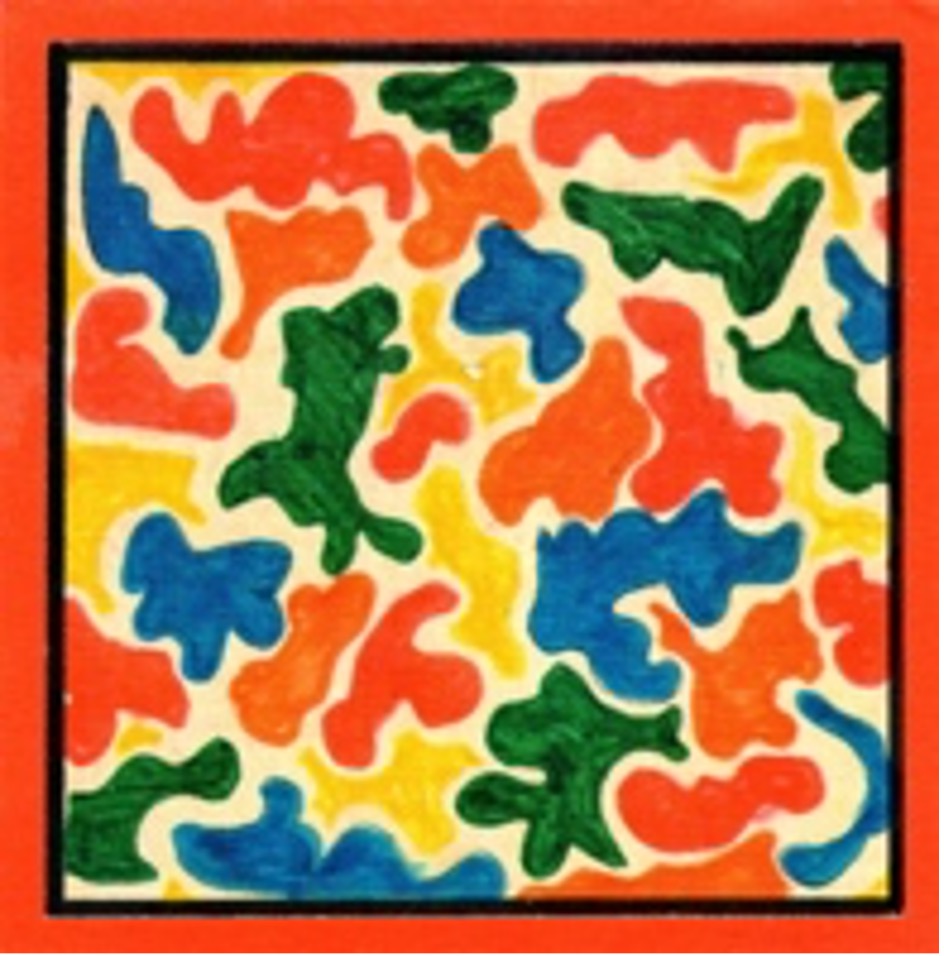
“You are indeed, here, have this complimentary gift, a book by the first specialist Art Teacher in a Steiner high school in Australia, Alan Whitehead. He’s been involved in this exciting area since 1967 you know. The book is called Choirs of Colors and, as well as looking at a lot of general aspects of the painterly world, characterizes the first 7 Primary School Painting units. All watercolor they are too.
But to pop the whole thing in a nut … er, ‘butterfly chrysalis’! … I’ll go through them quickly. In Class 1 we have Primary Colors; there are 6 of these actually, 2 each (warm and cool) of red, blue, and yellow. These create 8 hue combinations.
In Class 2 we actually provide the 3 Secondary Colors, orange, green and violet, as well of the 3 primaries of course. 9-year-olds in Class 3 enjoy the 9 Color Clans – or ‘families’ of colors. Like the ‘light family’, and its partner, the ‘dark’ – oh, and the 3 ‘complementaries clans’, like the reds-and-greens. In Class 4 it’s Single-Color Painting – or ‘two-of-a-kind’ – say Prussian and ultramarine blue.
Class 5 – um – the full 6-primary color range for Mounted Wet-on-Dry Painting. Prior to this ‘age of objectivity’, all pictures by the younger children were wet-on-wet. Ah, Class 6, wet-on-dry again for Light and Shadow Painting, al fresco if you don’t mind! and Class 7 – Veiling; painting with the most delicate of pastel shades.
In high school, there’s a strong shift in emphasis from the wholly aesthetic, to a range of ‘modern’ interpretations, techniques, and media – to equip the students for the real world1 Class 8 is Poster Color; 9, Acrylic Landscape Painting – you can see examples of all these around the Art Room walls … there’s a Class 10 Watercolor, using traditional rather than, er, the more metaphysical prismatic hues of primary. And there’s a Class 11 Oil Painting – fantastic eh? Finally …”
“Yes I know, Class 12 Abstract Painting, thanks for that” murmured an appreciative School Inspector as he drew a line under this last entry “Now I’ll be off; and I hope to receive an invitation to any student art shows you might mount – oh, and I promise not to take notes!”
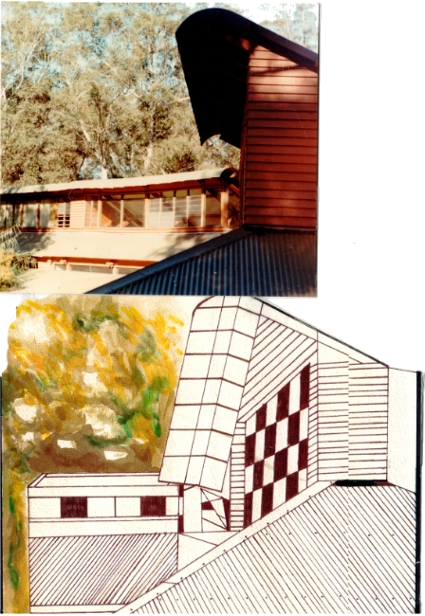
Student’s stylization of school building. See Class 12 Abstract Painting Chapter 12.










Leave a Reply
You must be logged in to post a comment.