
When you purchase a Planner Block from Earthschooling, we lead you through this process within the Planner Block itself. However, it is still helpful to read this document so you can understand the ‘why’ behind how we planned the lessons.
When you purchase a Subject Block from Earthschooling, it is assumed that you are already familiar with Waldorf education and how to teach blocks. However, even if you are an experienced teacher with this method, reviewing the ‘why’ every year is a great way to inspire you and center your intention for the year.
How We Organize the Subject Blocks
For the older grades, we include increasingly more instruction with each block because there is more complexity. However, for grades 1-4, the blocks are done using the same method for everything – a three-day rhythm (two is also OK from time to time) with specific goals for each day. So, as you open each lesson block, you will insert those lessons into this same formula again. It becomes much easier each time you do it. Soon it becomes second nature. When teaching a block for grades 5-8, you will find that most blocks include specific instructions on what to do for each section of content. You will also find numerous blue boxes or blue font that instruct you specifically on what to assign the student for their Main Lesson Book.
We have provided an excerpt from the eighth-grade Industrial Revolution Subject Block below:
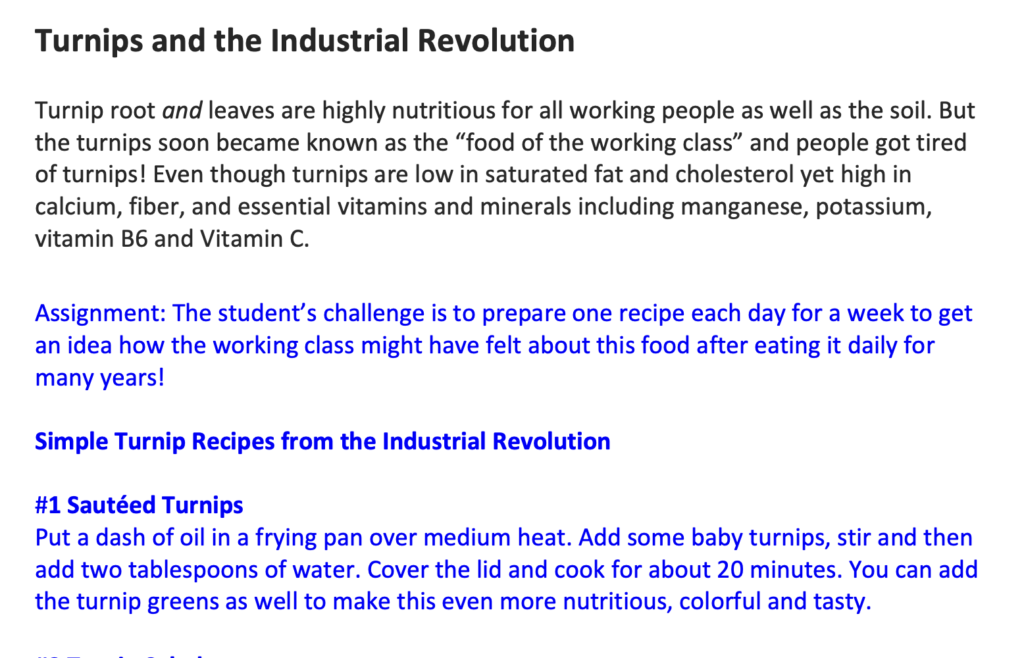
For subjects like math, you may find blue font for some assignments. However, usually your math assignments will be to take the appropriate worksheet and assign it by writing the problems on the board or giving the worksheet to the student.
If you do not find a ‘blue font assignment’ in your Subject Block or want to assign additional work for the student, you can use the method below.
Keep in mind that once you learn the “three-day rhythm” method and what to present on each of those three days, it becomes second nature, and using the blocks becomes much easier. You will be using this same formula repeatedly. There will be nothing new to learn. Also keep in mind that although I’ve been teaching for more than 20 years, I still need about a month to find the class rhythm at the beginning of each year. So, if you don’t feel things are going smoothly after the first few lessons or even the first few weeks, that is OK. Many of us feel that way, but it won’t impact your ability to have a great year, find your rhythm, and cover all the material.
How Will I Teach a Subject Block?
In general, with blocks, there are three things you need to know:
In what order will I do the lessons?
The Earthschooling curriculum is open-and-go. You will simply open each Subject Block PDF and go through it in order. It is ideal to tell the story or teach the lesson, but you can also read it from the page if needed or use the content on the page as a guide. Of course, the same method applies to the Planner Blocks. You will open them and teach all the lessons in the order they are presented.
The only exception in the Subject Blocks is when stories are presented in the lower grades (fairytales, fables, etc.); we have usually provided extra stories so you can skip the ones you do not want to use.
How long do I spend on each lesson?
In general, you should work through each lesson at a comfortable pace for your student. If you don’t make it through the entire block before it is time for the next one, that is acceptable. You will spend about 4-6 weeks on each Subject Block. Remember, this guide is for Subject Blocks and not Planner Blocks. If you are using Planner Blocks, we have set the pace for you. However, you are allowed to modify that pace if needed.
How will I teach the content in the Subject Block?
If you are new to Waldorf education, we highly recommend using our Planner Blocks or Living Lessons to get you started. Then, once you feel confident, you could switch to Subject Blocks.
If you are already familiar with Waldorf education and Subject Block teaching methods, or an enthusiastic new parent/teacher who wants to quickly dive into this method, you can review the guidelines for Waldorf block teaching below. The guidelines below consist of three articles we created to help you.
If you do not want to learn by reading the articles below, you can also learn the Subject Block method by using a Planner Block, or you can view some free Living Lesson samples on the website www.WaldorfSchoolOnline.com to see a Waldorf teacher instructing using the block method.
What are lesson blocks?
(Both our Planner Blocks and Subject Blocks both teach using the block method)
When Rudolf Steiner started the first Waldorf school, he established the “main lesson”—a two-hour class during which all academic subjects except for foreign languages would be taught. The subjects taught in the main lesson were studied for three weeks to three months. Many activities would fall outside of the main lesson block category, however. These include nature walks, bread making, cooking, and circle time (which happen daily), some crafts and handwork (which naturally flow into some lessons even if they are not your main lesson block focus), and review (for example, you may include some math review in your circle time even if that is not your main lesson block focus). In addition, many main lesson blocks naturally pair with lessons outside the main subject.
For example, when teaching Ancient India in fifth grade, this naturally pairs with the math lessons on ancient numbering. Adding these math lessons into the main Ancient India block greatly enhances student depth of learning, richness of experience, and retention for the block.
If you purchase a Subject Block, you have chosen to perform these integrations and enhancements on your own. If you purchase a Planner Block, our curriculum planners have carefully done this for every main lesson block and have explained why each Planner Block contains each lesson.
Why would I teach using the block method?
(Both our Planner Blocks and Subject Blocks both teach using the block method)
Teaching in main lesson blocks is one of the most successful features of Waldorf education, as it allows teachers to cover the curriculum intensively and for students to become immersed. I know from experience with myself, my students, and my children that immersion is the most effective way to learn many things. Learning in a block allows a student to open to a subject slowly and naturally understand, or to open to it quickly and fully experience the joy of becoming completely involved in something.
How do I take the content from a Subject Block and teach it?
You will plan your day by balancing the head, heart, and hands. For this reason, we usually do the main lesson block in the morning. In the Planner Blocks, we have done this for you. However, you can still benefit by reading the information below if you are using a Planner Block. The section below will help you understand how we planned your Planner Block day.
Morning (Head): Intellectual Work and Main Lesson
Middle of the Day (Heart): Form Drawing, Languages, Music, Plays
Later Part of the Day (Hands): Cooking, Free Play, Gardening, Crafts, Nature Walks.
You can rearrange these if you want. I usually like to start the day with “hands”.
What are the three parts of the main lesson?
The main lesson for a student in first through eighth grade is usually one hour for grades first through fourth and two hours for grades five through eight, but the main lesson can take less or more time depending on the student. This may seem like a long time for a grade school student, but it is divided into three parts.
Dividing it is very important to the lesson because each part addresses a different aspect of the student and often a different temperament as well. If you follow the 3-part process, you will find that your student feels more balanced in their learning process. You will also find that no matter what temperament your student is, they will be able to connect with the lesson on some level. This is why, although we divide the lessons into three parts, I do not designate a certain amount of time for each part. How much time I spend on each part will depend on the temperament of the student(s).
In a private or public-school situation where things need to be more structured and regular to fit within the school day and embrace multiple children, the suggested time is 20 minutes per part for students in first through fourth grade and 40 minutes per part for students in fifth through eighth grade.
Pre-Lesson
This should be the rhythmic part of the lesson where the student should participate in some kind of movement. Counting, memorizing math tables, walking while learning, repeating things, singing, speech exercises, poetry, and other such tasks are rhythmic. In the Living Lessons, you will see that the teacher usually starts each main lesson with a movement, verse, math practice, or all three just to get the student. We have provided this for you if you are using a Planner Block. In some, but not all cases, we provide resources for this within the set of Subject Blocks you ordered.
Part One – Usually* Day One
This should be the head-thinking part of the lesson (the head) where new material is presented to the student. This is usually when the teacher writes or draws on the board or tells a story. This part of the lesson has the intellectual content. This is what you will find in your Subject Block PDF. If you are using a Planner Block, you will find this content after the verses section, which is the pre-lesson part of the day.
Introducing new materials will look different depending on which subject you are teaching. In math or science blocks, this usually means drawing, using manipulatives, acting out math/science stories or actions, finding math/science concepts around the room or outside, building math/science concepts with blocks, or other hands-on experience related to the concept you are teaching. During this first part of the block, you are showing the student.
In language or history blocks, this usually means telling a story in a creative way or visiting a historical place and introducing the student(s) to the main idea of the language or history lesson.
In the case of form drawing, this usually means simply drawing the shape on the board and talking about how it is formed, acting out the shape, creating the shape in nature, or creating the shape in sand.
Part Two – Usually* Day Two
This will be the heart part of the lesson. After you present the content, you will take some time to ask the student questions and ask them to repeat back what you told them in the main lesson, to re-tell the story, or describe what the lesson is in their own words. Some students enjoy hearing the lesson again and acting it out with their body. They may even use costumes when acting the lesson out.
This is ideally done after the student has time to ‘sleep on’ the main lesson. Although these steps can be occasionally sped up, it is extremely important that the student have time to ‘sleep on’ as many lessons as possible. In both the Planner Blocks and Subject Blocks, we make suggestions about what you should ask the student or how they can review the lesson. The intention of this part of the main lesson is to allow the student to connect to the content with their heart.
Once again, this second day may look a bit differently depending on the subject you are teaching. In math, for example, this usually means introducing the lesson in a more formal way, such as discussing the ‘how’ or ‘why’ of the lesson from the day before or writing some of the math concepts on the board in a more formal way instead of just experiencing them or drawing them. This second day is also the perfect time to integrate math into another main lesson. So, if you are learning about Ancient India, this would be the day to bring in some math concepts the student has learned and talk about their history or how people use(d) them in real-life situations. In the Planner Blocks, we have done that for you. If you are using Subject Blocks, you can choose to expand your math lessons to include other topics or not. It is your choice.
Part Three – Usually* Day Three
This part is the hands (doing) part of the lesson where the student should be actively working on what they have learned. Most commonly, this part of the lesson will include a wet-on-wet watercolor, block crayon drawing, colored pencil drawing, writing in the Main Lesson Book, creating a clay sculpture, doing a science experiment, doing a math worksheet, or other hands-on task.
Usually* = You will usually split these parts across the three-day rhythm. However, if you include all the parts, you can speed up or slow down the process occasionally if needed.
How do I integrate enrichment into my subject block?
In the Planner Blocks, we have already done this for you. In the Subject Block lessons, we have done this to some extent, but have also left you more flexibility, as purchasing a Subject Block indicates that is what you desire.
To expand a Subject Block lesson into a full day, you would include verses, nature walks, a second-language lesson, and perhaps some review or “short lessons” in various subjects every afternoon. In the morning, however, you would focus on one or two Subject Blocks.
Some teachers hold firm to the “one block” at a time method. However, I find that with a smaller homeschooling class, two blocks can often be done at once if they are complementary subjects. For example, if we are doing a lesson block on Native American stories, we could easily do a grammar and writing block at the same time, as these can “go together”. Or, if we are studying Greek Mythology, it is also a natural time to do a block on Greece in general and learn more about the country’s geography and culture. In the Planner Blocks, our teachers have made these decisions for you.
As Steiner suggested, however, each teacher is unique, and that is why some parents/teachers choose to use Subject Blocks instead of Planner Blocks. There is even a wide variance in how Waldorf teachers across the world teach their blocks. Even Steiner varied the length of time he suggested for blocks. Some lasted as long as 3 weeks, and others for 3 months. He also recognized that each teacher would need to establish this time for herself and her class, so he did not set an exact “rule” or a specific number of weeks for each subject. He suggested a range of times. Additionally, you may plan to do a block for three months but feel “finished” at two months and want to move on. That is suitable too. Part of Waldorf education is to follow the natural rhythms of the child and life in general.
Additional Important Notes
As mentioned above, all our Planner Blocks and Subject Blocks are open-and-go. However, this means something different for each style.
For Planner Blocks, this means we have selected the stories, verses, lessons, integration, snacks, handwork, and music you will use each day. Using a Planner Block, you will simply open the Planner Block PDF and follow along with each section.
For Subject Blocks, this means we have provided the content and suggested assignments, worksheets, and lessons for your content. You will open-and-go by doing each lesson and story in the order in which we put it into the Subject Block. Our teachers have carefully selected the order of the lessons, so you should do them from page one to the last page without skipping around. You can skip or modify lessons if they do not suit your student(s), but you should not do the lessons out of order.
The only exception to this rule of “do everything in order” is when we are introducing fairytales in first grade, fables in second grade, saint and/or hero stories in second grade, creation stories in third grade, or other story-heavy blocks. In such cases, if you are using the Subject Blocks, you will find a larger selection of stories to choose from. You are not intended to use every story contained in your Subject Block.
Even in the Planner Blocks, we have added a few extra stories each week to allow each teacher more flexibility. If you are using a Planner Block, you will not use all the stories for the main lesson. You will tell some of the extra stories as bedtime stories or for language lessons. You may also save other stories to tell for the enthusiastic student(s) who just love hearing stories.
After each lesson, there is usually a suggested assignment or activity. If there is not, you will simply follow the three-day (three-part) rhythm described above. This usually means your student will create a wet-on-wet watercolor, drawing, or clay sculpture on their third day. This can also mean they will create a page in their Main Lesson Book which would include writing about the lesson and/or drawing it.
To offer additional assistance with this ‘doing’ part of the lesson, we have provided all members with access to Main Lesson Book samples and Member Galleries. All math Subject Blocks include a link to a page of worksheets. You will find this link at the bottom of your block page. Or you can link to all the worksheets for all grades HERE.
If you are using the Planner Blocks, you will also have samples included within your Planner Block. However, because we acquire and create new samples monthly, we highly recommend you also check the Member Galleries and Main Lesson Book uploads for additional inspiration and samples.
Finally, in the introduction and welcome letter for each Planner Block and Subject Block, we include information on why it is important to go into each block in more depth, but this is so important that it is worth repeating.
It is important to know that just because you are working in blocks does not mean you will not use the skills from all areas. For example, in one block, we may focus on language, but we will still use it throughout the year. We will just not focus on it. Or we may focus on math for a block, but we won’t avoid it the rest of the year when it comes up.
As much as possible, we integrate math and language studies into all our lesson blocks. We also try to incorporate science, music, geography, and many things. Teaching in blocks does not mean that you limit your learning possibilities by closing your mind to “tie-in” opportunities or even a little “unschooling” or child-led lesson planning. The blocks are a way to focus your lessons without limiting them.
Continue on to our next article HERE for more information on what a Main Lesson Book is and how to create one with your student(s).










Leave a Reply
You must be logged in to post a comment.