
Copyright Alan Whitehead & Earthschooling: No Part of this book, post, URL, or book excerpt may be shared with anyone who has not paid for these materials.
Alan speaks in a very symbolic and esoteric manner in some parts of his books. Although they can be read anthroposophically, passages speaking of Atlantis, archangels, gods, etc. do not need to be taken literarily to be meaningful. The more you read, the more you will realize he uses many different religions to express ideas in a symbolic manner and not in a religious manner. His writings are not religious. In some places his writings are meant to refer to religious events in a historical way. In some places he is using religious figures (from Christianity, Judaism, Islam, Buddhism, Hinduism, Paganism, Ancient Roman and Greek Religions, etc.) in a symbolic manner. However, at no point is he promoting a specific religion or speaking from a religious point of view.
I have kept the writing as close to one-hundred percent original so you will also find that he speaks of Australia often and some spelling or manners of speaking may be cultural. Any words I have changed are presented like this: <word>.
Also keep in mind that these books are written by a Waldorf teacher with decades of experience who also studied with a Steiner student himself, so he speaks to an audience that is dedicating their lives to the Waldorf method without exception.
Because of this, all of his views are not reflected in the Earthschooling curriculum and not all of them may be ones you want to embrace or are able to use. In all of Alan Whitehead’s writings the opinions are his own and may not align with Earthschooling or Waldorf Books. In some cases, we will be updating some of these chapters in the future with additional and/or updated information.
Ultimately, however, as I read through these passages I find I can distill wisdom from even those paragraphs that do not resonate with me.
We invite you to read with an open mind and heart and with eagerness to learn and discuss…
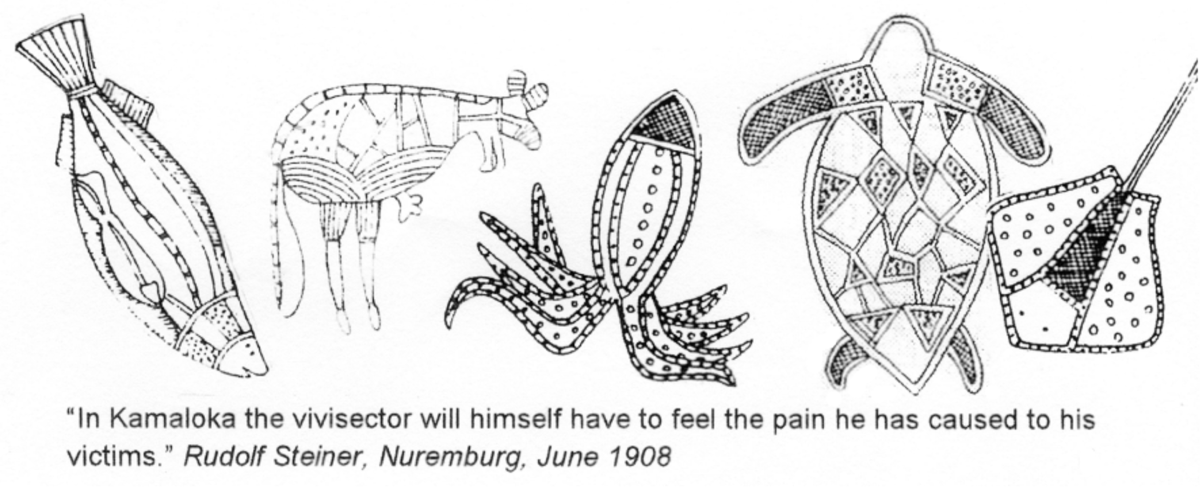
“In Kamaloka the vivisector will himself have to feel the pain he has caused to his victims.” Rudolf Steiner, Nuremburg, June 1908
Preface to Sacred Fauna
Every single aspect of one’s life is enriched by a long-term immersion in anthroposophical ideas and culture. This thought occurred to me this morning as I stood in wonderment at the vista of a rose-dawn light dusting a line of fluffy cumulous clouds along the horizon. A common enough sight one might think; until I recalled one of Rudolf Steiner’s reflections on sky watching. He said that observing the heavens in all their changing splendor cultivates the holy mood of “pious devotion” in the soul. In short, just watching the sky can be a profound spiritual experience. Imagine how this reverence increases when lovingly observing one’s very own favorite things! In your author’s case, since at least three years of age, this has been the wonderful world of animals.
I was fortunate to have incarnated into a family of “nature lovers”; a rarity in Australia in the 1940s and ‘50s. This loving ambience nurtured my soul right from my early birdwatching with my father. Of course, I tried to do likewise with my own two children. Then there was the teaching of an uncompromising conservation ethos in my long career in Steiner Education. This led to Golden Beetle Books; so many of which contain zoological content illuminated by Rudolf Steiner’s spiritual science Finally to Sacred Fauna, published in my 63rd year – a book penned in the spirit of veneration as a dedication to the long-suffering animal world.
From three to sixty-three? In six long decades, my love of nature seems to have come full circle! Yet still a perennial converse with the living world energizes me as nothing else. Indeed, the spiritual scientist calls on all three soul-energies to manifest new knowledge; will-energy, feeling-energy, and thought-energy. This triune is especially employed in the Three Ps of book creations, again a trinity: Preparation, Presentation and Publication. In esoteric circles, there is a wise aphorism that “a book finds its author”. How more real this is than the materialistic opposite – that somehow a writer extracts the ideas and images from his own head! According to Steiner, no higher concepts are possible without the collaboration of the spiritual world. This infers that a book has an independent (if initially metaphysical) “being”; a karma, indeed. On the other hand, the books a person chooses through life are an indelible component of his/her own karma.
If a book is a Being, of whatever kind, lowly or lofty, then by logical extension it must have a biography. The thirty-year catalogue of imperatives that were necessary to incarnate Sacred Fauna into the world in 1975. (Or was it 1944?!) It was then that I began researching much of the content for my Class 4 Man and Animalmain lesson. This was added to over the years by many other zoology units through both primary and high school. In time, these metamorphosed, in increasing complexity, in a wide range of teacher-education and general anthroposophical lectures through the 1980s, ‘90s and ‘00s. The gestation of the book was when this oeuvre of ideas found its way into manuscript form; the subsequent publication being its true birth – exactly three decades after conception.
Rudolf Steiner stated that the two main pillars of esoteric life are continuity and truth. Considering the above, I can certainly claim credit for the first; ‘continuity’ being the worldly-bodily component of this Joachim-Boaz dichotomy. Thirty years from a twinkle in the eye to global dissemination would seem to assure this to be the case. As regards the second, ‘truth’ (the supersensible of the twin pillars), lacking infallibility as I do, I can only assure my readers that I have tried my best to confirm the accuracy of the book’s – mostly original – content. Mind you, having such a long time to anneal the many and varied postulations in the furnace of truth should provide some confidence in its veracity.
To return to the book as Being. A new title is like a child; the author being merely the mid-wife; present at it conception, then assisting in its birth and early nurture, before liberating it to take wings on its unknowable journey into human will, hearts, and minds. My singular hope for Sacred Fauna is that it aids in deepening the spirit of sanctity in its valued readers for all God’s creatures – “great and small”. – Alan Whitehead, Blackheath May 2005
FROM: Sacred Fauna: Zoology in Light of Steiner’s Spiritual Science
Four Kingdoms Companion volume to: Sacred Places Minerals & Land; Sacred Fauna Botany; Sacred Faces A Study of Man
Important Earthschooling Notes
Copyright Alan Whitehead & Earthschooling: No Part of this book, post, URL, or book excerpt may be shared with anyone who has not paid for these materials.
Alan speaks in a very symbolic and esoteric manner in some parts of his books. Although they can be read anthroposophically, passages speaking of Atlantis, archangels, gods, etc. do not need to be taken literarily to be meaningful. The more you read, the more you will realize he uses many different religions to express ideas in a symbolic manner and not in a religious manner. His writings are not religious. In some places his writings are meant to refer to religious events in a historical way. In some places he is using religious figures (from Christianity, Judaism, Islam, Buddhism, Hinduism, Paganism, Ancient Roman and Greek Religions, etc.) in a symbolic manner. However, at no point is he promoting a specific religion or speaking from a religious point of view.
I have kept the writing as close to one-hundred percent original so you will also find that he speaks of Australia often and some spelling or manners of speaking may be cultural. Any words I have changed are presented like this: <word>.
Also keep in mind that these books are written by a Waldorf teacher with decades of experience who also studied with a Steiner student himself, so he speaks to an audience that is dedicating their lives to the Waldorf method without exception.
Because of this, all of his views are not reflected in the Earthschooling curriculum and not all of them may be ones you want to embrace or are able to use. In all of Alan Whitehead’s writings the opinions are his own and may not align with Earthschooling or Waldorf Books. In some cases, we will be updating some of these chapters in the future with additional and/or updated information.
Ultimately, however, as I read through these passages I find I can distill wisdom from even those paragraphs that do not resonate with me.
We invite you to read with an open mind and heart and with eagerness to learn and discuss.
END NOTE
Alan has presented dialogue in his writings in an expressive form, where he tries to capture the accent of the person he was with to give his writing more authenticity and to allow the reader to “be with him” in his experience. In no place in his writings is he using expressive language to make fun of or demean the speaker. So, as a person with a linguistics and anthropology degree I find this enriching and informative to me as the reader. Thus, we have made the decision to leave all expressive writing in its original form.










Leave a Reply