
“SPARE THE CHILD – SPOIL THE ROD”
BOOOOOMMM – RUMBLE – grumble – rollll. The thunder echoed from distant mountain to grey, foam-fretted sea … CRAAASH!! – a thunder bolt exploded right in the Conference Hall itself, or that’s how it seemed. All the delegates hid their heads in terror; but as they peeked out, they saw that nothing in the room had changed – well almost nothing. The Chairman of The Great Discipline Debate had arrived sometime during the confusion and was standing at the small wooden lectern. The thunder rolls retreated, and a soft rain began to fall.
“Good Morning everyone, my name is James – James Boanerges, and I have been asked to chair this conference.” The Chairman’s countenance was, although quite brown, clear, and light-filled. He was an odd sort through; his clothes were loosely fitting white cotton throwovers; something more appropriate to desert living perhaps? He carried an air of congenial authority as his dark eyes noted some detail or other about every delegate in the hall; he turned to face a small table near the door. “I see we have the press with us. “The sharp-featured occupant at the table self-consciously adjusted her notepad and pencils, she turned and smiled lamely at the assembly; the; Chairman continued “Welcome Miss Uncial, I do trust that you will maintain your profession ‘s high standard of accuracy and objectivity in your reporting – by the way, that’s b- o-a-n-e-r- g-e- s.”
“Hmmm, Greek isn’t it?” she said “Meaning ‘Son of Thunder’ – a good choice for a chairman I suppose they’ll need someone with declamatory power to discipline this lot, if other conferences on child control are anything to go on; these people ARE schoolteachers after all, the unruliest section of the communi . . . Hang on?! James Boanerges – that was the name of one ·or the disciples! ‘Disciple’., from the same root word as discipline meaning …”
“Ahem, yes – of course you ‘ r e here to report, not actually contribute. What experience could a young (and very pretty I must say) journalist have in this highly specialized field? You have observer status only …”
“The word disciple is from the Latin ‘discipulus – to learn’,” said a loud voice left rear “in its original sense it had nothing to do with control of children!”
Another loud voice retorted right rear “How can children learn unless there’s control?! It’s ratbags like you that have dragged the schools down to the sorry state ‘we see today. Let 1em do as they like! Is that how your kids learn?”
“He didn’t mean that, and you know it!”
“Leftie – Pinko!”
“What would you know – fascist …!?”
“Thank you!” thundered the chairman “A little decorum would be appreciated; everyone will have the opportunity to put their view. How can we cultivate self-discipline in our charges if we have none ourselves? Perhaps that’s the first stage in maintaining an orderly learning environment – self-observation! Now Ms. Uncial, as I said, we welcome your attendance, however it is the attention given by the press to the subject of discipline which has brought this debate about. It has been noted that the only articles about schooling that get into the popular press contain sensational stories about playground stabbings, gang wars, teacher bashing (your people are experts at that), and the general mayhem in classrooms …”
“Mayhem is from a word meaning ‘to maim’ …”
“I know! How sad that many of the fine achievements in modern schools are left unsung, or unwritten at least. The public perception of schools as blackboard jungles is in large part due to ‘your’ negative coverage. Are you taking this down?” Ms. Uncial was not, instead she was thinking furiously of a rejoinder, her face reddening “Could you list half a dozen of these ‘fine achievement’s?” she said smugly, her eyes glistening like glass beads. A clammy silence allowed James to respond.
“Er, I haven’t actually been around all that much – but anyway, that’s not on the agenda! Now the first item is a brief overview of the 6 Points of Punishment employed by most schools today; these are: Corporal Punishment; Expulsion, and its smaller brother, Suspension; Segregation; Work Punishments; Negative Records; and ‘Treatment’. Let me see, let’s begin with corporal punishment – will Corporal Adamantine take the lectern?” Rousing cheer from the right. Tramp-tramp-tramp – the smartly uniformed corporal marched down the aisle. He saluted with rat-trap precision, wheeled on his heel, and addressed the audience. “Attention! My experience is in the Cadet Corps – we truck no malingerers there you know; we turn boys into men pronto. Corporal punishment has been tried and found true for eons, and I am proud to say, it probably even originated in military training schools. We know how to sort out the pimps and the pansies!” he paused for effect. There was some restlessness in the audience, especially among the left rows. Ms. Uncial scribbled on.
“Corporal punishment is practiced the world over and has proved its effectiveness with the very worst child. The various methods are (I did my Masters on this): bum paddling; a whip on the legs; the strap (that’s a good one!); to that pinnacle of punishment, six of the best on the open hands with a cane. No classroom is complete without the ol’ bamboo persuader standing in the corner ha, ha – an ominous reminder to behave or else! Spare the rod, spoil the …”
“Absolut e rubbish!” said a rather tall woman rising to her feet “I maintain order in my classroom without the tyranny of corporal punishment.”
“Tyranny is a sign of weakness!” crowed a voice from the left.
“Thank you. Are we to degenerate to barbarians? Are we to throw away centuries of progress in compassion? The children absorb the examples we set them; it is well-known that those who are thrashed at home often grow up to mis-treat their own offspring – it Is not just cruel, it’s lack of progress!”
“Thank you,” said the chairman “but teachers are human, sometimes the behavior of a child can drive one to breaking point – what then?”
“That’s true” replied Anna “one of my teachers would often hit my classmates in desperation, he later sued the school for his nervous breakdown! Many teachers have hit a child in anger at some time; this is a reality – not to be recommended or even condoned but understood at least. It’s one of the hazards of the vocation, including the assault charges, criminal or civil, which may follow.
“The worst aspect however is that, in spite of perhaps years of joyful learning together, the first thing the ex-pupils remember when you meet them, even as adults, is the day ‘you hit so-and-so over the head with a painting board!’ This hurts: you did hope that they would have forgotten that ‘trivial’ incident – never! It’s the first thing they remember! And speaking of court action, it is against the law of the land to assault another person, child, or adult. A school with a caning policy is, if practiced, breaking the law. I bet they don’t cane the child of an anti-corporal punishment parent who also happens to be a criminal lawyer! The No Corporal Punishment policy should be enshrined in a school’s corpus of principles; this gives tangible support to those who, through weakness, might err. These are still not as bad as those who physically punish children with cold intent, a far greater crime than the ill-judged whack from an emotional outburst.”
Corporal Adamantine began to sweat under his starched collar. Anna noticed but continued. “However, there are exceptions to every rule, on rare occasions, when a child is suffering from hysteria of some kind, a sharp slap on the bottom can snap them out of it. This is using violence to a higher end – as an effective quick-fix to a larger problem.
“The difficulty with the- end-of- patience physical punishment is that it is even more dangerous than formal caning. I heard of a normally well-meaning teacher throw a blackboard compass at a child – a veritable javelin. Lucky he was a rotten shot! On other occasions, teachers lash out and hit the children on the head, this can cause brain damage. Or they cuff their ears – hearing problems. A child’s organs are very fragile indeed. A kick up the bum (what a sorry topic this is) can damage the sacrum, or ‘sacred bone’, causing permanent spinal damage.
The reason teachers lash out and assault children is often because they drag their emotional problems from home into the classroom. They may have had a bitter quarrel with their partner, and instead of leaving this psychic ballast at the door before entering the class, they bring it in and share it with the children. “Life is hard, but as teachers, we must develop an emotional cut-off switch when we enter the sanctuary of learning – or both we, and they, suffer.
“Again, it must be emphasized that if a child must be hit, the well-padded gluteus maximus is the only ‘safe’ place – and the open hand the only weapon. Indeed, the popular method of caning the open hand of children is, from a spiritual point of view, the worst. The hand is the most ‘human’ organ we have; many commentators ascribe our humanness to our large brain – a dolphin has a larger brain than we do! No, that which allows us the privilege of serving, the hand, is the most sacred of physical possessions. The hand is a symbol of the Spirit of the Sun, as seen in the wall decorations of Akhenaton’s Sun Dynasty in Egypt. Ma.nu, a Sun Host, means hand (manu-script, ‘hand’writing); Manu was a forerunner of the Sun God, Christ. The same who was nailed to the cross by his hands, preparing mankind for (among other things) the spiritual revelation of the Stigmata – the ‘bleeding palms’.
To cane a child’s hand is to violate the most sacred part of his Being. The caning of his Spirit.”
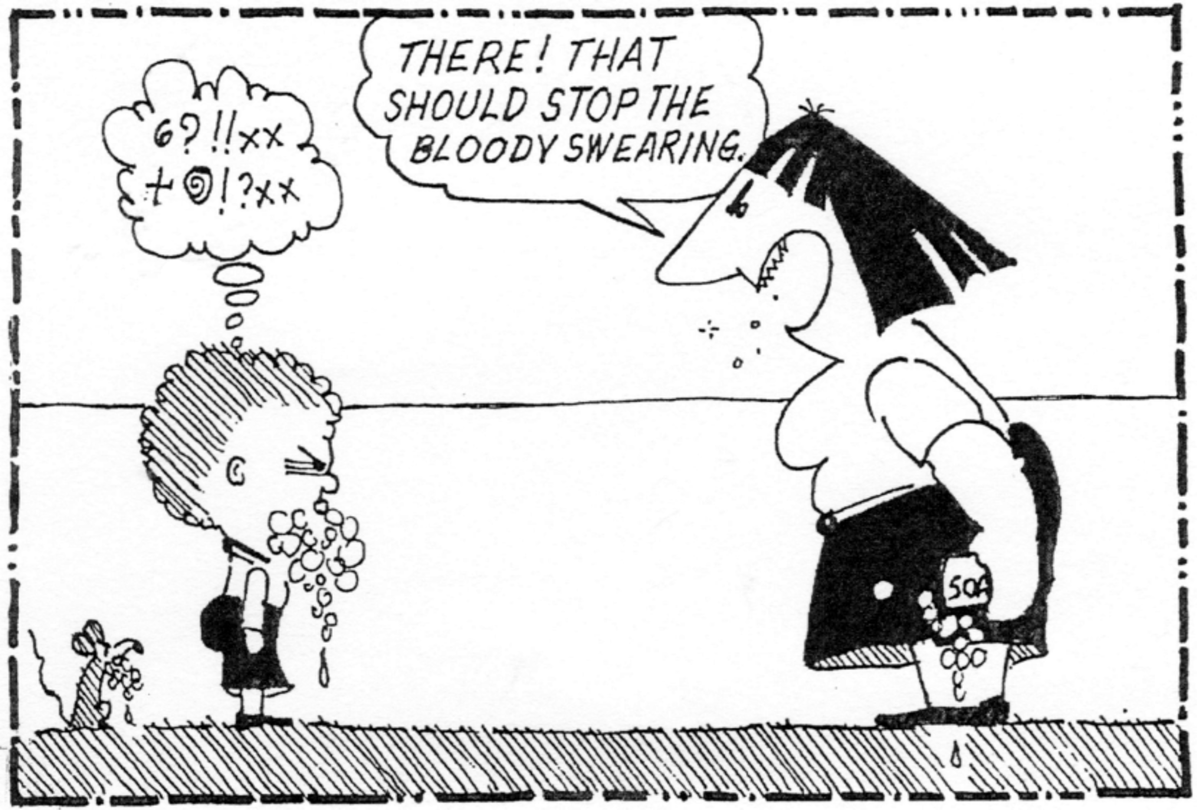
The roiling clouds issued an ominous grumble, Corporal Adamantine glanced round nervously, but answered bravely “Well I was given plenty of stick when I was a kid, and as you can see, it didn’t do me any harm – buggered if it did.” This assertion produced a few muffled giggles from the left of the hall ‘That’s what hethinks, hee, hee’. Ms. Uncial’s head came up from her notepad like an emu. “I beg your pardon!? I’m a Word person, and I find that kind of language offensive – you need your mouth washed out with soap!”
The corporal blushed “That’s what they used to do with me, a lot of good it did – haw, haw.”
Anna was again on her chubby little feet; the whole issue of corporal punishment was after all, her specialty. “Washing children’s mouths out with soap is just another form of corporal punishment – it is a physical trespass after all. What’s worse, it’s actually counter- productive! The child doesn’t leave the bathroom in a foam-mouthed mood of gratitude and contrition – it leaves with hatred, and a heart fill ed with the vengeance this kind of humiliation can curry. There is another way; corruption is coming from the mouth, we replace it with beauty; a good ‘punishment’ would be for a child to say, sing a song (to get rid of ‘Swearer’), or learn a small verse of poetry. This may seem more difficult than just ramming an unsanitary bar of soap into its gob; but the outcome will be constructive. Children will think twice before swearing if they have to read aloud a verse or two from Omar Khyam.”
“I wouldn’t consider that a punishment,” sighed Ms. Uncial “I love Omar – ‘… a jug of wine, a loaf of bread’ … or is that a jug of bread?”
“You’re not a 9-year-old child; the effort to express beauty can be quite painful for this kind of miscreant. Oh yes, it’s punishment all right, but with a positive outcome.
”We all ·have a streak of violence in our soul, I expiate mine in dreams. I often dream of losing control and wildly bashing some child in a futile attempt to impose my will. The hideous feelings this engenders on waking definitely deter me from carrying dreams into reality.”
“Well sometimes there’s no other way!” blurted the corporal, who looked appealingly over to the right for support – there was none. “Er, in one combat situation, where complete trust in one’s comrades was essential to achieve a specific mission, they had a problem. Soldiers’ personal possessions began to disappear – goodwill deteriorated; the company commander, in spite of tireless efforts to catch the thief, failed. He then assessed the probability of the situation and arrived at a fellow who had a bit of a history of petty theft. This of course was denied, so the hapless soldier was forced by the commander to the top of a water tower and questioned again. He still refused to admit his guilt – so he was pushed off and killed! The thieving stopped.”
“That’s taking corporal punishment a bit far, isn’t it?” said James after an uncomfortable silence “By logical extension, all schools should be equipped with a water tower – with incremental stages to suit the gravity of the misdemeanor. Or perhaps move to the hi- tech age with an electronic chair – a less effective cure for anti-social behavior than the high chair I’d say – hmmpff.”
“It was just an example where corporal punishment worked.” the corporal replied glumly “The principle is that, in both schools and the military in the field, there is no judicial system. The accused are tried, sentenced, and punished on the flimsiest evidence. But justice must be at least seen to be done if standards of discipline are to be maintained. The water tower is a bit extreme I admit, although sometimes it does seem the better option – ha, ha, ha … only joking.”
Another brittle silence – except for the scratching of the journalist’s pen, this stuff sounded newsworthy “I wonder if I can winkle that commander’s name out of the old windbag?” she thought but said instead.
“What about physical restraint? Surely there’s a time when a child needs to be forced to do something?” Anna rose again, regarding Ms. Uncial thoughtfully.
“That is so, especially in the primary years; the basis of discipline for children between 7 and 14 is authority. Not despotism, but the firm strength in an adult which gives children confidence that they are in safe hands. They want to feel that the teacher is a person of consequence, that she means what she says!” she said meaningfully “Authority is built on the foundation of consequence; if you ask a child to do something reasonable, and it refuses, then discuss it. There may be some factor…
Important Earthschooling Notes
Copyright Alan Whitehead & Earthschooling: No Part of this book, post, URL, or book excerpt may be shared with anyone who has not paid for these materials.
Alan speaks in a very symbolic and esoteric manner in some parts of his books. Although they can be read anthroposophically, passages speaking of Atlantis, archangels, gods, etc. do not need to be taken literarily to be meaningful. The more you read, the more you will realize he uses many different religions to express ideas in a symbolic manner and not in a religious manner. His writings are not religious. In some places his writings are meant to refer to religious events in a historical way. In some places he is using religious figures (from Christianity, Judaism, Islam, Buddhism, Hinduism, Paganism, Ancient Roman and Greek Religions, etc.) in a symbolic manner. However, at no point is he promoting a specific religion or speaking from a religious point of view.
I have kept the writing as close to one-hundred percent original so you will also find that he speaks of Australia often and some spelling or manners of speaking may be cultural. Any words I have changed are presented like this: <word>.
Also keep in mind that these books are written by a Waldorf teacher with decades of experience who also studied with a Steiner student himself, so he speaks to an audience that is dedicating their lives to the Waldorf method without exception.
Because of this, all of his views are not reflected in the Earthschooling curriculum and not all of them may be ones you want to embrace or are able to use. In all of Alan Whitehead’s writings the opinions are his own and may not align with Earthschooling or Waldorf Books. In some cases, we will be updating some of these chapters in the future with additional and/or updated information.
Ultimately, however, as I read through these passages I find I can distill wisdom from even those paragraphs that do not resonate with me.
We invite you to read with an open mind and heart and with eagerness to learn and discuss.
END NOTE
Alan has presented dialogue in his writings in an expressive form, where he tries to capture the accent of the person he was with to give his writing more authenticity and to allow the reader to “be with him” in his experience. In no place in his writings is he using expressive language to make fun of or demean the speaker. So, as a person with a linguistics and anthropology degree I find this enriching and informative to me as the reader. Thus, we have made the decision to leave all expressive writing in its original form.










Leave a Reply