
The Uniform Debate (newspaper article originally in two columns)
I was a member of the ‘Collar Up Gang’. We were easy to identify, wore our shirt collars turned up, our school ties only 3 inches long. This was an expression of our contempt for uniforms at my North Coast public high school un-affectionately known as The Penitentiary – circa 1955.
by Alan Whitehead
I later became a high school teacher, and a significant part of my onerous invigilating duties was to crack down on the same healthy distaste for school uniforms exhibited by the next generation of students. What a hypocrite I was. Teachers’ meetings were largely, debates on ‘What is the appropriate punishment if they wear sandals? ‘ ‘I know he had a grey shirt on, but was it regulation grey?’ – ‘If you suspend them they only hang around down at the beach – out of uniform!’ You’ve heard it all before. So much time and talent sacrifice to the insignificant.
Later I was in charge of a high school without uniforms – what a relief!
The school’s policy placed importance on the development of individuality above all else. A concept directly in opposition to uniformity. Not that other aspects of schooling, like concept development and the arts; were neglected. Indeed, they were enhanced by adolescents who could devote their considerable passion to the meaningful.
Uniform enforcement gives spirited young people a focus for their rage – a focus that should rightly be directed to say, protection of the living land, or the Slaughter of the Innocents in China.
Teachers ‘meetings at our school were free to become creative forums exploring the complementary and complex worlds of child and curriculum development.
Instead of uniformity, a policy of ‘appropriateness’ was in place, i.e., the right dress for the right occasion. Students had to wear protective. clothing, such as dust jackets, aprons, or overalls for activities like science, pottery or motor mechanics. If they were going out to a concert, they had to be spruced up or they didn’t go! Sporting activities were done in appropriate gear such as shorts and proper footwear. Oh, and that reminds me. There was one proscription – thongs – based on health and safety considerations only. Thongs contribute to poor walking habits, exercising the wrong muscles at the wrong time (to keep them on). More foot accidents are due to thong wearing than any other single cause. Bare feet are much healthier and safer! The students had to wear footwear at school, but due to the bush environment they could run around in bare feet at lunch time.
‘But teenagers always overdo it’ can hear the retort. Indeed, they do, but usually only as a testing ground. I remember when a wave of punk rainbow hair washed through the school. A few quivering voices suggested that this was the limit. However instead of castigating the colorful kids, we complimented them on the novelty and style. When the kindergarten started copying them, they knew it had run its course! The thing fizzled in about 3 weeks. Not long to wait, compared with 3 years of resentment if we had tried to ban it. ‘That’s disgusting, you can see that girl’s navel!’ one crusty old pedagogue exclaimed on a visit about a student in a fetching camisole. But she was the only one looking!
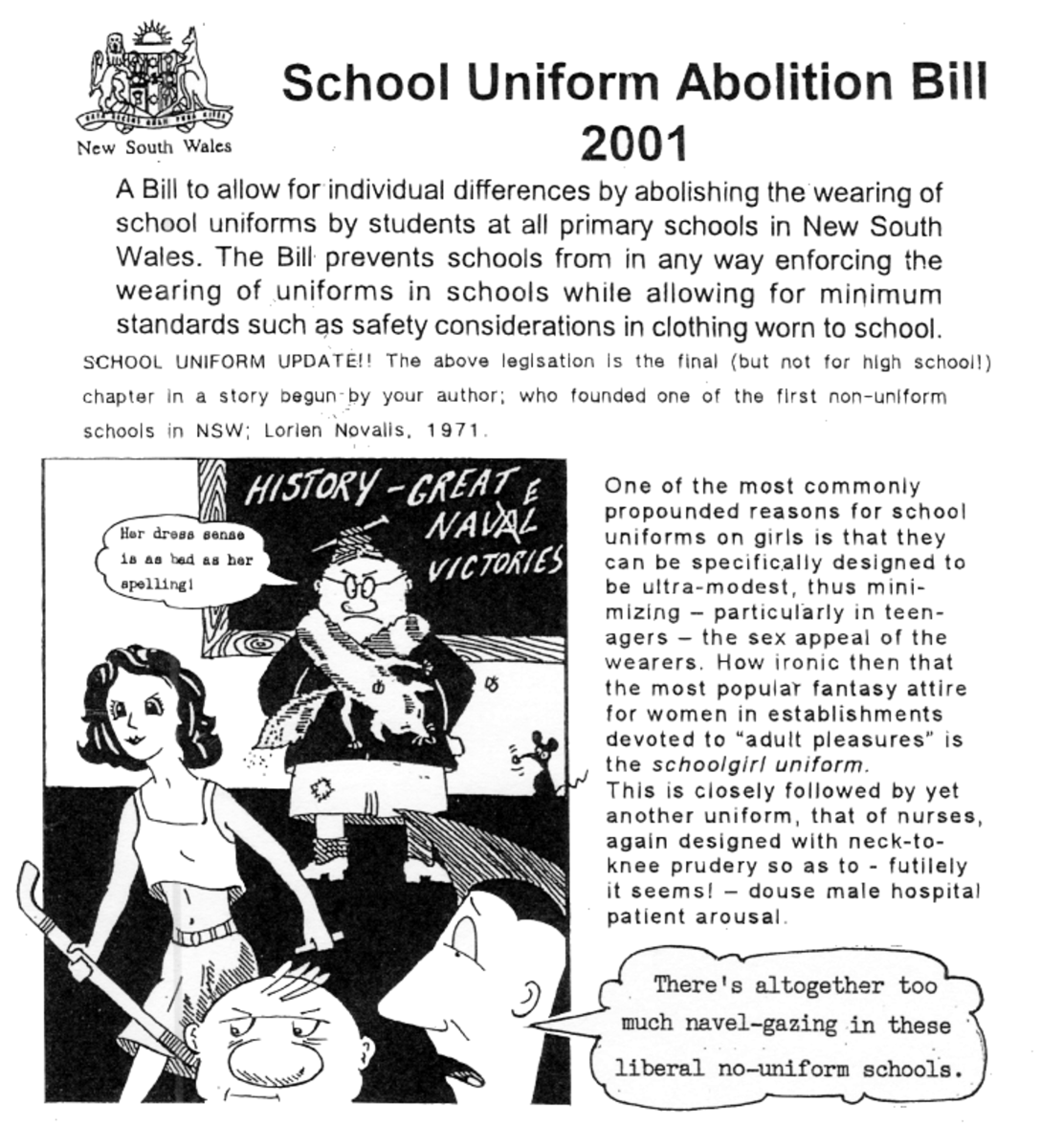
The myth of students vying with each other to be the most fashionable or expensively dressed is just that – a myth! At no time was any competitive spirit observed where Gucci students were pitted against St. Vinny’s. If anything, the opposite was the case with a genuine egalitarianism developing. Not one based on forcing everyone to be the same.
‘At least with uniforms you don’t have to agonize with them every morning about what they’re going to wear’. I hear the plea. Well, there has to be some price paid for individuality – not that I can remember parents complaining about this – and it was never the case with my 2 teenagers – they wore what they liked.
‘Uniforms aid in controlling children’. That is the greatest myth of all! Good parents don’t put their kids in uniforms at home to control them. Control is directly related to understanding – an inner process – never to externals such as uniforms, rules, and surroundings.
A good teacher can control his/her children under any external circumstances. A militaristic mentality with children tends to weaken control because it corrodes respect. They are required to respect the adults on an artificial premise rather than on one that has been earned.
Young people develop as free spirits by being given choice. Choice in personal appearance is one of the most important aspects of youth – a vehicle for self-expression. The adolescent years are just the ones for the unfolding of a sense of style. With free dress, teachers can aid and encourage this – with enduring positive consequences. To force students to express somebody else’s questionable fashion sense for one very large chunk of their young lives is a travesty. The history of school uniforms derives from Victorian Britain where boys of the gentry were dressed up as little gentlemen and sent off to expensive boarding school in a crass, display of wealth.
The mandatory school uniform has now become an eczema on the skin of the entire educational community. Uniforms are of course a necessary and appropriate part of modern, life – but not for school children. Viva la Collar Up Gang. (end of newspaper article)
James turned to Rosebud, nodding to her to continue.
“I know the piece Ms. Uncial wrote, it contains everything I wish to say on the subject, so I can go on. The same formalized nonsense is touted about names; some people think that respect is achieved by children having to call the teacher Mr. this or Miss that. The best disciplinarians I know are called by their first names. The surname is a family name only, linking its owner with the old, and usually degenerate, Folk Soul – an entity under the rulership of the Spirits of Passivity! These are invisibly called forth every time we address someone by their surname. The first name is so much more expressive of the individual. Which brings us to nicknames – if these are in any way offensive or demeaning, they must be proscribed. They are a kind of character assassination, and contribute to unsettling the poor child so named, leading in turn to an erosion of good order.
“Some name shortenings do this as well, like truncating the lovely name Victoria to Vicki – the double short ‘I’ is a diminutive sound, over time contributing to a lowering of self-worth. And speaking of diminutive, I shall conclude with a word from that pint-sized giant among men, Napoleon, who said ‘Imagination rules the world.’ Thank you.”
“Einstein said the highest human faculty was imagination. I’m sorry, my subject is human speech, an even higher faculty. The Discipline of Authority has been characterized by the Lyrebird” said Snub, in a voice somewhere between ambrosia and polished walnut. Deep within his being sang the Honey-voiced Women of long-gone Lemuria. The Chairman wisely allowed him to make his own introduction.
“Some people are born with authority, some learn authority, and some have authority thrust upon them – this is the case with most schoolteachers. However, the true ‘Lyrebirds’ of the profession are the first. The children sense this enigmatic quality of authority quite soon – as soon as they hear one speak really. The ‘voice of authority’ is no-where a greater reality than in teaching. Let’s look at a couple of examples where teachers demolish their own authority, and hence control of the children, every time they open their mouths. Firstly, there is the high-pitched voice, always walking the tightrope of hysteria. Then we have the ‘vulgar’, who thinks that by descending to the vernacular of the billiard room (especially with high school students) he might curry acceptance – not likely!
“Or even worse is the teacher who humiliates the children with name calling and sarcasm; the voice here is used as a razor- sharp weapon to intimidate. Respect, and hence co-operation, is never an outcome of this. We speak to every child with respect, even (ironically) when upbraiding them. Teachers should meditate on the 3rd principle of the Buddhist 8-fold Path, Right Word, to reveal the Mysteries of Authority. Not just the tone of our speech must be right, but the content – including the grammar! A well-spoken child finds it hard to look up to a teacher whose language standard is lower than its own. After all, language is of the nature of the human Ego – and true authority comes from a well-centered Ego.
“The 12-string Lyre of Ancient Greece was emblematic of the Ego; the Lyrebird has 12 filament tail feathers, framed by the two beautifully curved ‘body’ feathers. The Lyrebird of course has the greatest and most perfectly pitched tonal range, or ‘voice’, of any bird – a true Ego image.
“The quantity of speech is also important. I’m sure some people join the profession just as an excuse to talk all day! This drives children mad – how they yearn for peace, especially if the teacher delivers in 3-figure decibels. We should consider the old proverb – birds again!
‘There was an old rooster who lived on the road,
The less he heard the more he crowed.
The more he crowed the less he heard.
Who wants to be like that noisy old bird?
There was an old owl who lived in an oak,
The more he heard the less he spoke.
The less he spoke the more he heard.
I want to be like that wise old bird.’
Important Earthschooling Notes
Copyright Alan Whitehead & Earthschooling: No Part of this book, post, URL, or book excerpt may be shared with anyone who has not paid for these materials.
Alan speaks in a very symbolic and esoteric manner in some parts of his books. Although they can be read anthroposophically, passages speaking of Atlantis, archangels, gods, etc. do not need to be taken literarily to be meaningful. The more you read, the more you will realize he uses many different religions to express ideas in a symbolic manner and not in a religious manner. His writings are not religious. In some places his writings are meant to refer to religious events in a historical way. In some places he is using religious figures (from Christianity, Judaism, Islam, Buddhism, Hinduism, Paganism, Ancient Roman and Greek Religions, etc.) in a symbolic manner. However, at no point is he promoting a specific religion or speaking from a religious point of view.
I have kept the writing as close to one-hundred percent original so you will also find that he speaks of Australia often and some spelling or manners of speaking may be cultural. Any words I have changed are presented like this: <word>.
Also keep in mind that these books are written by a Waldorf teacher with decades of experience who also studied with a Steiner student himself, so he speaks to an audience that is dedicating their lives to the Waldorf method without exception.
Because of this, all of his views are not reflected in the Earthschooling curriculum and not all of them may be ones you want to embrace or are able to use. In all of Alan Whitehead’s writings the opinions are his own and may not align with Earthschooling or Waldorf Books. In some cases, we will be updating some of these chapters in the future with additional and/or updated information.
Ultimately, however, as I read through these passages I find I can distill wisdom from even those paragraphs that do not resonate with me.
We invite you to read with an open mind and heart and with eagerness to learn and discuss.
END NOTE
Alan has presented dialogue in his writings in an expressive form, where he tries to capture the accent of the person he was with to give his writing more authenticity and to allow the reader to “be with him” in his experience. In no place in his writings is he using expressive language to make fun of or demean the speaker. So, as a person with a linguistics and anthropology degree I find this enriching and informative to me as the reader. Thus, we have made the decision to leave all expressive writing in its original form.









Leave a Reply
You must be logged in to post a comment.