
SUFFER THE LITTLE CHILDREN
The Tragedy of Family Break-up on Children
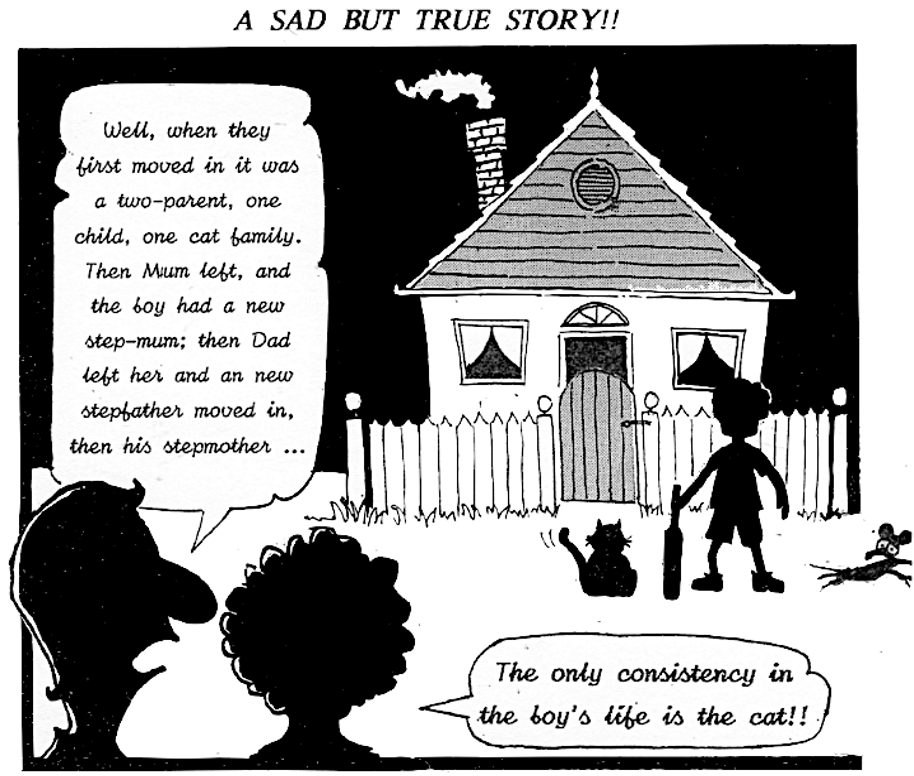
The 9-year-old girl walked slowly along the footpath jangling a stick against the open-bar fence. Out raced the Alsatian – a clockwork dog, its alarm set off by the perceived trespass. It snarled and barked at the little girl; and she barked back. Alas, her face was too close to the fence and the dog tore half her cheek away.
“How shocking!” was the heart-felt sentiment in the staffroom.
“Yes, but it’s even worse than that,” added the girl’s Class Teacher “her parents split up just a couple of weeks ago” More sympathetic comment followed, mostly in the form of cliches (We were schoolteachers!) ‘It never rains it pours.’ ‘Double trouble.’ And from the more avant-garde ‘Rotten karma’. Then a ‘penny dropped’ – for me at least. I’d been teaching long enough to recognize a familiar pattern in this tragic incident. How often have I witnessed the psychological distress of a family break-up followed by the physical distress of a child having an accident? Too often.
Does the ever-alert subconscious of that true victim of separation, the child, organize an ‘accident’, hoping that, as in the past, the parents will rush together in a common bond of concern? And the family will be one again? Sometimes it works. Sometimes.
Oh, by the way, with the miracles of plastic surgery, the little girl’s face healed beautifully.
Well, it’s only a theory, but if it heightens the quality of vigilance in those responsible for children caught in the emotional maelstrom of separation, the theory may have some value. It may also influence the ‘manner’ of the parting. The pain experienced by the children in family break-ups is often heart-rending – after all, they usually love both parents. Bitterness, acrimony, and vitriol are often new and unwanted foster – siblings, who play Chicken with the children’s psychological well-being.
How much better if the parents do their dueling in private. Splitting up need not be the end of the world for children, indeed, in some cases it can be the beginning. The amount of soul-scarring suffered by a child seems to be related to the intensity of the negative emotions in its environment.
Parents who extricate themselves from a hopeless relationship with dignity and civility harm their children least. As do parents who refrain from denigrating each other to the children. In assassinating the character of the opposite number, the ‘assassin’ is, in a subtle way, doing the very same thing to the child, who feels itself intrinsically a part of both parents.
Referring to the, say, father as ‘… that lying, worthless lay about!’ infers to the child that s/he also has this make-up – sins of the fathers? How much nicer if the parent refers only to Mummy or Daddy in, not necessarily terms of idolatry (children smell hypocrisy like Beagles), but at least positively.
Schools can even play a small but important role; a teacher may have become aware of a slanging match between the parents, possibly in an attempt to coerce allegiance in a custody struggle ‘Your Honor, the child has stated that it hates its father.’, The ‘father’ has been reduced in a few weeks in the child’s mind from Apollo-like status to something lower than a parasite.
If the teacher refers, in the course of a normal lesson, say in Maths in Building, to the child’s father as ‘… one of the best carpenters in the whole area’, it can have an immediate and sustained salutary effect on the unhappy child. Someone of authority, the teacher, has confirmed what the child inwardly knows, but, in the darkness of the hour, has been forced to suppress.
It is lovely for the child if, although separated from one parent physically, s/he can ring up any time and have a natter – and is indeed encouraged to do so. Or if say Dad comes over and helps move the fridge and everyone has lunch together, even the new girlfriend! (Mum can’t stand her, but after all, it’s the children we’re concerned about here!).
Some think that the bewildered offspring are little affected by break-up because they don’t show extreme emotion. The reality is that they are often deeply disturbed – the older the child, the more so it seems. To the perceptive ear, little comments years later like ‘Wouldn’t it be great if you and Daddy got together again?’ point to hidden longings.
But why Dad on the outside? It just seems to happen that way in the majority of cases. Breaking up is mostly caused by a breakdown of responsibility of some kind; financial, sexual, emotional, or otherwise, by Mum or Dad or both. The Emerald Serpent of Promiscuity may have taken habitation in the warm bed of the couple ‘s relationship; a serpent with the inevitable sting of self-assertion in its tail. So often we observe a further decline of responsibility and a polarization occurs, with, say again, the father abrogating any sense of duty he may previously have had to his progeny; and the mother increasing hers! Some fathers spawn and then abandon up to three and four families, taking no responsibility for any of them, either financially or spiritually. A woman of that ilk is rarer than a wide mouth frog! Frog? Maybe not – sparrow perhaps? With a nest full of fledglings – if she’s lucky enough to have a nest!
This ubiquitous scenario is seeding the community with a new and important social factor, the Single Mum. We are able’ to draw a profile on this less-than-endangered species; she is independent, she expresses over-average concern for her children’s ‘inner’ welfare, she is gregarious. And she is usually (although sometimes lonely for adult company) a freer and therefore more fulfilled individual.
Many women having recently ‘gone over the wall’ from a porridge of a marriage have a new radiance. But sometimes, if they’ve acted impulsively, they haven it!
As well, the splitting-up syndrome has created a new kind of child; the old European ethic has, as its ideal, ·obedient children being cared for by a loving but submissive mother, who too is obedient to a divinely anointed father – The Head of the House. His unquestioned (and unquestioning) influence tends to emphasize the ‘masculine’ traits in his children, like ambition, competition, and steely emotions.
Backward politicians support this simplistic view in their vote-seeking frenzy. This heavy bias is absent in the Single Mum family, and more ‘human- centered’ ideals, such as compassion, creativity and sociability emerge. These could be characterized as ‘female’ attributes, of course they are not – they’re universal! A society rushing Lemming-like into an uncertain technological future needs these softer qualities in megabytes!
Many Single Mums play with their children in the evening, involving themselves in a richly imaginative, but less sophisticated world. In many father-dominated families, the children are quickly dismissed by the world-worn dad for the seductive wiles of the video. Wiles palpably unsuitable for the emotional needs of the young.
I was writing the address of a new child on the enrolment form and noted to the Single Mum that it seemed familiar.
“Yes,” she replied “Three of us have placed our children in the school in the last few weeks. A group of 6 Single Mum families have formed a kind of Domestic Co-operative. We realized that the most supportive people in our lives were other Single Mums; so, we thought we’d reinforce this by living together. We’ve rented a very large old house and we share everything – the rent, cooking, babysitting, laughter, and tears. We are really very happy – and we’ve attracted some media attention too! We have one firm rule though – men may only visit, all dalliance is to be conducted outside.”
I was impressed! The children were self-reliant, happy, and creative little souls – a delight to teach. “… and they embrace New Age philosophy, and are active in socially responsible pursuits like the Conservation Movement, and they …’ I gushed to a friend sometime later.
“Oh, that Community.” he said “They split up months ago – the ladies and their children all dispersed. ”
“But why?!” I gasped in dismay.
“Who knows? They only had one rule though …”
“Yes, I know but …”
“And they all broke it!”
One still cannot condone the dissembling of families – families which, in their expression of Yin Yang principles of balance are ideal environments in which to raise children. But the ‘family’ must keep pace with the consciousness of the community. Long ago humanity witnessed the Twilight of the Gods – then the Twilight of the Kings, and today we see the Twilight of the Fathers. Fathers, that is, who cling to hoary anachronisms like ‘power’, ‘head- of- the-house’ and ‘authority’. New fathers are equal partners in a relationship, they encourage the ‘human’ as well as the ‘survival’ elements in their children’s character – and they communicate rather than dictate.
Many children suffer intense short-term pain when the family, the very foundation of their existence, collapses. Yet in the long- term, this social aberration may benefit the broader community. It is hard to imagine the children exposed to a largely ‘feminine’ domestic environment reverting to a patriarchal system when they build their own nests.
The task of everyone, mothers, fathers, teachers, and friends, is to help the children of broken homes through the inevitable, but not necessarily damaging, pain.
“With the kleptomaniac child (and other conditions), we must transplant ourselves wholly into their situation, and invent tales in which things that are done by the child are shown to end in absurdity.” Rudolf Steiner, Domach, June 1924
“A right education is mainly about the removal of hindrances so that the child’s spirit can awaken after puberty to freedom.” Rudolf Steiner, Oxford, August 1922.
“Rudolf Steiner demanded that people gather in silence some time before the beginning of his lectures. Here he addressed higher faculties; he spoke as higher self to higher self. To arrive at the lecture straight from the everyday rush meant the same to him as to arrive too late for communion, to push through the crowd in haste and rush up to the chalice. He was punctual to the point of pedantry. He always appeared five minutes before the start of the lecture; he began to the minute. Not once did I see him arrive too late or let anything be cancelled. “I shall come!” – and he came. It was said that he excluded some students only because they had been late, and in spite of that had come into the lecture room. He explained it so: Either one wants to come, or one doesn’t want to come, but under no circumstances is one allowed to disrupt the concentration of those present. He who does not understand this proves that for him the time to work esoterically has not yet come.” Andrei Belyi
Important Earthschooling Notes
Copyright Alan Whitehead & Earthschooling: No Part of this book, post, URL, or book excerpt may be shared with anyone who has not paid for these materials.
Alan speaks in a very symbolic and esoteric manner in some parts of his books. Although they can be read anthroposophically, passages speaking of Atlantis, archangels, gods, etc. do not need to be taken literarily to be meaningful. The more you read, the more you will realize he uses many different religions to express ideas in a symbolic manner and not in a religious manner. His writings are not religious. In some places his writings are meant to refer to religious events in a historical way. In some places he is using religious figures (from Christianity, Judaism, Islam, Buddhism, Hinduism, Paganism, Ancient Roman and Greek Religions, etc.) in a symbolic manner. However, at no point is he promoting a specific religion or speaking from a religious point of view.
I have kept the writing as close to one-hundred percent original so you will also find that he speaks of Australia often and some spelling or manners of speaking may be cultural. Any words I have changed are presented like this: <word>.
Also keep in mind that these books are written by a Waldorf teacher with decades of experience who also studied with a Steiner student himself, so he speaks to an audience that is dedicating their lives to the Waldorf method without exception.
Because of this, all of his views are not reflected in the Earthschooling curriculum and not all of them may be ones you want to embrace or are able to use. In all of Alan Whitehead’s writings the opinions are his own and may not align with Earthschooling or Waldorf Books. In some cases, we will be updating some of these chapters in the future with additional and/or updated information.
Ultimately, however, as I read through these passages I find I can distill wisdom from even those paragraphs that do not resonate with me.
We invite you to read with an open mind and heart and with eagerness to learn and discuss.
END NOTE
Alan has presented dialogue in his writings in an expressive form, where he tries to capture the accent of the person he was with to give his writing more authenticity and to allow the reader to “be with him” in his experience. In no place in his writings is he using expressive language to make fun of or demean the speaker. So, as a person with a linguistics and anthropology degree I find this enriching and informative to me as the reader. Thus, we have made the decision to leave all expressive writing in its original form.










Leave a Reply
You must be logged in to post a comment.