
THE TEACHER’S NEW CLOTHES!
The hall was very quiet as the remaining delegates wondered what the Chairman would do next. “I’d like to say a few words on how teachers can influence their environment to produce positive conduct in their pupils. Naturally as they have the power to control, they are also often responsible for the erosion of good order.
“The first is dress, children like their teachers to look smart, they feel proud to be in a class where the teacher displays better sartorial taste than the wider community. Alas, the opposite is so often the case, with many educators creating an unsettling feeling in the child’s soul by appearing before them all day in holey jumpers or moth-eaten fox furs.
All quiet on the leftist front.
“Naturally the dress appropriate to the community the school serves; starched collars do not fit in a New Age school and vice versa. Particular attention should be paid to the shoulders – yes the shoulders! Our instinctive disciplinary faculty emanates from this Ego center; a teacher can often increase his influence simply by wearing a smartly tailored jacket which emphasizes the square cut of the shoulders. That links to the next teacher aspect – gesture and deportment – the body language we speak with all day in front of our class. A teacher who is not conscious of the shoulders, letting them droop, holding one higher than the other etc., is subliminally telling the children that…
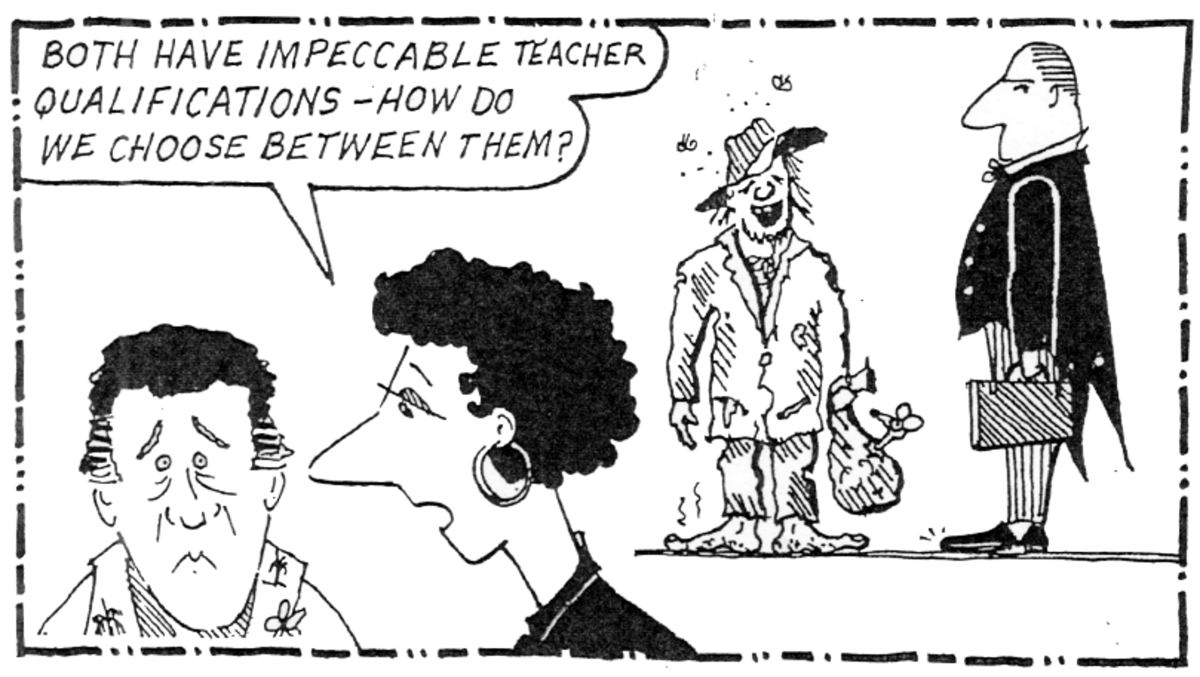
…there is a shortcoming in the Ego area. Both shoulders raised up around the ears like a retrenched vulture indicates social fear; those held too far back express imperiousness. A state children will attempt to demolish!
“So too will they when their teacher confronts them with what’s called in movement circles, ‘schoolteacher posture’; here there is clearly observable tension in the sacrum region (Remember the ‘sacred’ bone?). Of course, there is the other extreme, lying around on desks or holding up the walls is just as bad. Gesture and movement are allies; some teachers irritate children (provoking bad behavior) by pacing up and down like caged ocelots. Another may stand like a statue in a niche while telling a story – hands firmly clasped behind the back. Yet others only face one section of the class – or in extreme cases, one child!
“Some are guilty of unspeakably annoying habits, like pulling at the nose, or playing with split ends. Sometimes children misbehave for the oddest of reasons! It is essential for the learning environment to be both beautiful and orderly; chaos, dirt, and neglect (like overflowing bins) causes soul discomfort and hence rowdiness. Especially in primary children unfolding the Etheric Body. This is a supersensible organ which flourishes in orderly surroundings.
“Lesson content is perhaps the most important of all, you can get away with most of the others if you consistently present a rich feast of imagination and intelligence for the children, who will naturally muck up if they are bored – or indeed over– stimulated even. Perhaps we should have a Great Debate on lesson content?” Nobody seconded the motion, so Chairman James continued.
“Creative and original stories well told will glue children to their seats; intelligent concepts will inspire compliance, due to an unspoken sense of gratitude invoked. And a fine balance of physical activities will provide an outlet for the enormous energy potential of the young. A discipline-friendly program will give equal emphasis to head, heart, and hand.
“The mystery of discipline is that there is no single teacher- type who has it. The simplistic stereotype of the stern, powerful, no-nonsense teacher is absurd. Indeed, this typical imposition merely postpones the inevitable bad-behavior response – bursting out on the train going home, or at the dinner table. ‘I wish I was like your teacher Des Pott’ wails mother to her uncontrollable ‘He doesn’t stand any nonsense!’ Sadly, Des is actually the cause of her problems!

Important Earthschooling Notes
Copyright Alan Whitehead & Earthschooling: No Part of this book, post, URL, or book excerpt may be shared with anyone who has not paid for these materials.
Alan speaks in a very symbolic and esoteric manner in some parts of his books. Although they can be read anthroposophically, passages speaking of Atlantis, archangels, gods, etc. do not need to be taken literarily to be meaningful. The more you read, the more you will realize he uses many different religions to express ideas in a symbolic manner and not in a religious manner. His writings are not religious. In some places his writings are meant to refer to religious events in a historical way. In some places he is using religious figures (from Christianity, Judaism, Islam, Buddhism, Hinduism, Paganism, Ancient Roman and Greek Religions, etc.) in a symbolic manner. However, at no point is he promoting a specific religion or speaking from a religious point of view.
I have kept the writing as close to one-hundred percent original so you will also find that he speaks of Australia often and some spelling or manners of speaking may be cultural. Any words I have changed are presented like this: <word>.
Also keep in mind that these books are written by a Waldorf teacher with decades of experience who also studied with a Steiner student himself, so he speaks to an audience that is dedicating their lives to the Waldorf method without exception.
Because of this, all of his views are not reflected in the Earthschooling curriculum and not all of them may be ones you want to embrace or are able to use. In all of Alan Whitehead’s writings the opinions are his own and may not align with Earthschooling or Waldorf Books. In some cases, we will be updating some of these chapters in the future with additional and/or updated information.
Ultimately, however, as I read through these passages I find I can distill wisdom from even those paragraphs that do not resonate with me.
We invite you to read with an open mind and heart and with eagerness to learn and discuss.
END NOTE
Alan has presented dialogue in his writings in an expressive form, where he tries to capture the accent of the person he was with to give his writing more authenticity and to allow the reader to “be with him” in his experience. In no place in his writings is he using expressive language to make fun of or demean the speaker. So, as a person with a linguistics and anthropology degree I find this enriching and informative to me as the reader. Thus, we have made the decision to leave all expressive writing in its original form.










Leave a Reply
You must be logged in to post a comment.