
“SHIP UP OR SHAPE OUT!”
Chairman Boanerges peered at the agenda and cleared his throat, so did the storm over the gun-metal grey hills. “The second discipline principle is that of Expulsion, or in its lesser form, Suspension. Who wishes to open the discussion? And your name sir?”
“Vicar Xavier Ausize, I’m the principal of a very select church school in Silvertailtown. I wish to speak in favor of expulsion as a tried-and-true method of student control.” A round of applause erupted from the right of the hall. The vicar’s bald head shone brightly, as did his smile, he self-effacingly continued “As I tell the students at Prayers every Monday morning – it’s shop up or shape out – er, I mean ship out or sheep in … (giggles from the left) they get the message anyway – any problems and they’re out!” He paused for effect, glaring at the audience, his smile gone. “This method has worked in human communities from time immemmemorabbl … immorable – for a long time. It is of course based on that inviolable principle that the common good takes priority over that of the individual. Where would civilization be today if we pandered to every problem-ridden pleb? Our first goal is excellence, and future generations depend on our striving to reach even higher plateaus … pluteaux – heights, of scholastic attainment. Only last year we had a 95.7 per cent success rate in the matric, with decile averages of, er, anyway it was a near perfect result from our, well you could only call them, perfect stude …”
“Humbug!” said a short, teacher with a snub nose, obviously of Aboriginal descent. His hair was tied in a ponytail, his strong hands grasped the back of the chair in front. “You call yours a Christian school!
Wasn’t it Christ who said that He came to save sinners? Naturally we take this word in a liberal sense – save the ‘ imperfect’ perhaps? Of course, some children seem more imperfect than others. Our Wise Ones say ‘There are no perfect people, only perfect intentions. ‘I say to you sir, that even your intentions are deeply flawed.” Snub strode out and stood nose-to-nose with the clearly unsettled man of the cloth. Ms. Uncial looked up with interest, after all, she had made it to the top of her profession in spite of academic attainment, not because of it. She was expelled in junior high for some trivial adolescent prank, like smoking a joint or something. Oh, how she remembered the teachers foaming at the mouth in horror and self-righteousness – how she despised them for their unworldliness, but back to the present, she addressed the vicar.
“I always thought the educational viewpoint expressed in many so-called Christian schools was sexist, discriminating, and elitist. Do you really think Vicar that Christ included children in His ‘save the sinners’ rave?” Her voice was baiting, the vicar, with bated breath, turned to the right for support – there was none. Snub answered instead.
“He meant every human being, then arid forever – even Mary Jane users! What did He answer the Disciples in relation to ‘Who was the greatest? ‘” Chairman James opened his mouth to answer, but the question was only rhetorical, Snub surged on “The children, of course – they are the greatest.
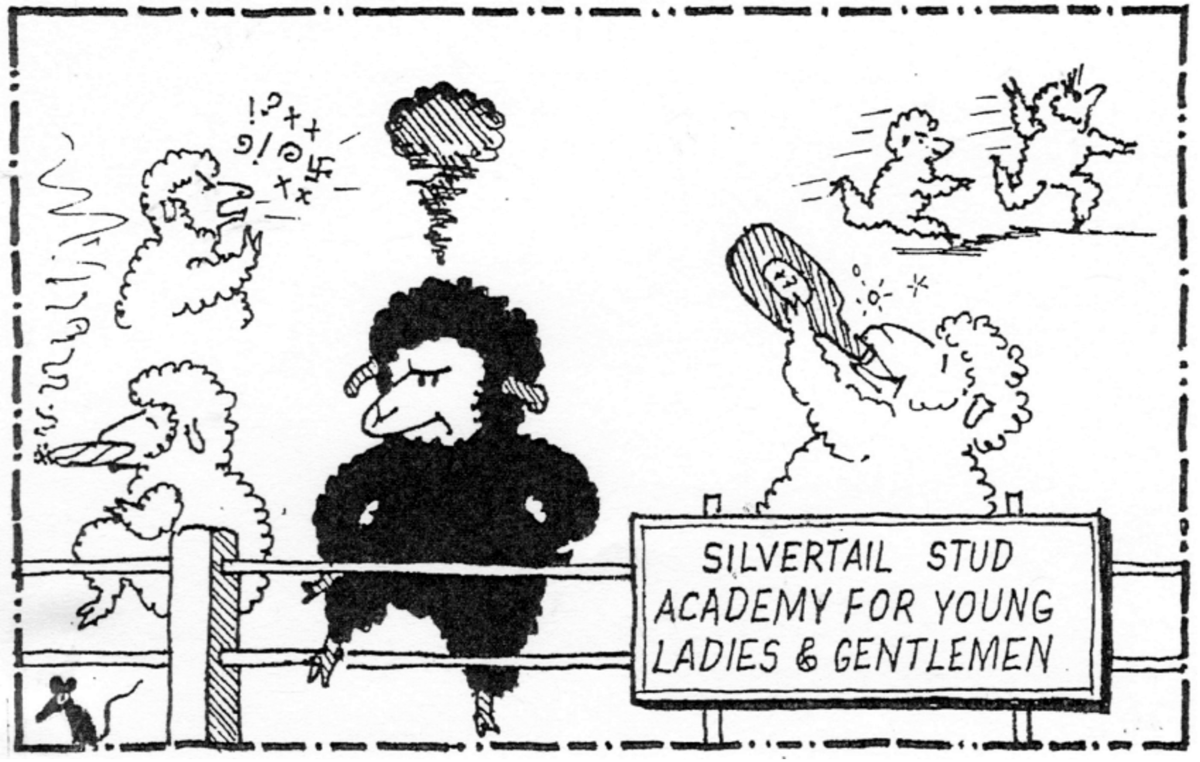
‘Woe to he who rejects (read ‘expels’) the greatest.’ Said Jesus – woe indeed! The young are those with a pure heart, that’s why they’re ‘the greatest’. And what about when Jesus was asked: ‘If the wolves prowled the hills, and one sheep strayed from the flock and was lost, what should the (good) shepherd do? Leave the flock unprotected and go out looking for it? Or leave it to its fate, assuring the safety of the rest. You know what He said don’t you Vicar?”
“Er, this was a mere allegory – things are different in modern life, with competition and …”.
”What did Christ answer?!”
“He said the shepherd must go out and look for the lost sheep.”
“Exactly! The Cult of the Individual you could call it; the lost sheep has no hope alone in the wolf-infested night, but the flock still has a kind of collective security – in fact each member in it has a fairly good chance of survival – -the lost sheep has none.
“The message for educationists is clear, no child is to be expelled – cast to the wolves. By doing so we are violating its karma; it was ‘sent’ to us (in many cases to our initial regret) so that we can grow together as human beings. We must regard it as a privilege to be entrusted with the challenge of helping a young person with severe ‘imperfections’. Ms. Uncial is right to question the use of the term ‘sinner’ to describe children. To sin is of the Ego, a not fully incarnate (hence not responsible) entity until the age of 21 or thereabouts. So, in the strictest sense, a child cannot ‘sin’ – or commit evil even. Which is not to say they can 1t err – but we must think of these ‘errors’ as being imposed from outside, from parents – and teachers like us. We adults can certainly indulge in evil, like banishing a child from our community! Remember the line in the Lord’s Prayer Vicar? ‘Deliver us from evil’ – the 4th invocation, that of the Ego. Only an Ego can commit evil.”
“A story from the Bible always touched me deeply,” said Ms. Uncial, her pen lying idle on the table “and somehow seems relevant to this discussion. There was a pressing crowd around Jesus, and some children tried to squeeze through to catch a peek. The ever-helpful (but not too bright) disciples pushed their back.” James blushed noticeably as he adjusted a fold in his shift. “But the Lord said those sublime words ‘Suffer the little children to come unto Me’. Indeed, in that moment he counselled the whole of Mankind to allow the children to enter the Temple of Love, as our schools should be” She turned to face the vicar “You can’t love someone and kick them out.”
“I suppose Vicar the motto in your school might be ‘Suffer the little children – except the naughty, the slow learners, the emotionally disturbed …” Before the abashed man could sputter an answer, Snub had swung around to face the press.
“That’s it in a nutshell Ms. Alcuin – I mean Uncial – those are the Three Imperfections! Naughtiness or bad behavior is the Imperfection of the Will; the child’s motivational life – the life of deed, or Right Action, is troubled, so their conduct is in chaos. If teachers knew the source of the disturbance, in this case the Metabolic/limb system, then healing could begin, and behavior improve.
“The second Imperfection, emotional instability, is the Imperfection of the Feeling life – the heart region is the key in dealing with these children to ease their distress.
“The third is the slow learner, this. is essentially an Imperfection of Thinking – of the head. Of course, one has to ascertain that the child has a problem at all – maybe it’s the school’s-teacher’s-parent’s problem – due to unrealistic expectations of the child. Expectations out of synch with its nature. This area of the ‘problem’ child needs a Great Debate all of its own. Indeed, the demands made of a child should never exceed its capacity to fulfil them – if they do, YOU’LL have a problem.”
Ms. Uncial tapped her pen before speaking “Yes, I remember when the gym teacher told me to jump over the vaulting horse, I simply couldn’t do· it, it was too high. My failure brought about in me a spate of bad behavior in his lesson for weeks – serve him right. ”
“Ahem, remember you’re here to report, not contribute.” said James.
“I’m sorry, go on please.”
“Thank you, if these problems were approached with greater understanding and sensitivity, most discipline aberrations would evaporate. The school that expels its problems cannot grow spiritually; I know of one which expelled a high school pupil for wearing his hair over his collar – I mean really!” Snub tossed his ponytail in defiance.
“In Indonesia they shave the heads of rioting students to ‘control’ them, a fatuous failure! A child was booted out because his play was too adventurous, climbing trees, disappearing into the bushes – that sort of thing. Another was threatened with the ‘gate’ because he sneaked a bottle of gin into a school function and laced the punch with it. Not the kind of thing you’d ‘ give him a gold star for, but pretty ‘spirited’ I’d say – huh, huh, huh. (So, Snub did have a sense of humor!) But a quality, correctly harnessed, we want to encourage in our children.
“Ah, kindergarten – one child was ‘asked to leave’, to employ a euphemism, because he was ‘unteachable’! No, when a school expels a child, it expels its own right to care for and educate the young. With complex and difficult children, we do indeed ‘suffer’ their presence, but from this pa.in, and the _profound triumph we feel when we succeed with them, we grow. It has been observed in many cases that the rumbunctious child is often destined £or high spirituality, or major value re-arrangements in society in later life – the submissive becoming more, shall we say, sheep like.
“Of the many hundreds of children I have educated, the handful of truly ‘tough nuts’ are those to whom I am most grateful. It is they who have made me the teacher I am today – real ‘character builders’ they are. The saving of the planet could well depend on the black sheep outnumbering the white in the flock of Mankind.”
The Chairman ruffled some papers “I’m trying to sort out the legal situation here,” he said slowly “the State enforces a compulsory education law – a child MUST attend school – then they expel them, in effect forbidding them to attend school, a crime incidentally for which the parents are liable. What’s the answer? Is this an attempt to drive the child into welfare care of some kind? A kind of unwritten agenda?” Nobody could answer this one, but Vicar X. Ausize mounted a last desperate defense of the ‘If in doubt, chuck ’em out.’ policy.
“Mostly,” he began apologetically “the pressure to expel children comes from other parents; the~ see it as the expulsee being damaging to their own children. It’s difficult to stand up to these forceful people with their persuasive arguments. ‘Every crime,’ they say, ‘began as a disobedient child!’”
“Persuasive yes, truth no.” Snub was in his stride again “Children’s education which is built on the rubble of another is unjustifiable.” Snub suspected that the vicar would fall for this one “Everyone gains from the struggle, and hopefully the success, of persevering with a black sheep, still if you recall, a member of the flock. This success is a collective achievement, say a child is rowdy in class, there is pain, ‘good’ children can’t concentrate, time is wasted. Then with a bit of careful manipulation by the teacher, peer pressure begins. This, more than any fulminations by the teacher, begins to moderate this. mini hurricane. The spiritual-moral gain of first suffering then transforming a ‘lost’ child far outweighs any loss. To exile the child renders one morally bankrupt.
“The principle of the children as disciplinarians is too seldom exploited – peer pressure is the most effective of all to a child rebelling against adult authority. We may have a good working class with a· co-operative attitude and a respect and affection for the teacher; the ‘bad seed’ (there is no such thing) comes into the class and takes the mickey out of him, mistaking his amiability for weakness perhaps. How re-assuring it is if the other children turn on her (the ‘seed’). Putting her in her place as only children can ‘You’re dumb, you’re never gunna learn nothin’!’ may be a poor reflection on the grammatical standard of the class – it may even be cruel – but it works as no teacher admonition can!
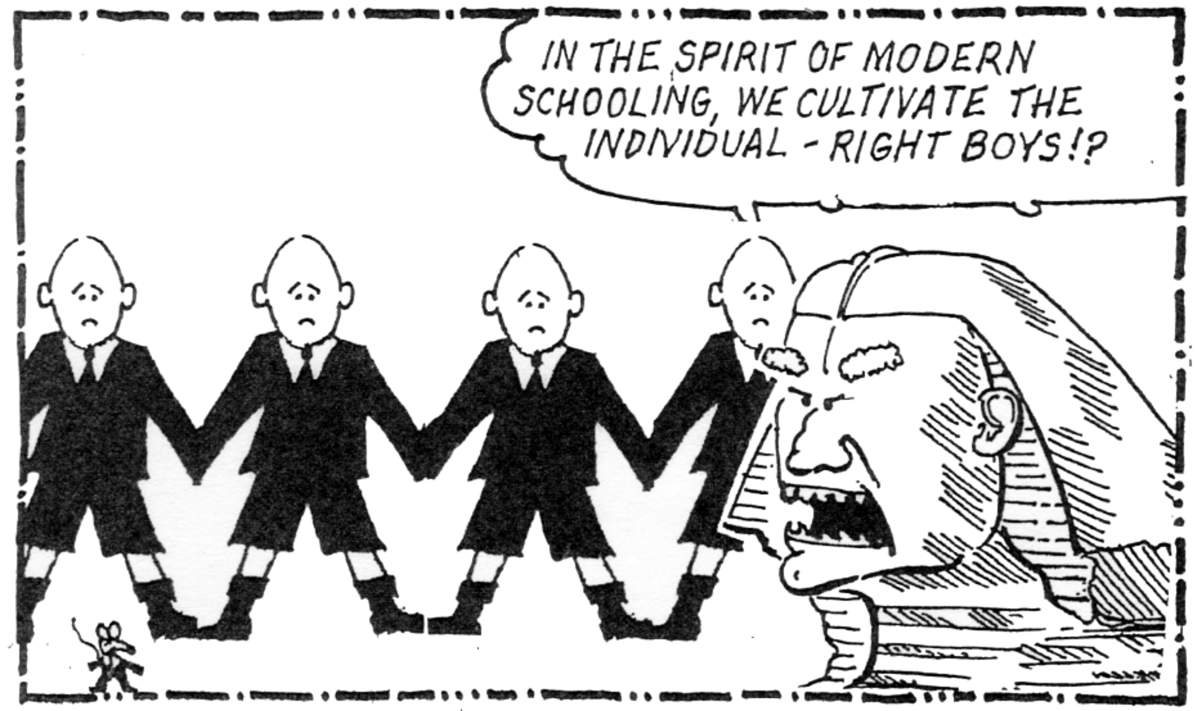
“Yes, I know the old parent pressure trip ‘If that child is allowed to stay, mine leaves!’ There’s only oneanswer to threats like this – or ‘brown-mail’ as we call it – ‘Do as you will.’ Under these circumstances it is not the teacher who sent the ‘good’ child away, it was the parent – the school was perfectly agreeable to educate white and black sheep alike have seen schools cave into this threat because of perhaps financial considerations – how reprehensible to put money before principle.”
Ms. Uncial broke in again “I agree, the school’s financial bank account might remain in the black, but the moral one is empty.” Being a writer, she enjoyed transforming these realities into little metaphors, she scribbled it down quickly and went on “There seems to be another way of getting rid of children without actually expelling them, that is by making their lives so miserable that they leave the school anyway. I have seen a full class reduced to a handful of pupils in just a year. by a teacher who would refer to her class as ‘a carcass attracting flies’. This person (I hesitate to call her a teacher) had a subconscious desire for the class to fold so that she could, without appearing to abandon ship, depart on another career path. One based, regretfully, on the skids of irreverence.”
“Yes,” said Snub cutting in before Chairman did “others humiliate children so badly that they leave in despair – expulsion by any other means, yes? They do this under the dark cloak of ‘getting tough’ with f the child – getting tough is fine, as long as it’s tempered with love – and not contempt! It is our sacred duty to do the best possible for every child in our care. This is the educational equivalent of the Hippocratic oath.
“Ah and speaking of children organizing their own expulsion; some will unconsciously push so hard that subsequent events will lead to their leaving the school. Usually this is a response to something wrong in the child’s school or home life, more likely the school. Remember the boy in that marvelous film Dead Poet’s Society? The one who received a phone call from God in the school assembly? The ‘head’ was onto his. little scheme, rewarding him with, not expulsion as he planned, but a thrashing. Another case of not wanting to see the school fees walk out. We should search for the source of the child’s discontent – and fix it!
“Many scallywags at first seem ‘impossible’, but any worthwhile endeavor at first seems impossible, not the least being the solution to the mystery of that most complex creation in the universe, the child. One of the greatest and most compassionate maxims of our society is ‘No man shall be abandoned’. In social, economic, medical, judicial, and political terms even, this is applied through statute and practice – but in education?! If it were, then a lot of disciplinary problems would dissolve. If children know deep in their hearts that their school and teacher will persevere with them – no ·matter what – then they will be more likely to co-operate, and sooner.” Snub sat down; his face serene; he’d been waiting years to say those things. It was lunch time.
What is happening to our young people? They disrespect their elders; they disobey their parents. They ignore the law. They riot in the streets, inflamed with wild notions. Their morals are decaying.” Plato
Important Earthschooling Notes
Copyright Alan Whitehead & Earthschooling: No Part of this book, post, URL, or book excerpt may be shared with anyone who has not paid for these materials.
Alan speaks in a very symbolic and esoteric manner in some parts of his books. Although they can be read anthroposophically, passages speaking of Atlantis, archangels, gods, etc. do not need to be taken literarily to be meaningful. The more you read, the more you will realize he uses many different religions to express ideas in a symbolic manner and not in a religious manner. His writings are not religious. In some places his writings are meant to refer to religious events in a historical way. In some places he is using religious figures (from Christianity, Judaism, Islam, Buddhism, Hinduism, Paganism, Ancient Roman and Greek Religions, etc.) in a symbolic manner. However, at no point is he promoting a specific religion or speaking from a religious point of view.
I have kept the writing as close to one-hundred percent original so you will also find that he speaks of Australia often and some spelling or manners of speaking may be cultural. Any words I have changed are presented like this: <word>.
Also keep in mind that these books are written by a Waldorf teacher with decades of experience who also studied with a Steiner student himself, so he speaks to an audience that is dedicating their lives to the Waldorf method without exception.
Because of this, all of his views are not reflected in the Earthschooling curriculum and not all of them may be ones you want to embrace or are able to use. In all of Alan Whitehead’s writings the opinions are his own and may not align with Earthschooling or Waldorf Books. In some cases, we will be updating some of these chapters in the future with additional and/or updated information.
Ultimately, however, as I read through these passages I find I can distill wisdom from even those paragraphs that do not resonate with me.
We invite you to read with an open mind and heart and with eagerness to learn and discuss.
END NOTE
Alan has presented dialogue in his writings in an expressive form, where he tries to capture the accent of the person he was with to give his writing more authenticity and to allow the reader to “be with him” in his experience. In no place in his writings is he using expressive language to make fun of or demean the speaker. So, as a person with a linguistics and anthropology degree I find this enriching and informative to me as the reader. Thus, we have made the decision to leave all expressive writing in its original form.










Leave a Reply
You must be logged in to post a comment.