
BUILDING BLOCKS OF NUMBER
Geometry in Architecture – Class 8 – Main Lesson
As a Class Guardian for the new pioneer high school class in Lorien Novalis School in 1981, I took Rudolf Steiner’s injunction on the need for specialist teachers in secondary school seriously – even for my Class 8. So having few maths skills myself, I commissioned a number specialist to take my class for their first Geometry main lesson.
I was appalled by the poverty of life, color, creativity – or any other educational quality The Doctor enjoins us to employ in teaching anything, especially maths, which can so easily lean into abstract intellectualism. Worse still, I was assailed by my grumbling students singing that old refrain “We hate maths!”.
Next year, in the equivalent lesson with a new Class 8, I took the Geometry lesson myself; the hate-maths-maker had gone, and there was simply no-one else willing or able to do it at the time. “Damn, I’m breaking one of the first principles of high school teaching, that of the specialist teacher!” I agonized as I tentatively prepared the first lesson. “But at least I’m a ‘specialist’ in Steiner method.” I added as a compensation. This method before content, Spirit before substance, helped pull me through the next 3 weeks. As it turned out, due to panic-based diligence, it was Spirit and substance – but definitely in that order.
This, as a main lesson, appeals pre-eminently to the ‘head’ or scholastic forces in the students. Geometry is of course maths, the 2nd of the 4-fold ‘body’ learning streams of language, maths, social science and science. These relate to ego, astral, ether and physical bodies respectively.
Maths, as the astral or ‘soul’ body lesson calls on the forces swelling in the Astral Sea, or ‘waters above’ as Genesis so poetically describes it – a Steiner epithet for one aspect of the same divine realm in NumberEther. This high mansion, from whence all the wisdom of Numerology is drawn, often expresses as intuitivenumber skills; demonstrated in a curious way at times by people who are, well, cerebrally challenged!
One such was the character played so brilliantly by Dustin Hoffman in the film Rainman. He was at the same time an intellectually disabled person, and a number genius! Here self-conscious ego forces are dimmed, allowing the subconscious, dreamlike astral light to shine. He would merely glance at a box of matches and know how many there were!
In the 12-fold Subject Zodiac, maths is the Taurus stream. The Bull, that great symbol of cosmic metabolism, reigns in the astral quadrant of the Animal Circle – he swims in the Astral Sea of digestive juices! The twin pillar of Taurus, the Sense of Thought and Quality of Will, both build and nourish the students when engaged in umber pursuits.
The sense builds their finer bodies right now; ‘thought’ taken in, as a sense by definition is, a constructive, creative process. A young person who is not exposed to mathematical ideas will be poorer for it – in body and soul. The quality, in this case of will, is however for the future.
The will to struggle with a number problem today flowers in later life as informed will; not just any kind but based on the power of logic, of cause and effect.
Ah, so maths, like very main lesson subject, devolves further into 3 strands, expressing body, soul and spirit. In high school these three are Geometry, Finance and Numeracy. The first, meaning ‘earth measure’, is of the body – both the earth’s an our own! This body principle is seen in Geometry being the first of the 7 Liberal Arts; of the four taught in Egypt that is; the Quadrivium as it’s known. The other three, Astrology, Arithmetic and Music, express etheric, astral and ego respectively.
Mathematical principles built into the human form can be brought to consciousness by a study of Geometry; how convenient is the orb of the eyeball in describing a sphere! But on a high level, Geometry is also of the soul – like Life Soul in fact.
In the etheric realm, in which Geometry finds its happy home, there are 3 mansions: Sculpture is the Art of Life (etheric) Body, as Rudolf Steiner informs us. Geometry, sculpture raised to a higher level, is the Art of Life Soul. This faculty is also known as Rational or Intellectual Soul, the semi-transformed etheric body. That’s why Geometry was so popular in Ancient Greece, Land of the Rational Soul! Higher yet again is Eurythmy, Art of Life Spirit – fully transformed life body!
So what kind of Geometry in Class 8? 14-year-olds are experiencing their singular year, in the 40-fold human development, of the Spatial Aspect of the Astral Body. This incipient astrality, expressed in ways both physical and psychological in the young adolescent, must first come to terms with its spatial surrounds.
As a person on entering a strange room first takes in its spatial characteristics, so does the 14-year-old explore the spatial limits of the 7-year astral ‘room’ he has just entered. We help awaken this unconscious exploratory need, and hence bring it under control, by teaching a Geometry lesson on Shape and Space. This dual title represents the 2nd and 3rd dimensions respectively.
The main goal of this main lesson it to, through content and concept, explore and master the laws of Space and Shape as they manifest in circle, quadrangle and triangle; or their 3rd dimension equivalent, sphere, prism and pyramid.
In Steiner method, ‘theme’ is all important; maths can only be comprehensible to the young when expressing something – the more tangible the better. Otherwise most of these by now earth-bonded teenagers just can’t see the point – hence many will reject it.
So where do Shape and Space incarnate in the world? What a smorgasbord! I chose buildings, so that theme was strengthened (any other large slice of life would do as well, say botany); the architectural expression of a people reflects their collective form consciousness.
The first form principle is the circle. This shape is pre-eminent in Stonehenge, or any of the ancient Druidic ‘stone circles’. Here the moving rings of the heavens found their earthly counterpart in the igneous.
If god has a shape, it would be a circle – or halo! Neolithic folk were especially obsessed with the spiritual ramifications of the circle – and so were cerebrally-awakening Class 8 students!
However I had to assure that their knowledge was grounded in a more earthly zone by presenting the 12 Elements of the Circle; an apt number considering its zodiacal implications. These 12 are related to: sectors; segments; quadrants; chords; arcs; diameter; tangent; semi-circle’ perpendicular; radii; center; circumference.
In all cases, the number principles can be related to the real – the circles of Stonehenge; or indeed any other circles one conveniently finds in the world. Full-body learning is still relevant in Class 8; so they enjoy doing some of the geometry out on the lawn with string and pegs. Not only a pleasant diversion, but deeply educational.
The circle over the eons slowly contracted, with its fellow-traveler in evolution the soul of man, and became the square. So we find ourselves in Egypt; circle interest had diminished, but a compelling love of the quadrilateral, with it remarkable geometric characteristics, was kindled. This is seen in the square-based pyramids, temple design – and the clear defining of agricultural land.
Again an exposition was given on the six different quadrilaterals – the square itself; rectangle; trapezium; parallelogram; trapezoid; rhombus. This is well demonstrated by deriving this hextet from the circle itself, a true growth-of-consciousness, transitional process.
The students love practical things: — How does one find a right angle when you only have a sheet of paper? Fold once, then fold again along the edges – a right angle every time!
It’s also valuable information for students to know how to draw the diagonal scale, to scale up or down: take any rectangle or parallelogram, draw a diagonal through it; any rectangle, either smaller or larger, drawn along the diagonal using the same base angle will have the same proportions as the original figure.
With the precession of the sun through the zodiac from Taurus to Aries, Egyptian civilization gave way to Greek; here we find the circle, hence square, contracting even further; we now see etheric or triangleconsciousness emerging. This is especially so in the souls of its great mathematicians, like Eratosthenes. He correctly, via triangulation, figured out the size of the earth – and its distance from the sun!
Again we immerse the students in the labyrinth of triangle concepts, detailing the six (yet again!) triangle types: right; acute; obtuse; isosceles; equilateral; scalene. Teach the class how to construct hexagons and pentagons using 6×60° and 5×72° triangles respectively. Again the piece-of-paper geometry to construct a pentagon: simply fold on angle a parallel strip of paper twice over itself; press down and – presto, a perfect pentagon! Aesthetically the students will view the beautifully proportioned triangle on Greek pediment, and in a less obvious way in sculpture, with new eyes.
So too will they observe the incarnation of the solid in Ancient Rome. Humankind had descended so far as to be bonded into matter itself, as expressed in the 3rd dimension. This was expressed weightily in column-like sculpture and in a more formed way, in architecture.
A roman city looked like, to the imaginative observer, a pile of children’s building blocks, with cubes, cylinders and prisms of all kinds – hexagonal, square, triangular and orthorhombic. An overview of the various building styles in Rome – the aqueduct, colosseum, barrel vaults, pillars and triumphal arches – all celebrate this 3D awakening on earth; but the gates of Heaven were firmly closed!
A brief look at the earth’s expression of this principle of the solid was taken with, again a revised, study of the 7 Crystal Systems. These are the orthorhombic: tetrahedral; isometric; monoclinic; triclinic; hexagonal and rhombohedral.
Theorems and calculations on regular solids can amuse for hours; such as finding the surface area of a cylinder – 2xPi r squared + 2xPi rxh! But humanity could not remain embedded in the solid forever; our gaze gradually shifted skyward again with the advent of Christianity; and with it a new concept of Spirit, one embodied in the sphere. Contraction was over, and the cube was expanding again, this time, in building at least, to the dome.
Byzantine and Islamic cultures revered the orb of Heaven, placing it on church and mosque throughout the Eastern Empires Spherical geometry tests the students’ staying powers as no other; a transition from the gravity of the regular solid through to the levity of the globe can be seen in the sphere-on-pendentives in many early churches.
How do you find the area of the surface of a sphere? 4 Pi X r squared of course! Here we also look at other spherical forms, like the torus and the obolid The consciousness of the people, and their expressive requirements, determined the various domes employed, from the massive flattened Hagio Sophia, to the flame domes(onion!) of Russia – right up to the egg-shaped St. Peter’s Rome dome. Each made a particular spiritual statement, understood by the heart, if not necessarily the head, of the worshipper.
Then the dome shot even further skyward in the form of the cone; not by accident the form on the nose of rockets! Both Medieval minds, and their cityscapes, were studded with cones and spires of various kinds, from little flat caps to spindly lightning rods! Spire means breath, the breath of the deeply religious European communities longed to be one again with their Maker.
The towering spires and vaults of the Gothic cathedrals express this yearning for the Divine. The cone indeed has been recognized as the most profound – most spire-itual! – regular sold of all. The four Conic Sections; circle, ellipse, parabola and hyperbola, can be demonstrated in wax or wood. The four represent, according to that most imaginative of mathematicians, Rudolf Steiner, the physical, etheric, astral and ego.
When we find these archetypal number curves in nature, one or other of the four ‘bodies’ will be dominant, such as the parabolic/astral curve in a Sperm Wale’s toot – the ‘curve of desire’! Cones also lead us to a study of their even further contracted equivalents, the many regular pyramids, and their truncated versions, the frustrums.
N.A.S.A., the U.S. space agency, knew about the super-earthly implications of the four conic curves; they computer-programmed the maths of the circle to send up a satellite to orbit (meaning to encircle) the earth. The circle is the curve of the physical or earth body.
For a spacecraft to travel round the sun, the etheric realm according to The Doctor, the maths are that of the ellipse, the curve of the ether body. All the planets journey, as Kepler so brilliantly discovered, endlessly on this elliptical path.
Travel to the moon, or indeed other planets throughout the solar system, requires a parabolic projection. This astral travel, in the true meaning of the term, reflects the curve of the ‘star’ body itself.
Finally, to cast a space craft out of the Solar System altogether, the Curve of the Ego is employed, the hyperbola, meaning ‘to throw far’! Rudolf Steiner threw a far light on these sublime curves when he related them – again in the same order – to the four arithmetical processes – division, addition, multiplication and subtraction. (Descriptions and constructions of these four magical maths processes can be found at the end of the book.)
He even worked out a mathematical construction based on the four processes to prove it. This was a number breakthrough, of beguiling simplicity, but unknown to mathematicians at the time – and still largely the case today. These must be taught to students in a Space and Shape lesson, as they represent the four foundation stones of both principles. This exercise is usually indeed the climax of the unit; Space become Shape becomes Spirit.
Understanding of these beautiful Number Mysteries can enliven our conceptual and observational life to such a degree that our gaze turns irrevocably heavenward. Was this the cryptic meaning of the Medieval conic dunce hat! Or the high hats with streaming ribbons worn by Middle ages, if not middle aged! Damsels in distress!
But what of today? We are not, in building at least, a cone age; rather is the Spirit moving inspired architects to that of free form, as exemplified in the ‘sails’ of the Sydney Opera House. Here a most complex curved-surface geometry prevails; so difficult indeed, that the computer had to be invented to deal with the millions of computations necessary to create those marvelous forms.
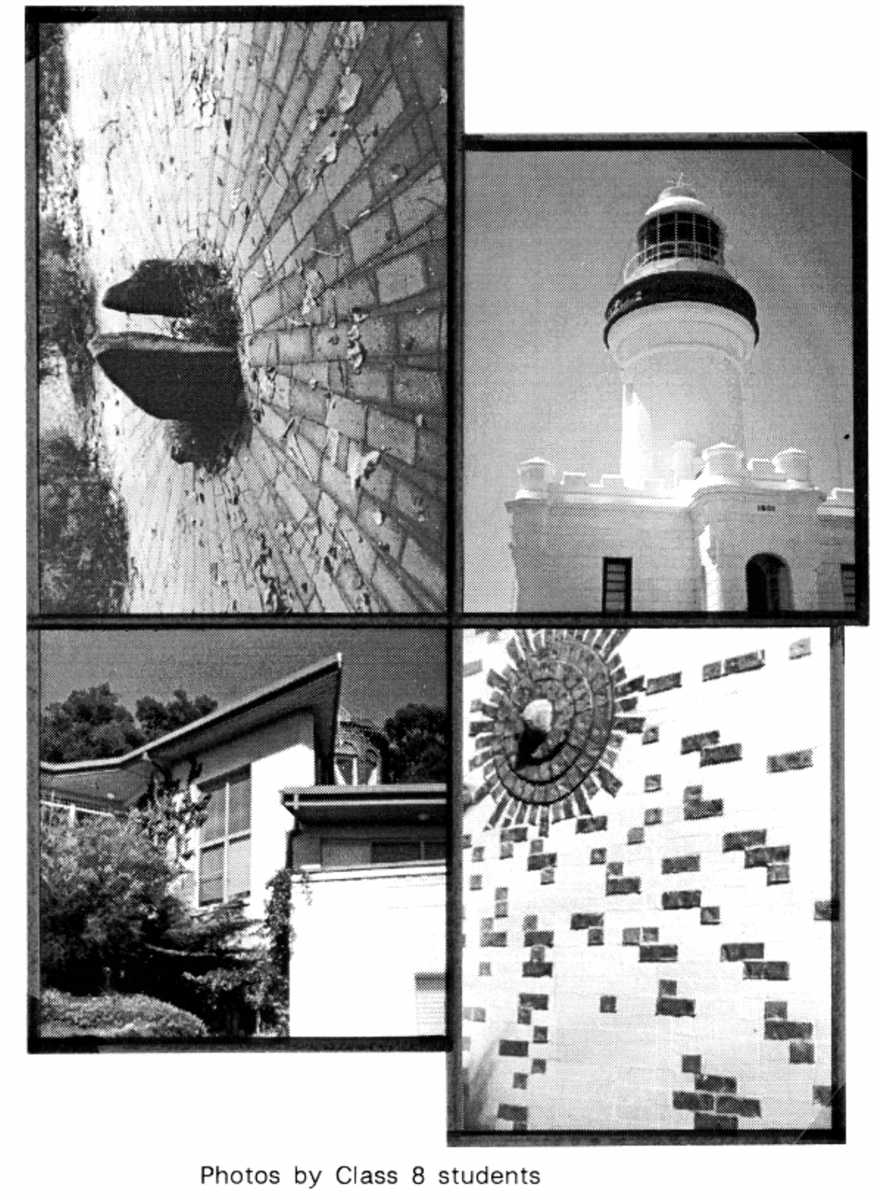
We can only hint at this rarified realm of mathematics to our 14-year-olds. But to cement the main lesson in memory – and have a lovely day out! – we went on an excursion to see living geometry in living buildings; and photograph it. We visited a square-based Egyptian obelisk; a neo-Greek porticoed structure; a Middle East dome, a spired cathedral; and the Opera House itself.
We stopped the bus to stare at the city skyline from a distant hill. “It looks like a jumble of children’s building blocks.” Commented one imaginative adolescent observer. “It can’t be, that’s what Rome was supposed to be.” Replied another. And so it was – and so it is!
Far from being ‘modern’, our 20th Century cities are, in form at least, expressions of archaic Roman consciousness, with their slavish adherence to the regular prisms. This final apotheosis exhausted us all, so we went to the beach for the afternoon! Er, to study the free-form wave shapes of course.










Leave a Reply
You must be logged in to post a comment.