
MY WORD IS MY BOND
Personal Finance – Class 8 – Main Lesson
The Iranian god Mithra was born from a rock; his mission, to serve an earth-bound humanity. He sits on the right-hand side of Ahura Mazdao, the Sun God. Mithra slew the Cosmic Bull; whose blood subsequently nourished the sentient animal world – the whole Astral Creation indeed – that which found it cultural expression in Ancient Persia (Iran). The bull is the eternal symbol of the astral body, a winter phenomenon. The Festival of Mithra was held on the Autumn Equinox.
The god carried a torch in one hand, a symbol of spiritual enlightenment, and a knife in the other, representing swift retribution for disobeying his strict laws – Mithra was the god of contracts.
In time this developed into the cave temple cult of Mithras in far off Rome, where its God-given principles of honor and bond were enshrined into the codex of roman jurisprudence, the umbrella under which we still ostensibly shelter today.
In Rome alas the system degenerated to one of protecting the interests of the plutocracy from the plebeians. In later Christianity, especially under the influence of such institutions as the Franciscan Order, the law grudgingly turned its gaze on justice for the poor – the ‘power of poverty’, as Francis called this age-old state, was now respectable. And today? Well it would seem that the rich still have ready access to the courts, while justice is just a dream for the common folk.
This golden light of honor, centered in the human heart, the moral organ, has had a long and uncertain incarnation, Originally the spirit of contract was honored by one’s Word only, by the power of the sun-based Logos in fact. The Romans felt however that they had to confirm a contract in a physical way, by an arm clasp – a ‘bond’!
Curiously this still reflected the Persia-Gemini spirit – Persia was a Gemini age, the arms and hands the Gemini organs. The ‘sense of ego’ of Gemini is a sense of Logos, or primal sun forces – of Ahura Mazdao!
This firming of an agreement further evolved, downward under the Mithraic rites of the European Freemasons as the handshake – Gemini again. Today the signature, the imprisoned Word, is usually necessary – with witnesses even! – to close a contract; a far cry from ‘a man’s Word is his bond’ of earlier times. This same high but taciturn Being today expresses as the Archangel Michael.
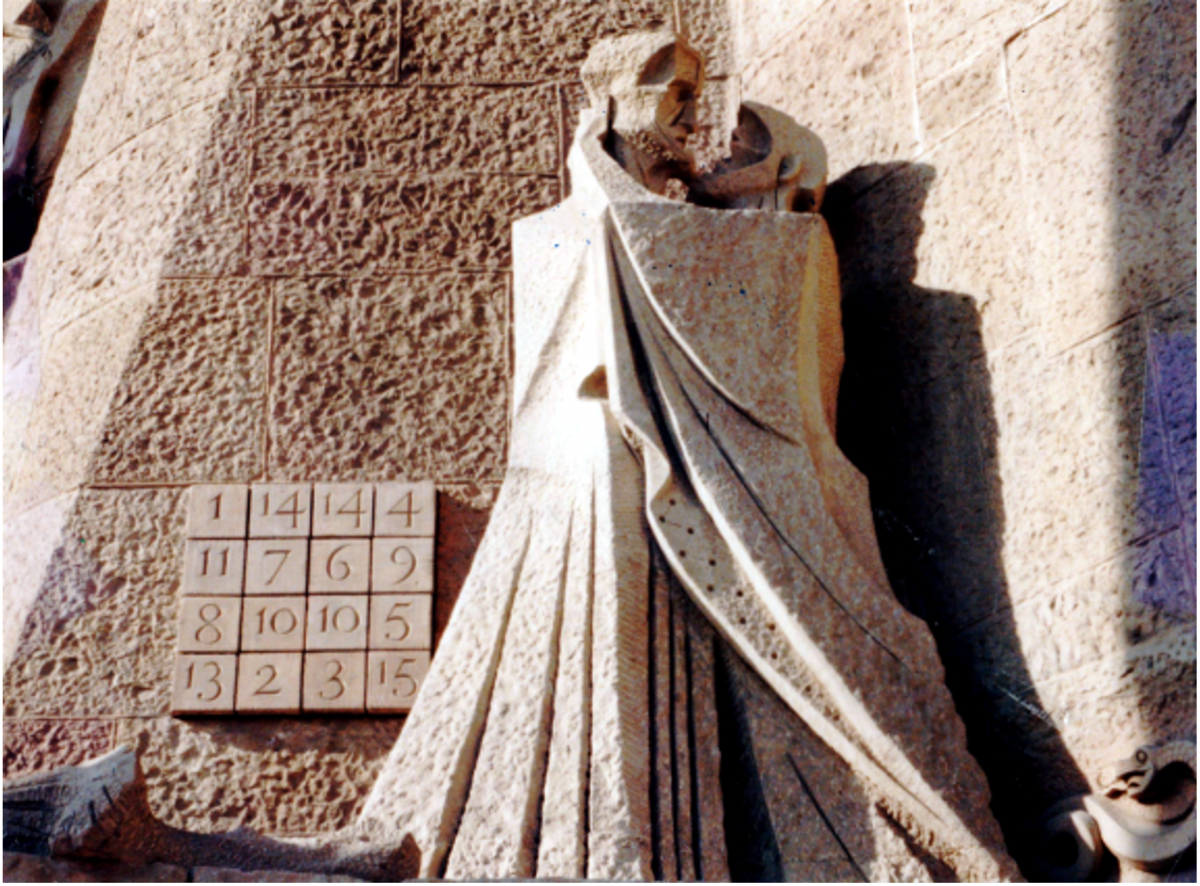
The Spirit moves in both mysterious and numerical ways; above, a remarkable ‘magic square’ hidden discreetly behind the powerfully moving sculpture of Judas’ kiss of betrayal on the west (ego) entrance to Antonio Gaudi’s Sagrada Familia cathedral in Barcelona. Give students the task to see how many additions – vertical, horizontal, diagonal, corners, etc., etc. – of 33 they can find. Of course this is the number of the years this ‘Ego God’ spent on earth. This is not only fun, but spiritually enlightening.
Michael is the regent of the physical body, occupying as he does the Aquarian quadrant of the zodiac. Michael (meaning ‘with God’) too sits on the right side of the Sun god – and his festival is in Autumn! In the unfolding of the Educational Zodiac, starting in Class 1 with Cancer, Class 8 are Aquarian students. They are also often thieves!
We can lift these aberrant impulses into a higher realm, that of ‘honor’ or contract, with a main lesson on Personal Finance. This is one of the three maths main lessons in Class 8, the one occupying the Soul, nominally known as the Finance stream. There is one Finance main taught each year from Class 8 to 12. Maths is the Astral main lesson, and its subtend, Finance, its soul expression.
In the ordering of the 3-fold Commonwealth, as designated by Rudolf Steiner, Finance is the body principle. Liberty, Equality and Fraternity being spirit, soul and body respectively (culture, rights and economics or finance). So finance is a soul/body phenomenon – a soul-less body is a morally corrupt one, so any teaching in this important realm must include ethics. Soul imbues money with humanity.
The Covenant of Mithras included this knowledge, as dos the Steiner curriculum, of which this Personal Finance main lesson is a legacy. There are three money mains in primary school – body soul, spirit again. The first is Money itself in Class 2, where the 8-year-olds are introduced to currency (the body), especially Australian money.
In Class 5 there is a Finance unit, where the history of money and its various functions, like interest rates, the stock exchange, plastic money, etc. are explored. Then there is the Economics, the ‘spirit’ lesson, in Class 7. Here the whole range of forces along the spectrum of poverty and prosperity are taught; like the effects of unemployment, inflation, over-production and so forth.
So Personal, and any kind for that matter, Finance is really about moral conduct in managing one’s affairs. This ‘heart’ path is also 3-fold; children 0 to 7 learn the morality of the body; their only obligation is to survive. From 7 to 14, morality rises to the level of community; to responsibilities in relation to home and school in particular.
The adolescent rather looks out to wider horizons, to society as a whole, especially Australian, in terms of moral development; s/he becomes aware of wider issues, like the politics of poverty. Australian finance embraces this societal principle; one’s personal finance can never really be separated from the Big Picture.
Of course after 21, morality is focused more on the Self, from relationships with partner and offspring, to self-in-relation-to-the-world. What is my obligation to global peace – to evolution even!
14-year-olds are, from a pragmatic point of view, entering the confronting world of Personal Finance as never before. Their needs are greater and more expensive. This lesson empowers them with the knowledge of how to obtain money; then how to spend it wisely. But above all, the Spirit should be ever-present in the lesson in relation to the ethical conduct of handling money – the Timeless Law of Contract.
A convenient and workable program might be 12-fold (a good number of study topics for any main lesson); from a plethora of finance areas, we might select one of each of the following to be studied each day: Banking; Tax; Investment; Budgeting; Asset/Liabilities; Home Buying; Borrowing; Fraud; Income; Welfare; Buying/Selling; The Future.
A word of caution; don’t slip into Small Business, this has a main lesson all its own in Class 9. Now a brief word on each of the Big 12: all aspects of Banking can be covered, including checks, deposits and withdrawals. The actual check forms can be filled out and put in their books. Then there are different types of accounts; overdrafts; statements; plastic money, bank services, such as strong box storage of valuables.
A talk by the local bank manager, with a peek inside the big safe eve, makes the unit memorable. There is no better way to initiate the innocent into the world of Tax than by giving them tax forms which, using hypothetical figures, they have to fill in. These too find their way into the main lesson books. Here the students learn the jargon as well as the process, even though they won’t be sending in tax returns for some years yet, the seeds of confidence are well sown in this lesson.
Investment can include perusing the financial paper of newspapers and comparing the various investment offers. Discussions on ethical investment must enter here. How about each student ‘buying’ $10,000 worth of shares, and seeing over the weeks how well they might or might not have done by following the stock market prices? Or a visit to the public gallery of the stock market even?!
Budgeting – the twin but often irreconcilable principles of a regular income but irregular outgo (bills!) can be at least clarified by teaching budgeting strategy. Design a payment plan to get out of debt; or teach goal-realization with a 5-year projection to buy a house – or a 1-year projection so that the budget at least balances at the end of the year. Separate essential from non-essential expenditure. Have a supplementary income plan. Describe the implications of insolvency and – perish the thought! – bankruptcy!
Assets and Liabilities shows the students how to determine real wealth, not merely money in the bank. Have them draw up an assets and liabilities account of their own.
As well as cash and savings, include in the Assets and Liabilities columns an approximate value of clothes, sporting gear, music, books, etc. Describe how to convert this to cash if need be. Perhaps you can bring this to practical realization by having a class white elephant stall – to raise money for an outing or something. Hopefully the students; liabilities list will be short; they are only 14!
Home buying describes the ins and outs of the biggest single purchase most people make in their life – their home. Here we talk about mortgages, deposits, the best house on the worst street and vice versa; owner building; renovations and interest rates.
Home buying flows easily into Borrowing; a wide range of lenders should be brought to the students notice: pawn shops; credit unions; finance companies; banks; friend and family (with their ever-present fall-out pitfalls). Here we introduce concepts like equity, credit rating, repossession, debt collection and hire purchase.
The section on Fraud alerts the students to the fact that not all people they deal with out there hold the Mithraic Code of Contract sacred! Descriptions of shonky products, pyramid letters, gold futures, and pre-paid services should make this lesson sound like a program on consumer investigation!
In broad terms, the Income day deals with a range of options in earning one’s daily bread, and the advantages and vice versa of some. Working for yourself gives a certain freedom, but a level of insecurity. A safe job in the Public Service is usually the opposite. Here too we deal with work conditions, qualifications and pay awards.
Welfare makes the students cognizant of the safety nets in our benevolent society. These are there for when the hourglass of self-reliance runs out, and range from soup kitchens; the dole; pensions; family and friends again, if you don’t owe them money from ‘borrowing’! All this is important information in a Personal Finance unit.
Selling and Buying is good common-sense information, and can prevent painful earning experiences – did the family really need that old and expensive bus camper!? One horror trip a year, then where to park it? Who want to buy it!? Describe as many reasons as you (and they) can think of why stores discount products: old stock; create buying frenzy; bait products to get you into the store; unload shoddy goods; out of style or obsolete…!
Finally cast a long spotlight on the Future with an overview of things like insurance, superannuation, funeral plans, What happens to your personal finance when you die! Show them how to make a Will – and mount it in the main lesson book so the bereaved can find it!
The whole Personal Finance main lesson should be titillated by anecdote and story, such as: My mother paid the ‘insurance man’ tuppence a week from the time I was born to my 18th birthday. Then I received my first and only nest egg – one hundred pounds.
I trumpeted proudly to my friends about my new wealth (in 1990s figures, several thousand dollars). An acquaintance, after softening me up with beer and blandishments, asked to borrow my hundred. You guessed it; I haven’t seen the money nor my ‘friend’ since! This is a salutary lesson to impressionable 14-year-olds.
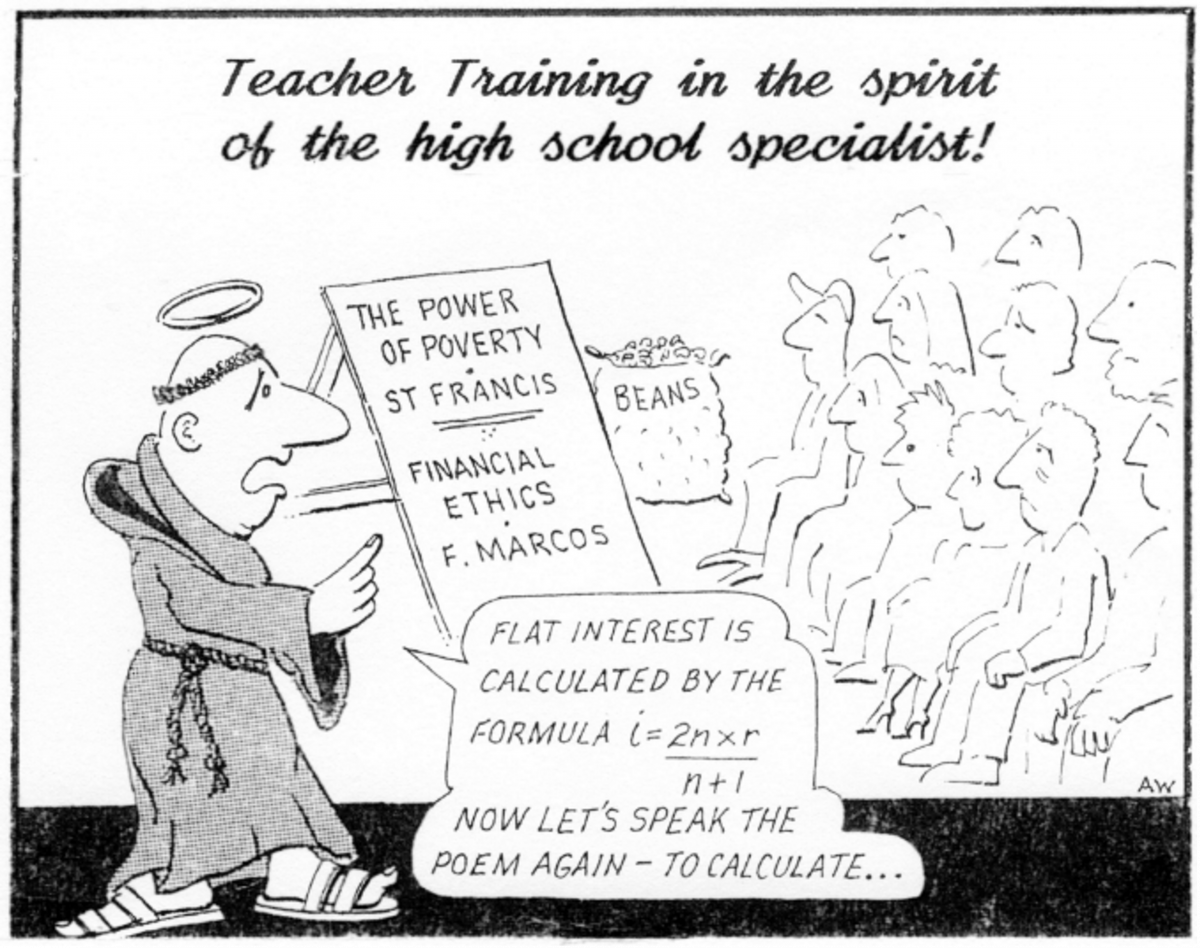
But this is a maths lesson, so a strong number-skills stream should accompany every segment. Problem-solving with flat and reducible interest, percentages and ‘unitary method’ is valuable. The formula for determining flat interest rates is: i = 2n x r over n + 1 when n is number of repayments and r is interest rate.
The students must think number every day of the main lesson, otherwise they won’t believe that this is indeed a maths lesson. One effective method of learning process is through simple little verses, accompanied of course by examples of the sums they describe – here are two – write some yourself, they’re fun:
To calculate our interest, this is all we have to do,
Change percentage to a fraction, then beside,
Put the money over 1 (yes that’s a fraction too),
Multiply them both together, then divide!
To find interest as percentage, find the interest you have paid,
What fraction’s this of your initial sum?
Put the interest over sum (that’s a fraction you have made)
Change it now to a percentage, and it’s done!
When these are learnt by heart, they become a readily accessible resource for young people who can’t hold the more abstract maths processes in their minds (like your author!). It is customary I Class 8, with the volume of calculation they are expected to do, to be introduced to the electronic calculator. This is an improper device for younger children, who should be instilling process into their number souls.
This having been done, a high school emphasis is more on product. Process and Product, the spiritual and the earthly, two faces of that rock-born spirit himself, Mithras/Michael; a benevolent Being who will bless our teaching of Personal Finance, but only if the content is braided with the sacred laws of honor and ethics – I give my Word on it!










Leave a Reply
You must be logged in to post a comment.