
THE FIRST OF THE LAST
Projective Geometry – Class 11 – Main Lesson
I will permit Rudolf Steiner to introduce this last of six golden Beetle Books on mathematics. And the last title of the entire 24-book Spiritual Syllabus Series. These six maths books detail over 60 3-week units. The following is one of Steiner’s general references to the number mysteries:
“Whether a think is beautiful or ugly can be greatly disputed, but if the fact has been revealed to our inner being that a triangle has 180° as the sum of its angles, we know that it is so because no external world can reveal this, only our own inner being. In dry, prosaic mathematics begins what we many call inspiration.
Most people take mathematics for something dreadfully tedious, and are therefore not very willing to let anything be revealed to them by this means. If we direct our spiritual gaze with feeling and receptivity toward this possibility of inner manifestation, we can educate ourselves in this way. Indeed education through sheer mathematics is very good. For instance, if one constantly devotes oneself to the thought “I many have my own opinion as to whether a thing is good to eat, but someone else maybe of a different opinion. That depends upon the free will of the individual, but mathematics does not depend on such free will.
I know of the above triangle axiom that it may reveal something to me by which, if I refuse to accept it as true, I prove myself unworthy of humanity. This recognition of a revelation through one’s inner being – if we devote ourselves to it in meditation. If we accept it as feeling, as an inner impulse – it is powerful educative force in the inner life of human beings. If, to begin with, we say to ourselves “In the sense world there is much that can only be decided by free will.
But out of the spirit, things are revealed to me and of which I, as a human being, must prove myself worthy.” If we allow this thought to become stronger and stronger, so that we feel overpowered by our own inner being, then we grow beyond mere egotism. A higher self, as we call it, gains the upper hand – a higher self that recognizes itself as one with the spirit of the world overcomes the ordinary, arbitrary self. We must develop something of this sort as a mood if we wish to succeed in reaching the portal that leads into the spiritual worlds.”
So much for that old catch-cry “What do we have to learn maths for? Hardly anyone ever uses it!” This ‘Inspiration’ about which the Doctor speaks, is, of the three meditation paths of Imagination, Inspiration and Intuition, that which is related to the central system of man, the heart – the ‘Sun’ realm. Class 11 students, in their developmental passage through the planets in the seven years of adolescence, (beginning Saturn in Class 8), are being specially soul-enlightened by the ever-generous Sun.
The 17th year is a seedbed for Sun-based Intuition; and it is through the (hopefully creative and enthusiastic!) presentation of so-called ‘dry’ maths concepts that this Intuition spark might be ignited. Who would have thought a universal maths education could lead to higher vision in later life? Rudolf Steiner would have, that’s who!
And now to another Steiner quote (The Doctor knows a lot more about the subject than your number-challenged author, so why shouldn’t be write the book?!); this time relating directly to our subject, geometry. Here he is providing apposite advice on teaching Class 11 to his Waldorf School faculty:
“The point is to go through, in as lucid a way as possible, spherical trigonometry, the elements of the analytical geometry of space. Then in descriptive geometry, Cavalieri perspective. The students should go far enough to be able to depict a complicated form of a house in Cavalieri perspective, and also the interior of the house. You should set value on practicing spherical trigonometry and its application to astronomy and higher geodesy in a way that is quite fitting to the age, so that it is understood as a whole.
Analytical geometry of space should be applied in order to show how forms can be expressed in equations. I should not shrink from allowing my lessons to culminate in, for example, understanding what sort of a curve this is: X to the power of 2 over 3 – Y to the power of 2 over 3 + 2 to the power of 2 over 3 = a to the power of 2 over 3. That gives an asteroid (a hypocycloid having four cusps – which is a curve described by a point on the circumference of a circle as the circle rolls around the inside of a fixed coplanar circle – whew!!). As much general education as possible (my emphasis) should come in.
Above all, make equations intelligible, so that the students acquire a feeling for how the things really are in the equations. Conversely, you should attend particularly to the following: I draw a curve in a plane, or in a space, or a solid in space that then, although the equation need not fit exactly, you recognize the equation, you have a sense for the equation. The student should come to understand that what is geometrical is only an illustration of what is measured by numbers. Then you get the integrals as the converse process. You do not start from the supposition that calculation is a fixing of geometry, but that geometry is an illustration of calculation. You go on from spherical trigonometry to the development of the concept of the sphere, qualitatively, without the immediate starting from reckoning. Instead of drawing on a plane, you must draw on a sphere, so that the class gets the concept of a spherical triangle, the concept of the triangle living on the sphere. It must be made clear to the students that the sum of the angles in notequal to 180°, that it is greater. (One of the vexing contradictions one finds in spiritual realms – which maths fundamentally is! – where one moment a thing is a certainty, then next, something quite different, see 180° reference previous page).
You must really make the students understand this concept, the triangle on the sphere with curved boundaries. You can only then advance to calculation. In geometry, the sphere is interpreted through calculation. I should like you to consider the sphere, not from the center of the globe, but from the curvature of the surface, so that you can pass on at once to a general talk, e.g. to the curvature, and to show how the corresponding figure would look as an ellipsoid; how it would look on a paraboloid of rotation, where it is not closed on both sides, but open. Do not start from the center, but from the curvature of the surface, otherwise you will not come to these other solids.
You must think of yourself in the plane; imagine to yourself – what do I experience when I pace out a spherical triangle? What do I experience when I pace out a triangle which corresponds to a spherical triangle on an ellipsoid? Then, in this connection, call the attention of the students to the effect of applying the usual Pythagoras to the spherical triangle. Of course you cannot take squares.
These things contribute to the students’ general education, whilst otherwise only the understanding is developed. In Class 11 they should learn sections and interpenetrations, shadow constructions, Diophantine equations (a polynomial equation for which the unknowns are to be rational numbers, from Diophantus, a 3rd Century BC Greek mathematician from Alexandria), and analytical geometry up to conic sections. In Class 11 the functions must be taken in a more inward way, in order that the principle of the ratio in the sine and cosine may be included. There you must of course start with geometry.
The realistic perspective is that the Cavalieri, all possibilities should be taken for the Cavalieri perspective. Architecture is definitely for Cavalieri. All the constructions should be sketched freehand; the final drawing can be done with instruments, like compass and ruler.”
I’m not sure why I’m beginning is such a cognitive way; possibly to screen out those readers who may not desire, or need, to embark on this voyage of senior high school mathematics. Steiner’s recommendations for secondary teachers is after all to be specialists in their field. Your author however, having taught most of this 2-year course, was anything but.
Only necessity spurred me on, as in our small school, no-one else was either capable of, or would undertake, this sacred task. In my own schooling, maths was always the bane of my existence Necessity in this case was the mother of incentive; so I struggled along, and in time began to actually enjoy the journey; my enthusiasm in discovery balancing my obvious academic shortcomings.
This book should make the task even more accessible to other faint-hearted aspirants; after all, if this innumerate can do it, almost anyone can! But a few words on one of Steiner’s favorite geometers, Bonaventura Cavalieri: he was a 17th Century Italian mathematician who made many creative advances in this science (art?) of the formative forces.
Cavalieri’s geometry was a precursor to integral calculus, especially his geometry of indivisibles. An example of this is his determination of the area of an ellipse. It is supposed that the ellipse has a major axis of length 2a, and a minor axis of length 2b. A circle is drawn around the ellipse with radius of a and the same center. Now it is supposed that a system of parallel lines is taken parallel to the minor axis. These parallel lines are intercepted to form chords of the ellipse and of the circle. It is a property of the configuration that the ratio of the length of a circle chord to the length of an ellipse chord is an over b.
Cavalieri conceived that the whole plane was divided into parallels. Each chord can then be thought of as a small rectangle of infinitesimal thickness he called an indivisible element. The area of a given figure is the sum of these elements, and it follows that the ratio of the area of a circle to that of an ellipse is an over b. This is the basic principle used in integration – an addition of an infinite number of infinitesimal parts.
Steiner’s reference to beginning with the sphere is valid even from the presentation of an historical tableau of Projective Geometry. The sphere is the form of Ancient Saturn; the second element, the line or tangent appeared rather on Ancient Sun, with a metamorphosis of the two on Old Moon with the free curve resulting in the surface or plane. This evolution can be seen in the three fundamental elements of the plant: the globular seed (generically speaking), triangular leaf and stems, and the multiform flower. The cube is an image of the 4th planetary condition, our Earth.
Naturally the students do not come in cold to this quite demanding Class 11 content. Their introduction to Pythagoras was in late primary; they learnt perspective drawing in Class 7; Technical Drawing in 8; and Cartography in Class 9. As well, Projective Geometry is just one of five main lessons on ‘earth measure’ in high school. This began in Class 8 with Shape and Space (see my book What is X? Why is Y?), then Trigonometry in 9: Navigational Geometry in 10 (both in Of Pine and Palm); and Sacred Geometry in Class 12 – later in this book.
In our maths curriculum is the recognition that numeracy skills are called upon in so many other units, from the science to the technical, right through secondary school. This numerical saturation is the reason that it is only considered necessary to teach four maths units per year – as against six in primary, where the solid foundations of number comprehension are firmly laid. The four annual high school maths units represent about 55 hours of teaching, not including home assignments.
In ‘straight’ education, most of the learning is via textbooks; from the above more organic hand-on practicality espoused by Steiner, it can be deduced that real teaching is the key to success. Hence a few words form the Master on the need to avoid textbook (or worse, computer!) teaching:
“It should be possible to give up textbooks for the students completely, when they are drawn up in such an un-educational way. The teachers can use them for their own preparation. Most textbooks are merely extracts.”
And so it has been in all good Steiner schools for the last 80 years; teachers rather filling the classroom with books of all kinds in relation to the particular lesson, to be referred to collectively by the class.
We leap forward an epoch or three from Old Moon to witness the birth of formal geometry – to Ancient Egypt. The geometers of this 3rd Civilization culture saw World Number as an image of Man. They codified this in their Four Liberal Arts, all being numerical in essence: Geometry; Arithmetic; Astronomy; Music. These express the four bodies of man and the world, in the same order: physical, etheric, astral and ego.
Egypt was unfolding the faculty of Sentient Soul, ‘semi-transformed astral body’ – akin to Steiner’s ‘number ether’. Not surprising then that the Egyptians perceived their world, both here and the hereafter, in terms of patterns, sequences, ratios – and legion other numerical manifestations.
In the spirit of consistency, geometry, expressing the number mysteries of the physical body, is the first. There is a nice synchronicity here, as Egypt flourished under the regency of Taurus, their vernal sign for 2160 years from 2907 to 747BC.
Class 11, in respect of the Educational Zodiac, beginning Cancer in Class 1, is the Taurus year. In the Subject Zodiac, maths is the Taurus discipline – with its ‘sense of thought’, as Steiner nominated to the Bull.
To complete the trifecta, Class 11 are revisiting their 19th Century consciousness. This was the period Projective Geometry officially became a separate maths discipline; so Class 11 is the perfect year to teach it!
In general, geometry is the limb on the Maths family tree concerned with properties of, and objects in, space. In the evolution of consciousness, geometry first recognized only surfaces – plane geometry; the rigid, 3-dimensional object – solid geometry. Finally it was realized that even mental abstractions – imaginations even – could be represented geometrically; a true Spirit Self (fully-transformed astral body) faculty.
One of these non-tangibles is Projective Geometry. Actually the dual fathers of this amazing art/science were not denizens of the Industrial Age. This formative forces child was conceived some two centuries earlier.
The French mathematician, Girard Desargues, discovered and proved a breakthrough theorem in 1639. About the same time, Blaise Pascal, a countryman, broadened a known theorem (from Pappus of 4thCentury Alexandria). As a mere stripling (about the same age as the students!), Pascal discovered the theorem of the relationship between any hexagram on a conic section, and the linearity, of the hexagon’s extended opposite sides; as the drawing at end describes.
These theorems were still thought of as parts of Euclidean Geometry that were merely unlike other parts. That is until another Frenchman, Jean-Victor Poncelet, after 200 years, discovered, formalized and published the basic postulates of Projective Geometry. This ‘French Connection’ has to do with the fact that France is the Rational Soul notion of modern Europe Italy Sentient Soul, Britain Consciousness Soul). A refined rationalization is necessary to grasp the essentials of geometry in general, the Projective Geometry in particular. The “Intellectual’ Soul classical Greeks were of course outstanding geometers; as to a lesser degree were the Romans.
In Desargue’s and Pascal’s theorems, the only relation that mattered was that of the incidence of points and straight lines – distance, angle, congruency or similitude were irrelevant. In general geometric lore, there are properties that depend on measurement (metrical properties), and those that do not. The latter are the characteristics of Projective Geometry.
Poncelet’s Eureka! Was his postulation of points at infinity, such that every straight line is extended to a point at infinity, and every plane with a line at infinity. This new point (or line) being the same point for distinct parallel lines (or planes). The point, line and plane represent physical, etheric and astral bodies respectively. All infinite elements of space were supposed to lie on the infinite plane of space – the ‘projective plane’; and by extension to the next dimension, the corresponding space known as the “projective space”. The rebirth of geometry in the 19th Century was mainly due to his elegance of Projective Geometry.
So, from France to Germany – to the Masters of the Formative Forces themselves! Karl von Staudt, in 1847, finally liberated Projective Geometry from its Euclidean chains with incidence axioms such as: two points determine one straight line; three points not a straight line determine a plane; two planes intersect in a straight line…Etcetera!
Fellow 19th Century countrymen, Felix Klein, Georg Cantor, Richard Dedikind, Moritz Pasch and Otto Stolz, all made incremental inroads into a deeper and wider understanding of Projective Geometry – leading up to Rudolf Steiner!
His stupendous achievement in solving the complex mathematical problems in his First Goethean, especially that of the intersection of two different sized domes, stretched the Projective Geometry envelope wider still. In speaking of this “Synthetic Geometry”, as Projective Geometry was commonly known, Steiner remarked that:
“We must be able to think the extensive intensively, and the intensive extensively.” How liberating! He also advanced insight into the relation between the four classic conic section curves; circle, ellipse, parabola and hyperbola – and their four arithmetical operations in the same order division (ego); addition (etheric); multiplication (astral); and subtraction (physical) – see construction details in my book What is X? Why is Y?
Rudolf Steiner’s movement art of Eurythmy embodies many of the same principles which elevate Projective Geometry to a high art. This is especially so in the choreography of specific forms created by individuals, but more so by groups, on the stage floor. This of course is best observed from above – alas, an unlikely vantage point. Susan Whitehead created the above four conic section curves in a memorable performance, a marriage of art and geometry, where by stepping, say, the subtraction ratios which create the hyperbole, the curve is miraculously manifested by the resulting arrangement of the performers. (12-11=1, 11-10=1, 10-9=1 …!) Ideally the geometry and eurythmy teacher should cooperate in expanding the horizons – all the way to the vanishing point! – of this great lesson.
Rudolf Steiner’s intellectual and cultural path straddled two centuries; according to his own account, it was geometry before all else (a first principle remember) which opened his inner eye to the absolute conviction of the hand of the Divine in the shaping of the world. In high school, he loved the subject above all others; in answer to the question “How did you first become aware of the difference between the vision of the sense world and that of the supersensible?, Steiner replied:
“It was the moment when I grasped the inner meaning of the so-called modern, synthetic (Projective) geometry. Because in this we live and move within the forms. Here we receive the stimulus to apprehend that mood of soul which, if further developed, leads us to enter consciously into the supersensible world.”
The contemplation of these forms, in reality spiritual archetypes (unlike Jung’s – a snake means this, a bilby that!), does indeed lead to higher vision. As The Master said, a triangle does not exist (triangular things do of course), though its infinitely variable archetype does. It is this which impresses triangulation onto the world – again in its myriads forms.
This triangle archetype, and every other divinely-created geometric form, can be comprehended, if not beheld, by living thinking – by Imagination. With this, we can build bridges between the point based on the physical world; the line of the etheric; the surface or plane of the astral; and the volume of the ego. This last is the most material principle on earth, but the most spiritually elevated of the archetypes – grasped with the cold, Ahrimanic forces of the intellect, but unreached by them in the Beyond. Projective Geometry does not create a material solid, or volume, rather the image of same – its supersensible counterpart.
As Steiner recommended for Class 11, Projective Geometry emphasizes not the static form, but movement, a fluid, metamorphic transformation of one form into another. This can be expressed with clay, either as a 2- or 3-dimensional expression; such as transforming a cube into an octagon, or a dodecahedron even. This is not Projective Geometry as such, rather a sculptural formative-forces associate.
This love of geometry by Steiner is a legacy to many spiritual researchers who followed in his wake; one, an old colleague of mine, John Blackwood, uses the sublime form ratios of Projective Geometry in a lifetime study of urchins – no, not grubby little slum dwellers, the ocean variety! These highly varied but all globular creatures are a relic of Ancient Polaria. Another distinguished Anthroposophical geometer is Englishman Lawrence Edwards. I arranged for this diminutive but brilliant man to lecture at our school in Sydney in the early 1980s.
And profound were his worthy offerings, mainly on plant forms, again Polarian in the geometry of pinecones. Also impressive, especially for a non-Australian, was the enlightening of his enthralled audience on the creation principles enshrined in our own unique native plant forms.
Here he convinced us that Projective Geometry is indeed an eloquent language of the creation of the world and man by the spiritual hierarchies. Edwards book, The Vortex of Life, employs Projective Geometry to reveal creation path curves, vortex structure and other cryptic nature relationships in both the organic and non-living worlds.
He even discovered a profound geometric relationship between the rose and the human heart – the Mystery of the Rose Cross indeed! The following are extracts from a highly prescient article written by Lawrence Edwards in 1951, in association with Charles Waterman:
“We cannot begin to understand the nature of matter, whether dead or alive, without penetrating behind it to the formative forces which organize it, so we cannot understand the etheric body without penetrating behind it into yet other realms. Just as the physical body is maya, not what it seems, to ordinary sight, so is the etheric body maya to clairvoyant sight.
The clairvoyant, if his vision is able to penetrate so far, finds that flowing into the human etheric body, from out of the cosmic ether-ocean, are streams of – as if were – warmth and light and music. Theses again are found to be manifestations of Beings, the Spirits of Form, the Exusial. Behind the forms of nature are the formative forces; behind the formative forces are the creative thoughts of the Second Hierarchy.
Much, for example, can be gained from the study of Projective Geometry, in which Dr. Steiner saw the seeds of a true etheric geometry, capable of fulfilling for etheric space the same kind of function that is performed by Euclidean Geometry (and its variants) for physical space. The history of Projective Geometry many indeed be viewed as pointing to a providential working of destiny in man’s affairs.
Three centuries ago, while Descartes was creating his system of Cartesian geometrical analysis, which was later to give modern materialistic science so powerful a tool, in the minds of some other men, notably Desargues and Pascal, a new geometry, instinct with a new vision, was arising. Quietly and unobtrusively this new way of thinking entered the world.
Few practical applications were found for the new geometry; and few people, outside a small circle of mathematicians, even heard of it. Yet through the centuries, Projective Geometry grew and developed – and in due time it was ready for Rudolf Steiner to point to it as the geometry of the realms of life, and to show that through its thought-forms we may draw near to a mental grasping of the etheric forces at work.
It is no wonder that a purely quantitative science should have found scant use for a geometry which pays so little heed to the metrical. Whereas the fundamental facts and propositions of Euclidean space are nearly all concerned with measurement, the equality of lines and angles, congruence of triangles, etc. In Projective Geometry one moves into a freer and more mobile region of thought. Here one meets the three basic elements of space – plane, point and line – but not in the fixed form of an ordinary geometrical diagram.
One meets them in interweaving intercourse with one another, point and plane as a polarity, with the line mediating between them; and generating from their intercourse an ever-changing series of curves and surfaces. Here, instead of dealing with forces proceeding from points and drawing material substance inwards towards a center, one gains insight into the mode of working of planar forces which play in from the infinite periphery and act on material substance by expanding it and drawing it outwards. (So one may think of etheric forces “sucking” a plant from the earth.)
Both geometries must be regarded ultimately as manifestations of Beings; as the thought imprints of the Spirits of Form, the Exusial, but with an important difference between them. In Euclidean-Cartesian geometry we seem to encounter the “finished work” of the Exusial; the fixed result of their creative labors in shaping the realms of nature during a far distant past.
In Projective Geometry we encounter a manifestation of the living activity of the members of the Second Hierarchy, as through the medium of the etheric forces they shape and guide the activities of living nature, the coming into physical existence, the growth and ceaseless metamorphosis and the passing away of her myriad forms, from fragile petal to long-lasting bone.”
Other Steiner luminaries who have spent their life exploring and publishing Projective, Synthetic or ‘Modern’ Geometry are George Adams and Olive Whicher. Again I’m grateful to be able to disseminate extracts from a long-forgotten article by both, published in 1950:
“From elementary Projective Geometry we learn that every plastic form in space – every curve or surface – has a dual aspect. The surface of a sphere, for example, is not only the sum-total of all points at a fixed distance from a given center. To describe it thus is only one aspect; in a qualitative sense it represents only half the truth. For at each point the sphere has also a tangent plane. It is enveloped by its tangent planes; we need only assign the right law of movement to a moving plane, to form the sphere of an infinite assemblage of points.
Modern geometry has learnt to think of all forms of space, even in the very structure of space itself, in the planar as well as the pointwise aspect. Known since a century or more ago, – its depth and beauty recognized and much admired by the pure mathematicians – this form of thinking has found very little direct application in mathematical physics, for the simple reason that the fundamental entities of physics are point-like; which is another way of saying, atomistic.
We shall discover, however, that it has its application in the sphere of life – in the morphology and physiology of living things. Nature reveals in her phenomena the planar and not only the pointwise aspect of space. For the planar aspect of the sphere, the elementary entities will be the tangent planes that touch and mold it from without. If we choose a finite number from among them and in a regular sequence or pattern, they will reveal a gently enveloping and enclosing gesture, like the petals of a half-opened flower.
In the space of modern Projective Geometry however – or in the different kinds of space to which it can give rise – it is quite logical to conceive a sphere that is filled, as it were with “planar substance”, from without inward; a sphere into which “planar forces” may pour from the periphery of space. To such a sphere we have not to apply the metrics of Euclid. It is only for the latter that the outer space is categorically infinite, while the interior is of finite volume. Even the very concept of a measured volume may not apply.
A geometrical space is a pure form of thought beheld in the eye of the mind. The spatial concept which enable us to penetrate with understanding any of the phenomena of Nature evidently bears relation to the ideal realm to which these phenomena belong – the realm which they make manifest to our senses. Euclidean geometry has been our guide in penetrating to the ideal reality of the phenomena of inorganic Nature. Another kind of geometry will provide an essential key to the phenomena of life, where inorganic matter often seems to rise beyond itself, and where the characteristics spatial forms and gestures are so very different.
The detail of this conception involves many problems. We have to learn to understand how the physical-material substance is received into the field of these ethereal spaces; to quote from Fundamentals of Therapy by Rudolf Seiner and Ita Wegman, how it is able to “withdraw from the forces that work upon it as from the center of the Earth and enter the domain of other forces – forces which have, not a center, but a periphery.” Also we have to adapt our thinking to a realm where there is not merely one single space, given rigidly and once for all, but untold numbers of formative spaces. For an “ethereal space” of this kind will have its innermost “infinitude” wherever there is a seed or focus of new life.
Certain it is that when thought and imagination are awakened to the character of these ethereal spaces, the world of plants places them visibly before our eyes. The plants will help to show mankind the way out from the rather dark and material phase of science – out into the coming age when science itself will tell how the creative archetypes work in towards the Earth from the celestial realms.”
One of the most celebrated luminaries of the Steiner Projective Geometry community is (was) George Adams; the following are a few apposite quote from one of his ‘formative forces’ writings, circa 1956:
“The inner harmony between art such as Barbara Hepworth’s, non-naturalistic yet in a deeper sense true to Nature, and the new phase in Science is brought out in Projective Geometry (‘modern’ geometry or ‘the geometry of position’). In this the integrating and in the literal sense ‘providential’ fore-seeing action of the Spirit of the Time has been at work. For at the birth of the new geometry, it’s inner relation to natural science and other realms of life could not yet be perceived.
This new geometry opens out the way to a scientific and at once imaginative understanding of the ethereal aspect of space and of living nature. In reality all space and all spatial form is at once physical and ethereal; one might also say, ‘earthly and celestial’; for the sundering of Earth and Heaven, light and darkness, heights and depths, lies at the very foundation of the eternal, spatial world in which we live. The new geometry begins by revealing space in both these aspects, whereas geometry as generally known – the classical geometry of Euclid – stresses a one-sided earthly aspect, so much so that the other is obscured and forgotten.
Euclidean measurements are necessarily rigid; their instruments and objects belong to the relatively lifeless mineral world. But that is only half of the reality of space; the other may more aptly be named helio-plastic. For it belongs to the creative and life-giving realm of the Sun – to the celestial spaces of sun and stars altogether. In formative activity moreover it is plastic rather than sharply metrical. It does not lack number and measure, but in its ordering is rather musical, as in the ‘measures’ of prosody. It takes its start, not like the old earthly geometry from the point, but from the plane; not from the center, but from the all-embracing periphery. It creates form, not masonically, as it were, stone by stone from within outward, but plastically, sculpturally, from without inward.
Hen embryologists find that the differentiated form of a living organism nearly always appears first on the surface rather than the interior of the new life, it is an elementary sign of this other formative principle in nature. Rudolf Steiner pointed out that this other kind of space, planar and enveloping rather than sharply pointwise, peripheral rather than centric, must always be present – however unconsciously – in heart and hand and imagination of the sculptor, the plastic artist. The ‘helio-plastic’ space, as I have here ventured to call it, belongs as essentially to sculpture as does the physical – in the narrower sense ‘geometrical’ – to architecture and engineering. The new geometry comprises both these aspects.
For the ethereal, the content of space is in a way the inside-out of what it is for the physical. The formative entities and substances which it conveys pour inward from the vast circumference, the infinite expanse of planes. The point, the central region towards which they tend, is rather like a receptive seed, a waiting emptiness within, a womb of receptivity. For the ethereal, the content of a sphere is not inside, but all around, the ‘infinite empty space’ is within the surface.”
Another less likely Steiner Projective Geometry luminary is Robert Gilbert, and ex-instructor in the Nuclear-Biological-Chemical Warfare Defense in the United States Marine Corps. After fortuitously encountering Steiner’s work, Gilbert gradually realized that all these weapons of mass destruction were based on – and could be countered by – geometric principles. For example, the first atomic bomb was only made possible when the actual form was changed from a traditional barrel to a sphere – one comprising energy-concentrating point-to-center cones.
Gilberts’ work (including a book) further conforms that Projective Geometry demonstrates the interface between the physical and etheric worlds. After all, an atom still exists only in the realm of theory; no-one has actually seen one; its power being etheric rather than physical. Like Steiner, Gilbert sees a deep study of these matter/anti-matter principles to be a path in the unfolding of super-sensible – etheric – vision.
In all Projective Geometry research, one must always have recourse to the Five Platonic Solids; these however are dealt with extensively in earlier years. An especially deep mystery is that of the highest, the Dodecahedron. Steiner chose this form, expressed as a double dodecahedron, for the Foundation Stone of his First Goethean.
The Doctor’s ashes are enshrined, to this day, in a copper dodecahedron. These most sacred applications point to the fact that this form is a geometric bridge between the physical and spiritual worlds.
Modern researchers have revealed that the form of the invisible Earth Grid is a dodecahedron, which contains the other four Platonic Solids within its dimensions. Another American, Professor Robert Moon, discovered that the entire Periodic Table of Elements correspond perfectly at a model of nested platonic solids. This was complete at Element 92, Uranium, which embodies the form of a double dodecahedron containing the other four solids within it. Beyond uranium, the ‘new’ elements have all been artificially created, and are inimical to life. Uranium of course is the heaviest, most compacted (Ahrimanic) natural material on earth.
But to lighter ruminations: Blaise Pascal, who died at a sadly too-young 39, was not only one of the fathers of Projective Geometry, but a mystic as well (these two factors seem to be mutually inclusive!). This is evidenced by his descriptions of his “night of fire”, an intense mystical conversion – the metaphysical equivalent of nuclear fire perhaps?
Pascal foreshadowed Steiner in this Provincials by treating the mysterious relations of Man with the Divine as if they were primarily a complex geometrical problem. And so, on an etheric level at least, they are. Projective Geometry is a (to some, illogical) path through this labyrinth of worldly-heavenly form and movement. As Blaise Pascal said: “The heart has reasons that reason cannot know”.
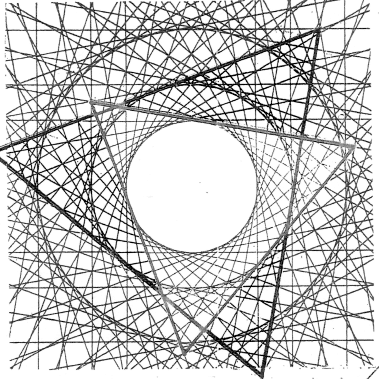
The polarity of physical and ethereal spaces, related to the levitational and gravitational types of force.
The Circle is the physical, the triangle the etheric; of which just two of an infinite number of equilateral triangles have been rendered in bold.

An example of the relationship between any hexagon on a conic section and the linearity of the hexagon’s extended opposite sides. Blaise Pascal.










Leave a Reply
You must be logged in to post a comment.